
Planning a Hindu Wedding in Toronto: Licences, Venues and Rituals
Families planning a Hindu wedding Toronto style juggle two calendars at once: the City's paperwork and the panchang's auspicious hours. One delayed form or one venue that refuses an open flame can unsettle months of preparation. I am a Vedic astrologer based in North York, and couples from across the city come to me first for kundli matching and muhurat, then with surprisingly practical worries. In more than forty years I have seen that the calmest weddings are the ones where the legal side is finished early, leaving the family free to enjoy the rituals. This guide explains where Toronto couples get their Ontario marriage licence and what to bring, who can legally perform a Hindu ceremony, how to agree the havan kund with a banquet hall or plan an outdoor fire, why the muhurat must be calculated for Toronto, and what the main rituals mean. I have no connection with any office, venue or temple mentioned. My aim is simply to help the day go smoothly.
Where do Toronto couples get an Ontario marriage licence?
The City of Toronto issues marriage licences by appointment at Toronto City Hall, 100 Queen Street West, and at the North York Civic Centre, 5100 Yonge Street. Complete the online marriage licence application first, then book. Walk-ins are not accepted, and the licence is valid anywhere in Ontario.
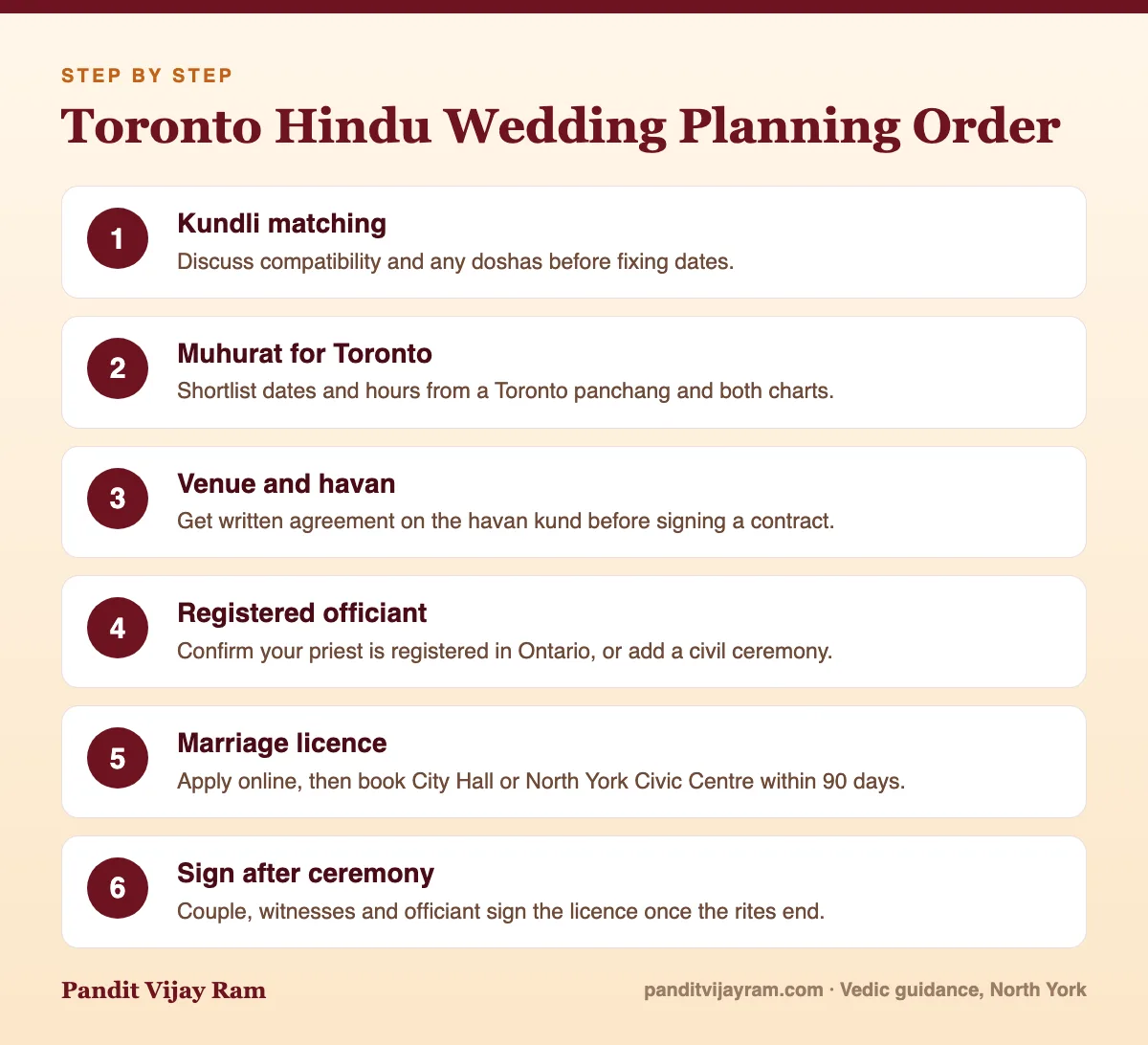
The City's pages set out a clear sequence. Following it early removes one of the biggest sources of wedding stress.
- Apply online. Fill in the City's online marriage licence application and keep the application number.
- Book an appointment. Choose City Hall or the North York Civic Centre. Only one partner needs to attend, but both must sign the application in original ink.
- Bring identification. Each applicant needs two original, valid, government-issued pieces of ID showing legal name and date of birth. Health cards, SIN cards, expired documents, photocopies and phone images are not accepted.
- Check previous marriages. Anyone divorced outside Canada needs a Foreign Divorce Authorization from the Office of the Registrar General before booking.
- Watch the window. The City advises applying within ninety days of the wedding, and Ontario says a licence is valid for three months from issue.
Applicants must be at least sixteen, and those under eighteen need written consent. There are no residency or citizenship requirements, so relatives flying in from abroad can marry here. For licence offices in other GTA cities, see our guide to marriage licences across the GTA.
Who can legally perform a Hindu wedding ceremony in Ontario?
Ontario recognises two kinds of officiant: a registered marriage officiant, such as a priest recognised by a religious body to perform marriages, and a civil officiant, such as a municipal clerk or judge. A Hindu priest must be registered to make the ceremony legally binding. Otherwise, add a short civil ceremony.
Many families assume any pandit can legally marry a couple. In Ontario that is not the case. The province's getting-married page explains that a religious marriage must be performed by a person recognised by their religious body and registered as an officiant. After the ceremony, the couple, the witnesses and the officiant sign the licence.
Practical questions to ask your priest:
- Are you registered to perform marriages in Ontario, and through which religious body?
- Will you sign and submit the licence after the ceremony, or should we?
- Which regional tradition do you follow for the order of rituals?
- How long will the core ceremony take, and what samagri will you bring?
If your chosen priest is not registered, a civil ceremony solves the problem. The City offers a short non-religious ceremony with a City officiant at the North York Civic Centre wedding chamber and at Old City Hall, and requires two witnesses aged sixteen or older. Many couples do this quietly a few days before the Hindu wedding. Our checklist of questions for finding a pandit in the GTA covers the conversation in more depth.
Can you have a havan kund at a Toronto wedding venue?
Often yes, but only with the venue's written agreement. Banquet halls set their own rules about open flame, ghee and smoke, and some require a smoke-free or electric alternative. Outdoor fires in Toronto are not permitted without approval; a ceremonial fire can apply for a Cultural Fire Authorization with a fire-service site inspection.
The sacred fire, Agni, is the witness of a Hindu marriage, so the havan kund matters. Venues, however, worry about alarms, sprinklers and insurance. Raise the question at the very first viewing, not a week before the wedding.
A simple decision rule:
- Indoor hall that allows a small fire. Ask for the conditions in writing: kund size, distance from décor, whether staff will isolate a detector and who stands by with an extinguisher.
- Indoor hall that bans open flame. Discuss a very small copper kund with a few drops of ghee and camphor, or a lamp-only ceremony. Many priests will adapt.
- Outdoor ceremony in Toronto. The City's open-air burning page says bonfires and fire pits are not allowed without an exception. A fire tied to a religious ceremony can apply for a Cultural Fire Authorization, and Fire Prevention inspects the site first.
Keep flowers, chunnis and lehenga hems well clear of the kund, and seat elders away from the smoke. Our guide to Hindu wedding rituals in the GTA explains how families from different regions handle the fire in their own customs.
How do you choose a wedding muhurat for Toronto?
Calculate it for Toronto, not for India. Muhurat depends on local sunrise, the Moon's position and the lagna rising at the venue, all of which shift with time zone and latitude. Start from a Toronto panchang, match it to both kundlis, then fit the venue's available slots around the best windows.
A common mistake is to take a muhurat printed in an Indian calendar and use the same clock time here. Sunrise, tithi changes and the rising sign at the venue are all local, so the result can be hours out.
The process I follow with couples:
- Kundli matching first. Compatibility and any doshas are discussed before dates. Our guide to kundli matching for love marriage explains the factors.
- Season and month. Families usually avoid periods such as Pitru Paksha and, in many traditions, Chaturmas. Customs differ by region, so say what your elders follow.
- Days from a Toronto panchang. Shortlist dates with a favourable tithi, nakshatra and weekday.
- Lagna at the venue. Narrow each date to the hour when a stable, favourable sign is rising in Toronto.
- Practical fit. Only then check hall availability and guests' travel.
For more on why local calculation matters, read wedding muhurat in Canada. Couples who want a reading can see the relationship compatibility service or the love marriage specialist in Toronto page.
What do the main Hindu wedding rituals mean?
Each ritual marks a promise. Kanyadaan is the parents' blessing and entrusting of their daughter. The pheras around the sacred fire make Agni the witness. Saptapadi, the seven steps, carries seven vows. Sindoor and the mangalsutra mark the married bond in many traditions. Explaining them helps mixed families feel included.
Toronto weddings often bring together families from Gujarat, Punjab, Tamil Nadu, Guyana or Trinidad, plus friends of other faiths. A short printed programme explaining the rituals helps everyone take part.
- Ganesh puja. The ceremony opens by honouring Ganesha, remover of obstacles.
- Jaimala or varmala. The couple exchange garlands as a sign of mutual acceptance.
- Kanyadaan. The bride's parents place her hand in the groom's, asking him to honour and protect her.
- Mangal pheras. The couple circle the fire, usually four or seven times depending on tradition.
- Saptapadi. Seven steps, each a vow about food, strength, prosperity, family, children, health and lifelong friendship.
- Sindoor and mangalsutra. In many North and West Indian traditions the groom applies sindoor and ties the mangalsutra; South Indian weddings centre on the thali.
Weddings attract attention and admiration. Many families add a small protective custom, described in our guide to nazar at weddings. Vijay Ram ji meets couples for in-person consultations in North York and supports others by phone, video or WhatsApp; the Toronto astrologer page has details. Couples in the north of the city may also find planning a Hindu wedding in North York useful.
The bottom line
A Hindu wedding in Toronto rests on three foundations. The Ontario marriage licence comes from an appointment at City Hall or the North York Civic Centre after an online application, and the officiant must be registered or a civil ceremony added. The havan kund needs the venue's written agreement, or a Cultural Fire Authorization outdoors. The muhurat must be calculated for Toronto, leaving the rituals themselves to carry the meaning.
Key takeaways
- Toronto issues marriage licences by appointment at City Hall and the North York Civic Centre after an online application.
- Each applicant needs two original government-issued IDs; health cards and expired documents are not accepted.
- Only a registered officiant or a civil officiant can make an Ontario marriage legal.
- Agree the havan kund with your venue in writing; outdoor fires need a Cultural Fire Authorization.
- Calculate the muhurat for Toronto's local sunrise and lagna, not from an Indian calendar.