
How to Win Back Trust After a Breakup

Not every relationship ends with a dramatic betrayal. Many end slowly, through missed calls, promises that kept moving, a temper that frightened, or a partner who always came second to work, phone or family. If you have been typing win back trust after breakup into a search bar late at night, you may feel stuck: there is no single wrong to apologise for, just a long pattern your ex no longer believes will change. In North York and around the GTA, I sit with many people in this position, often sincere and genuinely sorry, but unsure how to show it. This guide is for you. It looks at the quieter ways trust breaks, what real accountability sounds like, how change becomes visible, why anger needs special care, and how Vedic practice can support your own discipline. Cheating has its own guide, linked below. Over forty years of practice have taught me that trust is rebuilt in ordinary weeks, through small promises kept, long before any big conversation about the future.
What does it mean to win back trust after a breakup?
Winning back trust means the other person gradually comes to believe again that you are reliable, honest and safe to be close to. It cannot be demanded or argued into being. It grows from consistent behaviour over time, and it remains the other person's decision whether to offer it again.
Trust has a few working parts. When people say they no longer trust an ex, they usually mean one or more of these has broken:
- Reliability: you do what you say, when you say.
- Honesty: what you tell them matches what is true.
- Emotional safety: they can raise a concern without fear of anger, mockery or withdrawal.
- Priority: they feel the relationship matters to you, not just when it is convenient.
Knowing which part broke helps you focus. A partner who felt neglected needs evidence of priority. One who was frightened by anger needs evidence of safety. One who heard many promises needs evidence of reliability.
Notice that all of these are judged by the other person, not by you. You may feel you have changed completely. Their trust depends on what they see, over a long enough time for them to believe it is not temporary.
If your breakup involved infidelity, the earlier guide on rebuilding trust after cheating covers that specific situation, and getting an ex back when you were the one who cheated looks at it from your side.

How does trust break without cheating?
Trust often breaks through repeated neglect, unkept promises, angry outbursts, hidden money problems, small lies, or failing to stand up for a partner with family. Each instance may seem minor, but together they teach the other person that they cannot rely on you. The pattern, not one moment, is what ended things.
People sometimes say, But I never cheated, so why did they leave? Here are patterns that wear trust down just as surely:
- Chronic neglect. Work, gaming, friends or the phone always came first. Plans were cancelled at the last minute. See also when a partner never makes time.
- Moving promises. We will marry next year. I will tell my parents soon. I will look for a job. The date kept shifting.
- Anger. Shouting, slamming doors, insults, or sulking for days after a disagreement.
- Money secrets. Hidden debts, loans to relatives without discussion, gambling.
- Small lies. Where you were, who you were with, whether a task was done.
- Family loyalty over partnership. Staying silent when parents or siblings mistreated your partner.
Sit with this list honestly. Which applied to you? Writing them down in plain words, without excuses, is the first step toward real accountability. It also helps you avoid repeating them, whether or not this relationship returns.
For the broader psychology of suspicion and reassurance, the guide on trust issues in relationships offers useful background.
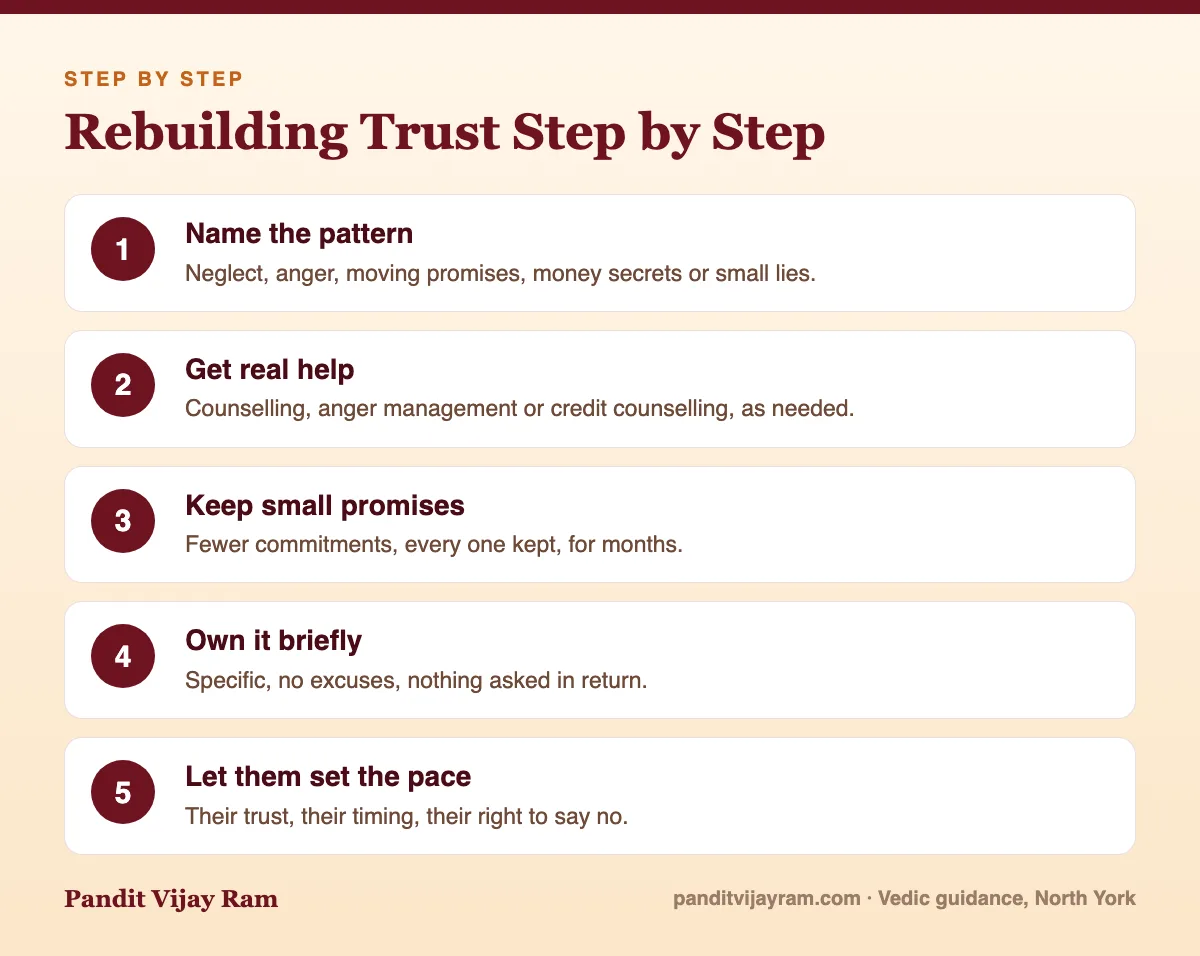
How can you prove to your ex that you have changed?
You cannot prove change in a single message or conversation. You show it through specific, sustained actions related to what went wrong: getting help, changing routines, keeping small commitments and accepting feedback calmly. Over months, these become visible. Telling your ex repeatedly that you have changed usually has the opposite effect.
The most common mistake is announcing change instead of living it. I am a different person now means little to someone who heard similar words before. Let your actions do the talking, even if your ex is not watching yet.
Match the evidence to the problem:
- If neglect was the issue: rearrange your schedule so it reflects your stated priorities. Keep a steady routine for months, not weeks.
- If promises kept slipping: make fewer promises, smaller ones, and keep every single one. Reliability grows from small things.
- If anger was the issue: join an anger-management course or see a counsellor. Learn and practise calming skills.
- If money was hidden: see a non-profit credit counsellor, make a budget, and be ready to share it if you reconcile.
- If family loyalty was the issue: have the hard conversation with your family yourself, without your ex needing to ask.
Do these things for your own growth first. If your ex is willing to talk again someday, you will be able to describe real, lasting change. If they are not, you will still be a better partner for whoever comes next.
Do not use change as a bargaining chip: I went to counselling, so you owe me another chance. That turns growth into a debt.
What does real accountability sound like to an ex?
Real accountability names the specific behaviour, acknowledges its impact without excuses, states what you are doing differently, and asks for nothing in return. It avoids words like but and if, does not blame stress or the other person, and accepts that they may need time or may say no.
Accountability is not grovelling, and it is not a long speech. It is clear and brief. A useful structure:
- Name it specifically. I often cancelled our plans for work at the last minute.
- Acknowledge the impact. That left you feeling unimportant and alone, more than once.
- Skip the excuses. No but I was under pressure. The reason may be real; mentioning it here dilutes the apology.
- Describe the change. I have changed my working hours and I am seeing a counsellor about how I handle stress.
- Release the outcome. I am not asking you to take me back. I wanted you to know I understand now.
Phrases that undo accountability include I am sorry if you felt…, You know I did not mean it, and We both made mistakes, even when the last is true. Your ex may have their own reflections to make. That is their work, not something to raise in your apology.
If you are preparing a fuller apology, see how to apologise to an ex. For the first message itself, the guide on what to say to your ex helps with tone and length.
If anger ended the relationship, is it safe to reconnect?
If your anger ever made your partner afraid, their safety comes first, and reconnection should not be pursued unless they choose it freely. Get professional help regardless of whether you reunite. Shouting that frightens, breaking things, threats or physical harm are abuse, not ordinary conflict, and they need specialist support.
It takes courage to look honestly at anger. Some people raise their voice in arguments and feel bad afterward. Others have thrown things, blocked a doorway, threatened, or hurt someone. These are very different situations, and the second needs a different response.
Ask yourself plainly:
- Did my partner ever seem scared of me, or change what they said to avoid my reaction?
- Did I ever break or throw things, or block them from leaving a room?
- Did I threaten them, their family or myself during arguments?
- Did I ever push, grab or hit them?
If any answer is yes, please seek specialist help now, for your own sake and for anyone you love in future. Your family doctor can refer you, and Ontario has programs for people who want to stop abusive behaviour. Do not contact your ex to tell them about this work unless they have invited contact.
If you are the one who was frightened by an ex's anger, and they are now asking to reconnect, trust your instincts. You do not have to meet them, and you can ask police or a support service for advice. The GTA guide to domestic violence help lists where to turn.
If shame or remorse is weighing heavily and your mood is low, call or text 9-8-8. Changing is possible, and you do not have to do it alone.
Can Vedic remedies help rebuild trust after a breakup?
Vedic practice can support your own discipline, patience and honesty, which are the foundations of trust. Remedies such as Hanuman worship for self-control, or a vrat as a commitment you keep, strengthen character. They are not tools to influence your ex, and trust itself remains something only they can choose to give.
In Jyotish, several planets connect with the qualities that rebuild trust:
- Saturn (Shani) relates to discipline, consistency and keeping one's word over time.
- Jupiter (Guru) relates to wisdom, ethics and good counsel.
- Mars (Mangal) relates to energy and, when unbalanced, to temper and impatience.
A reading can show which of these needs attention in your own chart. Someone with a strongly placed but afflicted Mars, for instance, might work especially on calming practices.
Practices many people find steadying:
- Hanuman Chalisa daily, as a prayer for strength and self-mastery. Hanuman is honoured as a model of devotion and controlled power.
- A simple vrat, such as a Saturday fast or a weekly act of service, kept faithfully. The point is learning to keep a commitment to yourself, which builds the muscle of reliability.
- Morning reflection: one promise for the day, and an evening check on whether you kept it.
If you would like a guided practice, the Hanuman puja and havan page explains what is involved. For relationship-specific insight, the get ex love back consultation offers chart reading and counselling. Vijay Ram ji is clear that no ritual can make another person trust you; it can only help you become someone worth trusting.
The bottom line
To win back trust after a breakup caused by neglect, anger or broken promises, focus on steady, visible change rather than words. Name your behaviour specifically, skip excuses and release any demand for a second chance. Where anger caused fear, safety and professional help come first, and spiritual practice should strengthen your own discipline rather than aim at your ex.
Key takeaways
- Trust breaks through patterns of neglect, anger, small lies and moving promises, not only cheating.
- Change is shown through sustained action, not announced in messages.
- Real accountability is specific, brief and free of excuses or conditions.
- If your anger caused fear, seek specialist help and let your ex choose freely.
- Vedic practice builds your own reliability; it cannot make anyone trust you.