
Signs Your Ex Wants to Come Back (and Signs It Is Time to Let Go)

After a breakup, every small thing becomes a clue. They watched your story within minutes. They liked an old photo. They texted happy Diwali with a smiley. Searching for signs your ex wants to come back can fill whole evenings, and the hope it brings can be followed by a crash. In North York and across the GTA, people often show me screenshots and ask what they mean. This article helps you read those moments honestly. You will learn which signs genuinely suggest someone wants to return, which ones are commonly misread, how to tell real effort from breadcrumbing, how to check what your ex actually wants without games, and when the kinder thing is to protect yourself and let go. In more than forty years of guiding people through heartbreak, I have learnt that clarity rarely comes from decoding. It comes from one honest question and from watching what people do over time.
What are the real signs your ex wants to come back?
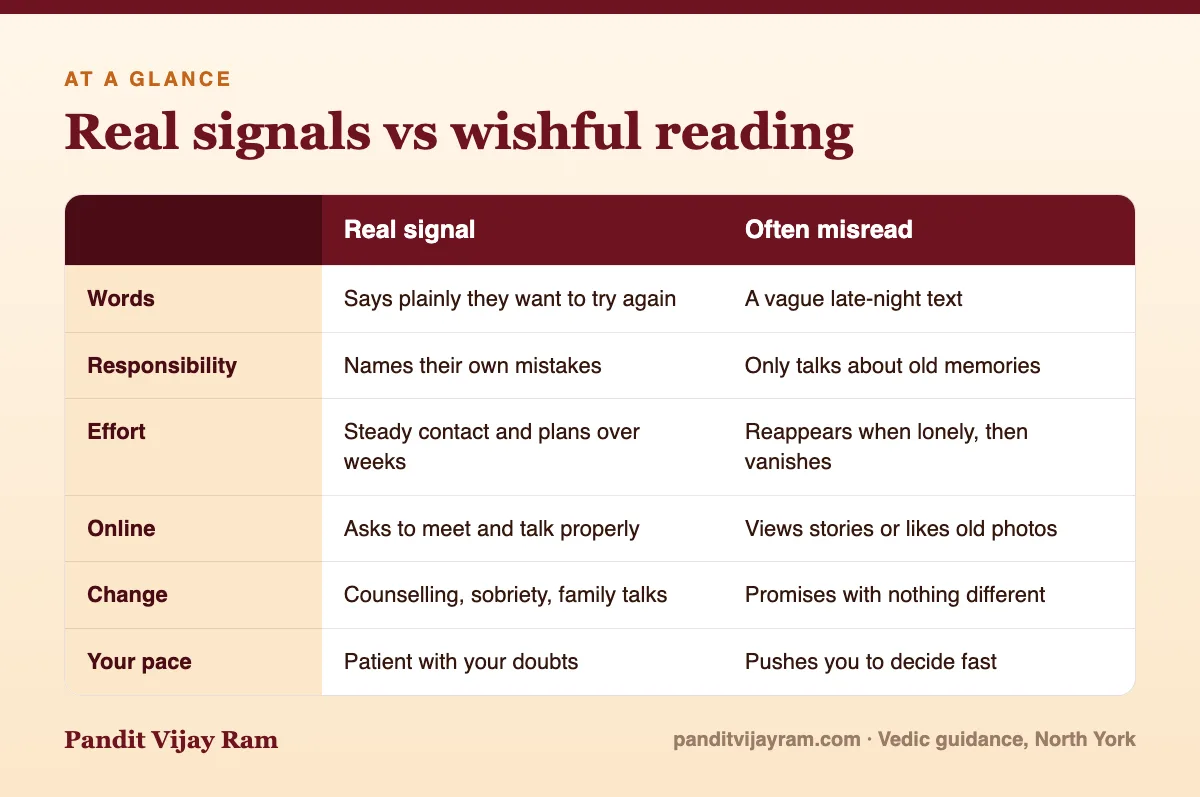
Real signs are clear and repeated. Your ex says directly that they miss the relationship or want to try again, owns specific mistakes, asks to meet and talk about what went wrong, and follows through over weeks. Change in behaviour, not just words, is the strongest signal of all.
When someone genuinely wants to return, they rarely leave you guessing for long. The signs tend to share three qualities: they are direct, specific and consistent.
Stronger signs include:
- Plain words. "I miss us" or "I'd like to try again," said sober and in daylight.
- Accountability. They name what they did wrong without being asked, rather than only listing your faults.
- A request to talk properly. Not just chatting, but asking to discuss the relationship and what would be different.
- Practical steps. They have started counselling, cut back on drinking, or spoken to their family about you.
- Consistency. Messages and effort continue over weeks, not just one emotional night.
- Respect for your pace. They do not pressure you to decide quickly.
Even with these signs, a reunion is a decision for two people. Wanting to come back is a beginning, not a solution. Our pillar guide on how to get an ex back with a calm plan explains what a healthy second try needs.

Which signals from an ex are often misread?
Story views, likes, a birthday wish, a festival greeting, a late-night message or asking how your family is doing are often misread. These can come from habit, curiosity, boredom, politeness or loneliness. They may mean nothing about getting back together, so it is wise not to build hope on them alone.
Social media has made misreading easier than ever. A view count tells you someone's thumb paused on your story, not why.
Common signals and what they often mean instead:
- Watching your stories. Curiosity, habit or the algorithm placing you first.
- Liking old photos. Nostalgia, sometimes even an accidental tap while scrolling.
- A text late at night. Loneliness or a few drinks; it may vanish by morning.
- Diwali, Eid, Christmas or birthday greetings. Politeness, especially when families know each other.
- Asking about your parents. Genuine care for people they grew close to.
- Keeping your photos up. They may simply not have thought about it.
None of these are bad signs, and a few might be early steps towards reconnecting. But a single signal is a weak basis for hope. Our article on signs your ex still loves you separates care and habit from deeper feelings. For guidance on handling online contact itself, read reconnecting with an ex on social media.
How is breadcrumbing different from an ex really coming back?
Breadcrumbing is giving small, occasional bits of attention that keep you hoping without any real commitment. An ex who is genuinely returning offers clarity, a plan and steady effort. If contact appears whenever they are lonely and disappears when you ask for more, it is breadcrumbing, not reconciliation.
Breadcrumbing can happen on purpose or simply because someone enjoys the comfort of your attention without wanting the relationship. Either way, it keeps you stuck.
Compare the two patterns:
- Breadcrumbing: messages at random times, warmth that fades if you ask a direct question, flirting without plans, reappearing after you post something happy.
- Genuine return: regular contact, willingness to answer hard questions, concrete plans to meet and talk, patience with your doubts.
A related pattern is the on-off relationship, where an ex leaves and comes back repeatedly. The unpredictable mix of affection and withdrawal can create a strong emotional hook, sometimes described as a trauma bond when the relationship also involves harm. Our guide on breaking the on-off cycle explains why these cycles are so hard to leave.
If your hope rises and falls with each message, step back. A short break from checking your phone often shows you the pattern more clearly than any analysis.
How can you find out what your ex really wants?
Ask once, directly and calmly. Something like: are you thinking about us getting back together, or just keeping in touch? Then accept their answer and watch whether their actions match it over the following weeks. Honest people usually answer honestly. Evasion is also an answer.
Decoding signs can go on for months. A single honest question can settle much of it in a day. Here is a simple method:
- Check yourself first. Are you calm enough to hear either answer? If not, wait.
- Choose a good moment. Not late at night, not after an argument and not in front of friends.
- Ask simply. "I've noticed we've been talking more. Are you hoping we try again, or is this friendship?"
- Listen fully. Do not argue with their answer or try to talk them into a different one.
- Watch for a few weeks. Do their actions match their words?
- Decide for yourself. Even if they want to return, you can still decide it is not right.
Avoid tests and traps such as making them jealous or going silent to see if they chase. Those tactics muddy the answer and damage trust. If you would like a calm outside view of your own patterns, the get ex love back consultation includes a reading of your chart and practical guidance, with no rituals aimed at your ex's will.
When is it time to protect yourself and let go?
It is time to let go when your ex says they do not want to return, has a new partner, only reaches out when lonely, repeats the same hurtful behaviour, or when the relationship involved fear or control. Protecting your peace and safety is not giving up. It is choosing yourself.
Sometimes the clearest sign is the absence of all the others. If months pass with only scattered messages, no accountability and no plan, that pattern is the answer.
Protect yourself when:
- Your ex has told you plainly it is over.
- They are in a new relationship. Please do not interfere with it.
- Contact always happens on their terms and stops when you ask for clarity.
- Your mood depends on whether they have messaged you that day.
- The relationship involved threats, control, cheating repeatedly or physical harm.
If you are unsure whether the relationship was healthy, our checklist for getting back with a toxic ex can help. If an ex is now following you, showing up uninvited or threatening you, that is not a sign they want you back; it is a safety concern. The GTA domestic violence help guide lists who to call, and in an emergency call 911.
Letting go can include prayer for both of you. Wishing your ex well while releasing the bond is a quiet act of strength, and it leaves you free for what comes next.
The bottom line
Genuine signs your ex wants to come back are direct, specific and consistent: plain words, accountability and steady effort over time. Story views, greetings and late-night texts are weak signals that are easily misread, and breadcrumbing keeps hope alive without commitment. Ask one honest question, watch actions, and protect yourself when the signs point to letting go.
Key takeaways
- Real signs are clear words, accountability and steady effort.
- Story views and festival greetings are weak signals on their own.
- Breadcrumbing offers attention without commitment.
- One honest question usually beats months of decoding.
- Following, threats or control are safety concerns, not romance.