
Settlement Services for New Immigrants in the GTA

The first months in a new country are full of forms, queues and unfamiliar rules. Free settlement services GTA agencies provide can take much of that weight off, yet many families I meet in North York never hear about them until a cousin mentions one by chance. Others lose money to a stranger who promised a job, a faster permanent residence file or a cheap apartment. In more than forty years of guiding families, many of them newcomers, I have learned that practical footing comes before spiritual calm. A household that knows where to get help with a SIN number, English classes or a lease sleeps better, and prayer settles more easily into a steadier home. This guide explains what settlement agencies do, how to find a legitimate one near you using official tools, which large agencies serve different parts of the region, how to spot newcomer scams, and how the emotional side of moving can be supported alongside the practical side.
What do settlement services in the GTA actually help with?
Settlement agencies help newcomers understand and access the systems of daily life. Typical help includes information and referrals, language classes, employment support, help with housing searches, school registration for children, and support for youth, women and seniors. Many staff speak several languages, and eligible clients usually pay nothing for core services.
A settlement worker is a guide to the systems most Canadians learned slowly over a lifetime. On a first visit they usually ask about your status, your family and your most urgent needs, then build a short plan.
Common areas of help include:
- Orientation and referrals: health cards, SIN, banking, transit and where to go for each document.
- Language: referral to government-funded English classes, often called LINC, and conversation circles.
- Employment: resumé help, credential recognition guidance, mentoring and job search workshops.
- Housing: understanding leases, tenant rights and how to search safely.
- Family: school registration, youth programs, seniors' groups and women's programs.
- Interpretation: some agencies arrange interpreters for appointments.
Settlement workers are not immigration lawyers. If your question is about status, sponsorship or a refusal, they will refer you to a licensed professional or to Immigration, Refugees and Citizenship Canada itself.
Moving also strains marriages and family roles. Our guide to marriage problems after immigration looks at that side, and parents of teenagers may find raising teenagers as immigrant parents useful.

How do I find a free IRCC-funded settlement agency near me?
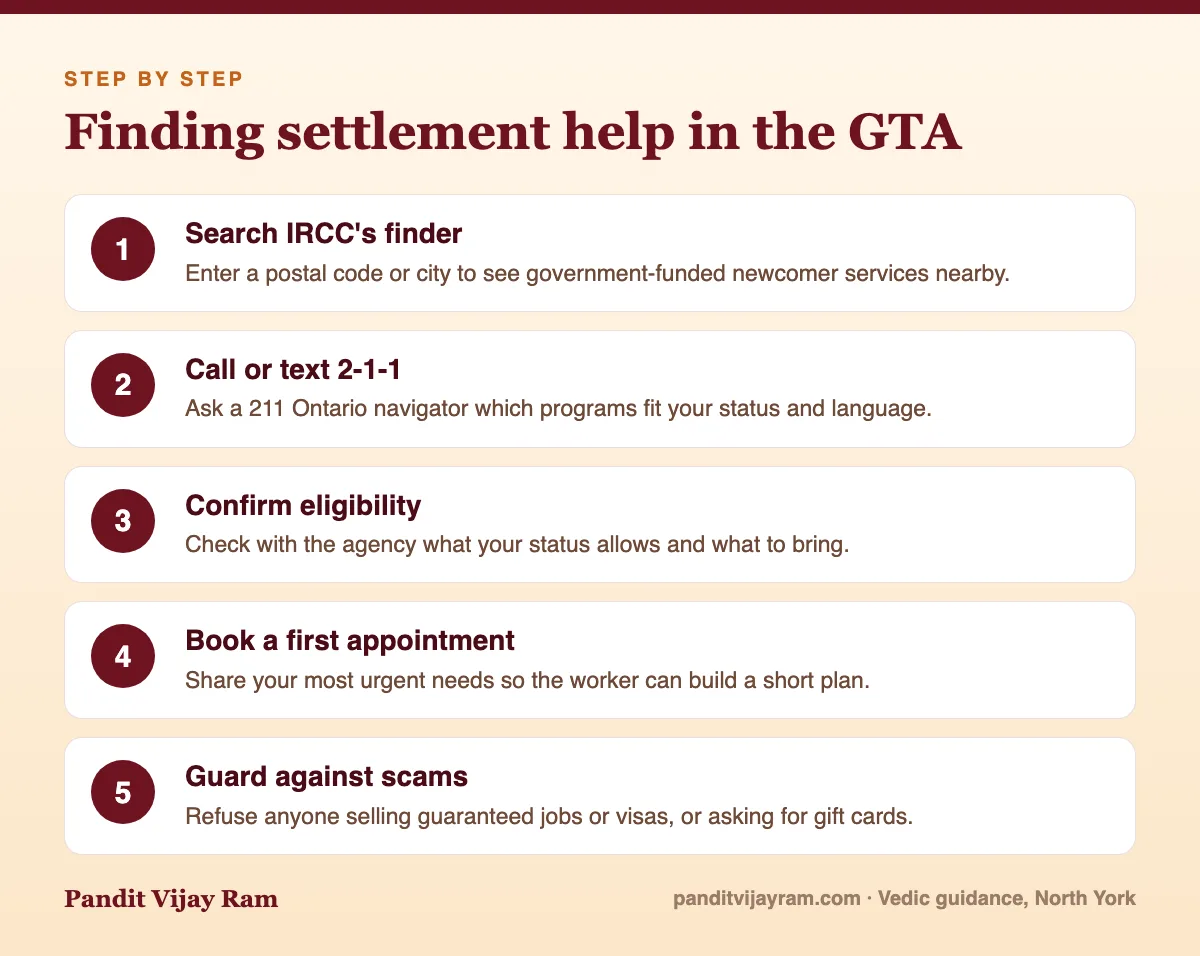
Use IRCC's official tool, Find free newcomer services near you, and enter a postal code or city rather than a full address. You can also dial or text 2-1-1 to speak with Ontario's community helpline, or browse Settlement.Org, which is managed by OCASI and funded by IRCC and the Province of Ontario.
Three official starting points cover almost every situation in the GTA:
- IRCC's service finder. The federal government lists the settlement providers it funds. Enter a postal code, city or province. The page asks you not to type a full address, and it lists who is eligible, such as permanent residents, protected persons and some approved applicants.
- 211 Ontario. Dial 2-1-1 or call 1-877-330-3213 to reach a person who can connect you with social services. 211 says its phone line is answered around the clock and that service is offered in more than 150 languages. You can also text 2-1-1.
- Settlement.Org. A plain-language information site for newcomers to Ontario with a Find Services Near Me tool. It is managed by the Ontario Council of Agencies Serving Immigrants.
Eligibility rules change. IRCC notes, for example, that some economic-class permanent residents can only use newcomer services for a limited time, so check the current wording on the finder page before you rely on a program.
If you are a temporary resident, a student or awaiting a decision, ask 211 which community programs you can still use. Many agencies run other services, funded differently, that are open to a wider group.
Which settlement agencies serve Toronto, Peel, York and Durham?
Several long-standing agencies work across the GTA. COSTI has many offices in the region, Polycultural serves Toronto and Peel, Punjabi Community Health Services works in Peel, and Welcome Centre Immigrant Services covers York and Durham. Always confirm a specific program, location and eligibility with the agency directly.
This is a short, verified sample, not a ranking. Each agency describes its own reach on its website:
- COSTI Immigrant Services says it has offices across the Greater Toronto Area, offers English training, employment and housing help, and has staff who speak many languages.
- Polycultural Immigrant and Community Services offers settlement help, refugee resettlement, LINC classes and employment counselling, with the Region of Peel among its funders.
- Punjabi Community Health Services works in Peel and Halton, and states that its services are confidential and at no cost, offered in Punjabi, Hindi, Urdu and other languages.
- Welcome Centre Immigrant Services lists locations in York Region and Durham Region, including Markham, Richmond Hill, Vaughan, Newmarket, Ajax, Pickering and Oshawa.
Plenty of other agencies, faith groups and libraries also support newcomers. The IRCC finder and 211 will show what is closest to you.
Neighbourhood-level guides go deeper. See family support services in Toronto and family support services in Brampton. Vijay Ram ji is not affiliated with any agency named here.
How can newcomers spot immigration and settlement scams?
IRCC warns that no one can guarantee a job, visa or permanent residence, that it never asks for payment by gift card or money transfer, and that it will never threaten deportation over unpaid fees. Be cautious with anyone who charges for help that funded agencies give at no cost or who pressures you to act immediately.
Newcomers are targeted because they are still learning which voices are official. IRCC's own fraud page lists patterns worth memorising:
- Fake officials. Callers who claim to be from the government and threaten arrest or deportation unless you pay. Caller ID can be faked.
- Phishing. Messages that ask you to click a link and enter banking details or passwords. IRCC does not contact you through free email services.
- Tax and benefit schemes. Promoters who promise benefits for periods before you arrived in Canada.
- Fake prizes. Texts saying you won a contest you never entered.
- Paid shortcuts. No honest helper sells a guaranteed job offer or a faster file.
Keep your UCI and file numbers private. If you have already shared information or money, contact your bank, your local police and the Canadian Anti-Fraud Centre. Our step-by-step guide on reporting fraud in the GTA covers police routes in each region.
The same caution applies to spiritual services. A practitioner who says your visa is blocked by a curse and asks for large sums is using fear, not faith. Our article on warning signs of spiritual scams explains what honest practice looks like.
Is it normal to feel low or unsettled after moving to Canada?
Yes. Loneliness, homesickness, disrupted sleep and worry about money are common in the first years, and long dark winters can add to them. Settlement agencies often run peer groups and can refer you to counselling. See your family doctor if low mood lasts, and call or text 9-8-8 in a crisis.
Many people expect the hard part of immigration to be paperwork. Often the harder part is quieter: a parent who used to be respected at work now stacks shelves, a child translates for the family, and a spouse misses the support of a large household.
When newcomers tell me they feel a heaviness since arriving, I first ask about sleep, work hours, debt, isolation and health. Those ordinary causes deserve care before anything spiritual is considered. Practical steps help:
- Join one regular group, whether a settlement agency circle, a library program or a place of worship.
- Keep a simple daily routine with light, movement and a fixed bedtime.
- Ask your settlement worker about counselling in your language.
- See your family doctor if low mood, anxiety or poor sleep lasts more than a couple of weeks.
Prayer and a calm home routine can support that work. Our guide to feeling heavy energy after moving to Canada offers gentle Vedic practices, and families wondering about timing often ask about spiritual support during visa delays. For a personal reading, the kundli and horoscope service looks at the chart as a guide to patience and planning, never as a prediction of an immigration decision.
The bottom line
Settlement services in the GTA exist to make the first years easier, and core programs are usually free for eligible newcomers. Start with IRCC's service finder, 211 or Settlement.Org, and confirm eligibility with the agency itself. Nobody can sell you a guaranteed job, visa or shortcut, so report anyone who tries. Look after the emotional side of the move too, with community, your family doctor and, if it helps you, steady prayer.
Key takeaways
- Many settlement programs in the GTA are funded by IRCC and free for eligible newcomers.
- IRCC's service finder, 211 and Settlement.Org are the safest places to start a search.
- No one can guarantee a job, visa or permanent residence, and IRCC never asks for gift cards.
- Settlement workers refer status questions to licensed professionals or IRCC.
- Low mood after moving is common; see your family doctor if it lasts.