
Diwali, Navratri and Holi in Toronto: Local Celebrations and Practical Rules
Every autumn my phone fills with the same practical questions. Can we light fireworks on Diwali night? Can the cousins play Holi in the park? Is a bonfire allowed for Holika? Families want the joy of the festival without a bylaw officer at the door. This guide to Diwali in Toronto, along with Navratri and Holi, answers those questions using the City of Toronto's own pages. I am based in North York and have guided festival pujas for more than forty years, so I also explain how to keep the spiritual heart of each festival intact when the rules narrow what you can do outdoors. You will read what the City says about fireworks and permits, why open flames outside need approval, when a park gathering needs a booking, what public celebrations look like, and how to set up a safe, satisfying puja at home. Rules change, so treat this as a map and confirm the details on toronto.ca before each festival season.
Can you set off fireworks for Diwali in Toronto?
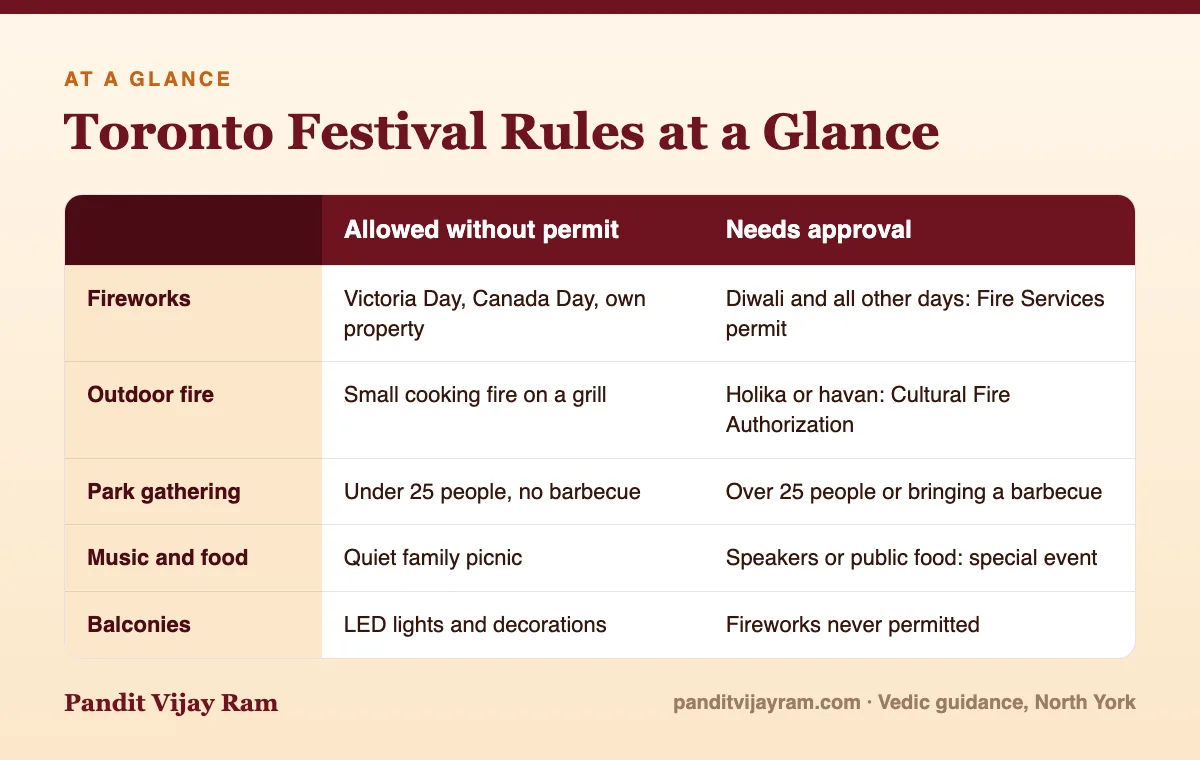
Only with a permit. The City allows consumer fireworks without a permit on Victoria Day and Canada Day alone. On Diwali, or any other day, you need a Toronto Fire Services permit, applied for at least ten business days ahead, and fireworks may only be used on your own private property.
Many families are surprised by this, because fireworks are sold in the days before Diwali. Selling and setting off are covered by different parts of the rules. Here is what the City's fireworks page sets out:
- Where. Only on private property you own. Parks, beaches, balconies, streets, parking lots and other people's property are off limits, and fines apply.
- When. Victoria Day and Canada Day need no permit. Every other day, Diwali included, needs a permit from Toronto Fire Services, and no permit allows fireworks after 11 p.m.
- Who. Only responsible adults. Anyone under eighteen is not permitted to set them off, and an adult must supervise throughout.
- Sparklers. Never light them indoors. The wire stays hot long after the spark dies, so drop used ones into a bucket of water.
- Disposal. Soak used and unused fireworks in water overnight before putting them out with the garbage. Never place them in the Blue Bin.
If you live in a condo or rent, the balcony rule settles the question. For apartment-friendly lighting, read our guide to Diwali diyas and condo fire safety, and for a city-by-city view see Diwali fireworks rules across the GTA.
Is a Holika Dahan bonfire or outdoor havan allowed in Toronto?
Not without approval. Toronto's open-air burning page says bonfires, fire pits and outdoor fireplaces are not permitted unless an exception is granted. Fires tied to a cultural or religious ceremony can apply for a Cultural Fire Authorization, which involves a Toronto Fire Services site inspection before anything is lit.
Holika Dahan is the festival most affected by this. In a village, the whole neighbourhood gathers around one fire. In a city of close-set houses and tall buildings, an unplanned backyard blaze is a real hazard.
The City's position is clear. Open-air burning covers bonfires, fire pits, sky lanterns and chimineas, and buying one at a hardware store does not make it legal to use. The narrow exceptions are a small supervised fire for cooking on a grill or barbecue, and approved gas fire pits kept clear of anything combustible. Burning leaves, waste or anything not related to cooking is never allowed.
For religious and cultural fires, Toronto has a separate route. A Cultural Fire Authorization covers an open-air burn connected with a specific practice, ceremony or event. Fire Prevention inspects the site before approval. Temples and community groups that hold a public Holika fire usually go through this process, which is why joining their gathering is often the simplest choice.
At home, a symbolic Holika works well: a single ghee diya at the shrine, a few grains and coconut offered beside it, or simply the prayer and parikrama without any larger flame. Our guide to Holika Dahan bonfire rules in the GTA describes these alternatives step by step.
Do you need a permit to celebrate Holi or Navratri in a Toronto park?
Small groups do not. The City says gatherings under 25 people need no booking unless you bring your own barbecue. Larger groups need a park booking, and anything with amplified sound, food served to the public, structures or alcohol becomes a special event with its own application.
Holi is the festival most people want to take outdoors. Coloured powder, music and water play belong in open space, not in a living room. Navratri garba also spills outside in warm weather.
Use this simple decision rule, based on the City's booking pages:
- Fewer than 25 people, no barbecue, no speakers. No booking is needed. Choose an open area away from playgrounds and clean up every trace of colour.
- More than 25 people, or your own barbecue. Book the space through the City's park booking system before inviting anyone.
- Speakers, food for the public, tents or a stage. This counts as a special event. Apply well in advance and expect insurance requirements.
A few courtesies keep neighbours friendly. Use plant-based colours, keep them away from dogs and strollers, and bag all packaging. Do not throw colour at people who have not joined in.
For the nine nights of Navratri, most families combine a public garba with fasting and a daily home puja. Our guide to Navratri in the GTA, garba and safe fasting covers that rhythm, and the Durga puja and havan service explains a fuller anushthan for those who want one.
Where do public Diwali celebrations happen in Toronto?
Temples hold the largest gatherings, with aarti, lamps and community meals. The City's own event calendar for Nathan Phillips Square has listed a Diwali Festival of Lights, and many cultural associations rent halls for melas and dance evenings. Check temple and City websites each autumn, because programmes and venues change.
Public celebration in Toronto takes three broad forms.
Temple Diwali. Mandirs across the city hold Lakshmi puja, long aarti sessions and annakut offerings, where tables of vegetarian dishes are offered to the deity and shared. Expect crowds and plan transit rather than parking. Our guide to Hindu temples in Toronto describes a few welcoming starting points.
Civic Diwali. The events page for Nathan Phillips Square, in front of City Hall, has listed a Diwali Festival of Lights among its bookings. Organisers change and any fireworks at such events need separate Fire Services approval, so check the City's square calendar each year rather than relying on last year's poster.
Community melas. Regional associations, student groups and cultural societies hold dance shows, bazaars and dinners in rented halls. These are often where newer arrivals find their own regional food and music.
Public events are joyful, but Diwali is first a household festival. The lamps you light at your own threshold, the rangoli your children draw and the puja you do together carry the meaning. Families who want a priest-led Lakshmi Ganesh puja at home can read our page on puja, havan and anushthan.
How can Toronto families celebrate safely at home?
Keep flames few, supervised and well away from curtains, and test your smoke alarm before the festival begins. Use LED strings for decoration and real diyas only at the shrine and threshold. Choose a muhurat from a Toronto panchang, and let simple prayer, not quantity of fire, carry the festival.
Most festival fires in homes start from too many open flames in too small a space. A safe Diwali, Navratri or Holi at home follows a short pattern:
- Count your flames. One ghee diya at the shrine, one at the main door and perhaps a pair on the windowsill inside a metal tray. Electric lights can do the rest.
- Clear the zone. Keep diyas away from saris, dupattas, curtains and paper decorations. Children and pets should never be left alone with them.
- Check alarms. Press the test button on every level of the home a few days before the festival.
- Time it locally. Use a panchang calculated for Toronto, since muhurat and tithi shift with location. Our guide to Diwali Lakshmi Ganesh puja at home walks through the rite.
- Close calmly. Put out every flame before bed. Lakshmi is welcomed by a clean, peaceful home, not a risky one.
If you want help choosing a muhurat or understanding which festival observances suit your chart, the Toronto astrologer page explains how consultations work. Vijay Ram ji sees people in person in North York and by phone, video or WhatsApp everywhere else.
The bottom line
Diwali in Toronto can be joyful and lawful at the same time. Consumer fireworks need a Toronto Fire Services permit on Diwali and may only be used on your own property, while open-air fires for Holika or a havan need a Cultural Fire Authorization. Larger Holi and Navratri gatherings in parks need a booking. At home, a few supervised diyas, a tested smoke alarm and a muhurat from a Toronto panchang keep the festival safe and meaningful.
Key takeaways
- Toronto allows consumer fireworks without a permit only on Victoria Day and Canada Day; Diwali needs a permit.
- Fireworks are never allowed on balconies, streets, parks or beaches in the city.
- Religious open-air fires need a Cultural Fire Authorization and a fire-service site inspection.
- Park gatherings above 25 people need a booking; speakers or public food make it a special event.
- A few supervised diyas and a tested smoke alarm make home celebrations safe.