
How to Get My Husband Back After Separation

The day a husband moves out, a home changes shape. There are questions from the children, worried calls from relatives, bills that suddenly feel heavier and a bed that feels too large. Many wives in North York and across the GTA ask me how to get my husband back while still in shock, trying to hold everything together. This article is written for that moment. You will learn what usually helps a separated marriage recover, the practical steps to take first for your children and money, how counselling works for separated couples, what to know about Canadian family law before signing anything, and how to keep yourself safe if the marriage involved fear. You will also see how Vedic prayer and a chart reading can support you without trying to control your husband. In more than forty years of guiding families, I have seen marriages come back together after long separations, and I have seen women find strength in letting go. Both began with steadiness.
Can a marriage come back together after the husband moves out?
Yes, many separated couples reconcile, especially when the separation was a pause rather than a final decision and both partners are willing to work on the problems. A separation alone does not end a marriage legally. What decides the outcome is whether the causes are faced honestly by both people.
A husband leaves for many reasons. Some leave after years of unresolved arguments. Some are overwhelmed by money stress, work or caring for parents. Some have met someone else. Others are pushed by their own family, especially in joint households where in-law tension has grown. And some leave because they feel they have no voice at home.
Ask yourself what kind of separation this is:
- A cooling-off pause. He needs time away after a crisis but has not decided on divorce.
- A trial separation. Both of you are testing life apart.
- A decided ending. He has told you clearly he wants a divorce.
The first two leave more room for repair. The third still deserves a respectful conversation, but it may need acceptance rather than persuasion. Our article on getting love back after divorce or separation discusses what is realistic over the longer term. For couples still under one roof but drifting, steps to save a marriage before it ends may be the better starting point.

What should I do first when my husband leaves?
Steady the household before trying to fix the marriage. Keep the children's routine, gather important documents, understand your finances, and avoid big decisions or signatures in the first weeks. Then send one calm message saying you want to talk when he is ready. Panic and pleading usually make separation harder to reverse.
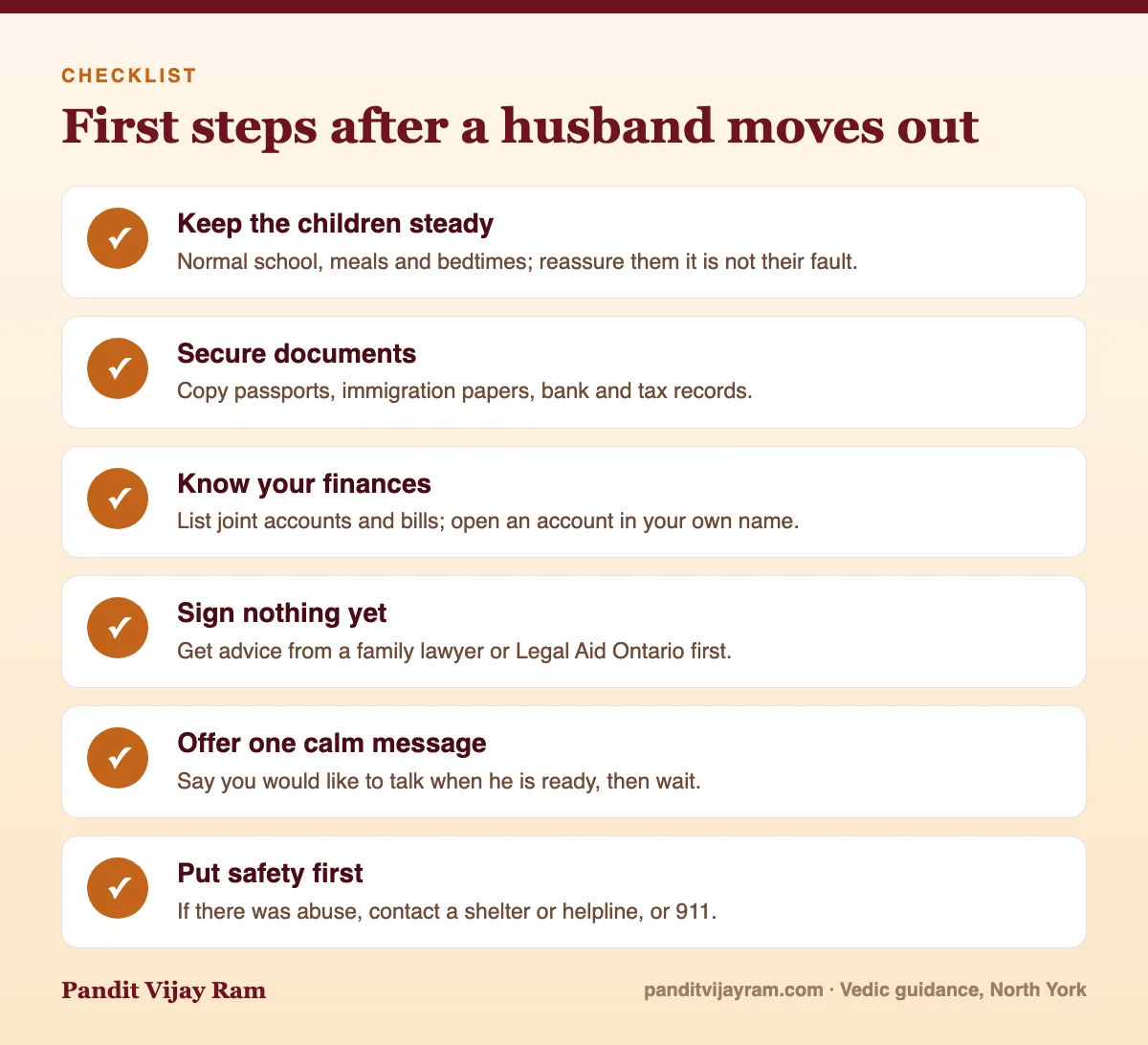
Here is a practical first-weeks checklist:
- Children first. Keep school, meals and bedtimes as normal as possible. Tell them, simply, that both parents love them and it is not their fault.
- Documents. Make copies of passports, immigration papers, health cards, bank statements, the lease or mortgage and tax returns. Keep them somewhere safe.
- Money. Know which accounts are joint, what bills are due and how they will be paid. Open an account in your own name if you do not have one.
- No signatures. Do not sign separation agreements, property transfers or loan papers until you have legal advice.
- One message. Tell him you would like to talk when he is ready, and leave it there.
- Support. Choose one or two people you trust, not the whole family network.
Relatives often want to call your husband or his parents on your behalf. Unless you both agree, this can harden positions. Let the first conversations be between the two of you, or with a neutral counsellor present.
How can marriage counselling help a separated couple?
Counselling gives both partners a safe, neutral room to say what went wrong without the conversation turning into a fight. Couples counselling suits a marriage where both are willing to try. Individual counselling helps you cope and grow even if he will not attend. Neither replaces the other.
Many South-Asian couples hesitate because they fear judgement or worry that private matters will be discussed outside the family. A registered counsellor or therapist is bound by confidentiality, and many in the GTA understand joint families, arranged marriage and immigration pressures.
What a counsellor can help with:
- Naming patterns, such as one partner pursuing while the other withdraws.
- Learning to raise a complaint without blame.
- Deciding how in-laws, money and household work will be shared.
- Working out whether reconciliation is healthy, or whether a respectful separation is better for everyone, including the children.
If your husband will not go, attend alone. Changes in how you respond often change how he responds. Our guide to relationship counselling in Toronto for South-Asian couples explains how to find registered professionals and what to ask in a first call.
Spiritual practice can sit alongside this work. Many wives keep a Monday prayer to Shiva and Parvati, asking for patience and harmony for both partners. The prayer is for the marriage and for wisdom, not for power over his choices.
What legal and financial issues should I know about during separation?
In Canada, couples can separate without going to court, but support, parenting arrangements and property all have legal rules. Divorce is a separate federal process. Before agreeing to anything, speak with a family lawyer or Legal Aid Ontario. Knowing your rights is protection, not a step towards ending the marriage.
Some wives avoid legal questions because they fear it will look like giving up. In fact, understanding the basics often lowers anxiety and lets you approach your husband from steadiness rather than fear.
Questions worth raising with a lawyer or legal clinic:
- How child support and spousal support are worked out in your situation.
- Who can stay in the family home for now.
- How parenting time and decision-making for the children are arranged.
- What happens to debts taken in either name.
- Whether your immigration status is affected. A sponsored spouse should get proper advice from a lawyer or licensed consultant, never from relatives or online forums.
Our guide on legal aid and legal clinics for family matters in the GTA lists where to start. The federal Department of Justice also publishes plain-language family law information. This article is not legal advice; laws change and every case is different. Mediation, where a neutral person helps both of you agree on practical matters, can keep the tone calmer and sometimes reopens the door to talking about the marriage itself.
What if the separation happened because of abuse or control?
Then your safety comes first, and getting back together is not the goal until the danger has been addressed. Hitting, threats, controlling money or movements, or pressure through immigration status are serious. Speak to a shelter or helpline, make a safety plan, and call 911 if you are in immediate danger.
Some women search for ways to bring a husband back after he has hurt them, because they love him, because family is pressing them to forgive, or because they worry about money and the children. Those pressures are real. But returning to a home where violence or control continues puts you and your children at risk.
Warning signs that need professional support before any reconciliation:
- He has hit, pushed or choked you, or broken things to frighten you.
- He controls your money, phone, documents or who you see.
- He threatens to take the children or affect your immigration status.
- He promises to change but the cycle repeats.
The GTA domestic violence help guide lists shelters, helplines and safety-planning basics. Help is available in many languages. A husband who genuinely wants to return after abuse needs his own counselling or a partner-assault programme, and real change shows over months, not in one tearful apology.
No prayer or ritual should be used to keep anyone in danger. In the Vedic view, protecting life is a higher duty than keeping up appearances for the community.
How can Vedic guidance support a wife who wants her husband back?
A kundli reading can show the emotional themes and timing pressures in your own chart and, if he agrees, in his. Prayer brings patience and calm. Vijay Ram ji offers both, alongside practical advice. He does not perform rituals to force a husband home, because a marriage held by force is not a marriage.
A reading for a separated wife usually looks at the seventh house and its lord, Venus and Jupiter, the Moon for emotional steadiness, and the current dasha and major transits such as Saturn. These show tendencies, such as a period that tests patience or favours careful conversation. They never decide what another person will choose.
Practical spiritual support might include:
- A short daily routine of lamp, mantra and a few minutes of silence.
- A Monday or Friday vrat, with care for your health if you have diabetes, are pregnant or take medication.
- A family puja for peace in the home, done with both partners' consent if he is willing.
The marriage problem consultation covers chart insight, prayer guidance and plain talk about family dynamics. If the separation has become an ex-back question after a divorce, the get ex love back service explains how Vijay Ram ji approaches reconnection with respect for both people. Whatever path you take, look after your own health and lean on people who steady you.
The bottom line
Knowing how to get my husband back after separation starts with steadying the home: children, documents and money first, no signatures without advice. Counselling, alone or together, gives the marriage a fair chance, and legal knowledge protects you rather than ending anything. Where abuse or control is involved, safety comes before reconciliation, and Vedic prayer should support your peace, never pressure him.
Key takeaways
- Separation is not divorce; many couples reconcile.
- Children, documents and finances come before the big conversation.
- Counselling helps even if only one partner attends.
- Get legal advice before signing anything.
- Abuse or control means safety first, always.