
Mental Health Support for South Asian Families in the GTA

If you searched for South Asian mental health GTA support late at night, you are not alone. Many of the families I meet in North York and across the region carry worry, sadness or panic quietly, because speaking about the mind still feels shameful at home. Elders may call it tension, weakness or nazar. Young people may hide it behind long hours and good grades. In more than forty years of Vedic practice I have prayed with many people who also needed a doctor, a counsellor or both, and I have learned that faith and treatment work best together. This guide lists culturally responsive services across the GTA that we checked on their official websites, the free public helplines every household should know, practical ways to start a conversation about stigma with parents or children, and where spiritual care honestly fits. Please read it as a starting point, not as medical advice. If anyone is in immediate danger, call 911 now, or call or text 988 to reach the Suicide Crisis Helpline.
Why is mental health hard to talk about in South Asian families?
Many South Asian families worry about izzat, family reputation, and the question of what people will say. Distress is often described through the body, as headaches, tiredness or tension, rather than as anxiety or depression. Elders may fear that a diagnosis will harm a marriage proposal or a career, so problems stay hidden until they become serious.
Stigma is not unique to any one community, but it takes particular forms in Hindu, Sikh, Muslim and Christian South Asian homes. Wikipedia's article on mental health notes that people facing mental illness may experience social stigma, which can make their difficulties worse. In my consultations I hear the same patterns again and again:
- Log kya kahenge. The fear of what relatives and neighbours will say keeps many families silent.
- Body language for the mind. A mother may say her heart feels heavy or her head is burning, when she is describing anxiety.
- Strength as duty. Fathers and eldest sons often feel they must carry everything alone.
- Spiritual explanations first. Some families assume black magic, nazar or a planetary period before considering illness.
- Immigration pressure. Isolation, long work hours and visa or money worries add strain.
None of this means the family is wrong or uncaring. It means the words they need are missing. Naming a feeling plainly, without blame, is the first remedy.
If you are unsure whether a loved one's change is spiritual or medical, our guide to negative energy or depression explains why a doctor comes first.

Where can South Asian families in the GTA find culturally responsive support?
Several GTA agencies offer services shaped for South Asian and racialized communities. Punjabi Community Health Services runs mental health, addictions and family programmes; the South Asian Women's Centre offers wellness and violence-against-women supports; Naseeha runs a helpline for Muslim youth; and Across Boundaries serves Black and racialized people facing mental health and addiction challenges.
Culturally responsive care means a counsellor who understands joint families, arranged marriages, religious duty and the pressure of migration without needing it all explained. These organisations describe that focus on their own websites:
- Punjabi Community Health Services (PCHS). A non-profit offering settlement services, mental health and addictions support, and family and seniors' programmes. Its mental health programme serves South Asian, newcomer and Muslim individuals and families, and it describes its services as culturally and linguistically appropriate.
- South Asian Women's Centre. Based in Toronto with a Scarborough location, it supports South Asian women and families through wellness services, a violence-against-women support group, legal aid and settlement help, with staff speaking many languages.
- Naseeha. A free, confidential helpline for Muslim youth, available every hour of every day by call or text at 1-866-627-3342, plus faith-aware online therapy.
- Across Boundaries. A Toronto-area charity providing free mental health and addiction programmes for Black and racialized people, using an anti-oppression approach.
Eligibility, locations and waiting times change, so contact each agency directly. Our city guides list more local options: see family support in Brampton, family support in Mississauga and family support in Toronto.
Which free mental health helplines should every GTA family know?
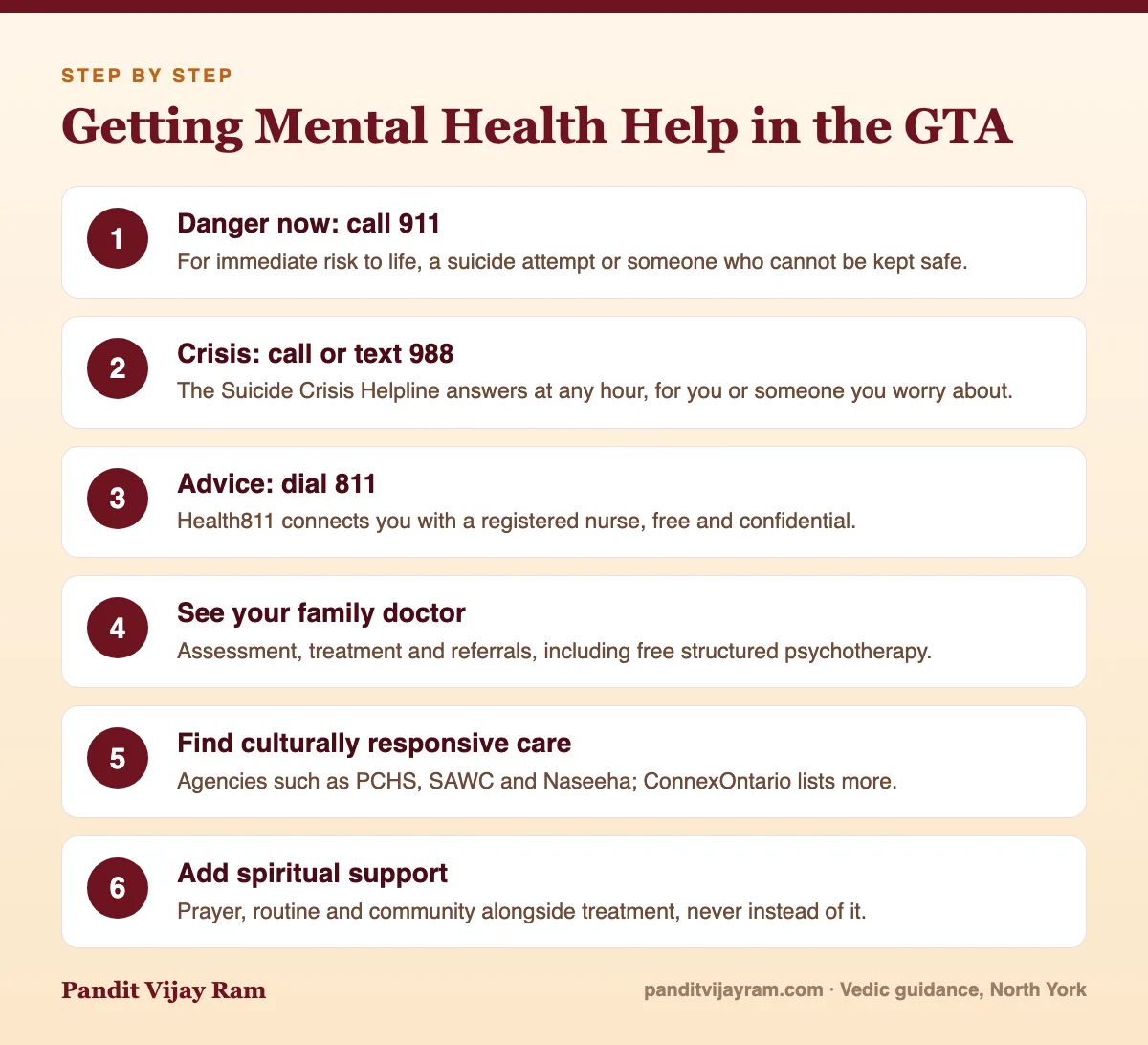
Save these now: call or text 988 for the Suicide Crisis Helpline, available all day, every day; dial 811 for Health811, where a registered nurse can advise on mental health concerns; call ConnexOntario at 1-866-531-2600 for referrals to local services; and call 911 if anyone is in immediate danger.
Many families only look for these numbers in an emergency. Writing them on the fridge before you need them is a quiet act of care.
- 911. For immediate danger, a suicide attempt, or someone who cannot be kept safe.
- 988 Suicide Crisis Helpline. Call or text 988, at any hour. It is for people who need help now, people unsure whether they need help, and people worried about someone else.
- Health811. Dial 811 to speak with a registered nurse about any health matter, including depression, anxiety and addiction. It is free, confidential and available around the clock, and also online.
- ConnexOntario. A free directory and referral service for mental health and addiction programmes, reachable at 1-866-531-2600 by phone, chat or email. It is not a crisis line.
- Your family doctor or nurse practitioner. They can assess, treat and refer, including to Ontario's free structured psychotherapy programme for adults.
For children and teens, Kids Help Phone offers confidential support; check its website for current ways to connect. Our guide to teenagers and immigrant parents covers how to keep those conversations open at home.
How do you start a conversation about mental health with parents or elders?
Choose a calm, private moment, speak about specific changes you have noticed rather than labels, use the family's own words, and connect help to values they hold, such as duty, health and faith. Offer one small, concrete step, such as a doctor's visit together, and be ready to return to the conversation more than once.
Children raised in Canada often find it hardest to raise mental health with parents raised elsewhere. These steps help, whichever generation you are speaking to:
- Pick the moment. After a meal or on a walk, never during an argument or in front of relatives.
- Describe, do not diagnose. "You have not been sleeping and you seem tired all day" lands more gently than "You are depressed."
- Use their words. If a parent says tension, start there.
- Link to shared values. Looking after the mind is part of looking after the body, which every scripture honours.
- Offer company. "Shall we see the doctor together?" removes some of the fear.
- Protect privacy. Promise not to share the conversation with relatives, and keep that promise.
- Repeat with patience. The first answer is often no. Return to it kindly.
Elders who are lonely after retirement or the loss of a spouse often brighten with routine and company. Our guide to caring for elderly parents also covers support for the caregiver, who can quietly burn out.
How can spiritual care support mental health without replacing it?
Prayer, mantra, seva and a faith community can bring comfort, routine and belonging, which support recovery. They should run alongside medical and psychological care, never instead of it. Any healer who tells someone to stop medication, avoid doctors or pay for fear-based rituals is not acting in that person's interest.
I am a Vedic astrologer and spiritual healer, not a doctor or therapist. When someone comes to me with weeks of sleeplessness, panic, hopelessness or thoughts of self-harm, my first advice is to see their family doctor, and in a crisis to call or text 988. Then we can talk about the spiritual side.
Spiritual care helps in honest, limited ways:
- Routine. A fixed morning prayer gives shape to days that feel shapeless.
- Breath. Slow, gentle breathing calms the body, though some practices need caution in pregnancy or with heart conditions.
- Belonging. A temple, gurdwara, mosque or church community reduces isolation.
- Meaning. Scripture and prayer can help people bear grief and uncertainty.
Be wary of red flags: promises that an illness will simply vanish, pressure to stop treatment, frightening claims of curses that demand urgent payment. Our guide to possession or mental illness explains why psychosis and seizures need urgent medical care first.
When a family wants prayer support alongside treatment, a health and wellbeing consultation focuses on calm and routine, never on medical claims. Darker months can deepen low mood; see winter low mood in Toronto for practical steps.
How can you support a family member who refuses help?
Stay connected, keep the door open, and look after your own health. Learn about the illness, offer practical help with daily tasks, and suggest the least frightening first step, such as a call to Health811. If there is any risk of harm, call 911 or 988 without waiting for permission.
Refusal is common, especially among elders and men who feel that needing help is a failure. Pushing hard usually makes them retreat further. A steadier approach works better over time:
- Keep showing up. Meals, walks and short visits matter even when conversation is hard.
- Reduce the barrier. A phone call to 811 feels smaller than a clinic visit.
- Find a trusted voice. A respected relative, family doctor or faith leader may be heard where you are not.
- Get support yourself. Caregivers can call ConnexOntario or Health811 for guidance and local family programmes.
- Know when to act. Talk of suicide, a plan, or behaviour that puts someone in danger means calling 911 or 988 immediately.
Families sometimes ask me for a remedy that will make a loved one accept treatment. I cannot override anyone's will, and I would not try. What I can offer is prayer for patience and clarity for the person asking, and practical encouragement to keep the relationship warm.
Vijay Ram ji is based in North York and meets families in person there, with phone and video sessions for others. See the astrologer in North York page, or the astrologer in Brampton page for Peel families.
The bottom line
South Asian mental health in the GTA is easier to support once families know where to turn and how to speak about it. Culturally responsive agencies such as PCHS, the South Asian Women's Centre and Naseeha sit alongside free services like 988, Health811 and ConnexOntario. Gentle, patient conversations break stigma more than lectures do. Spiritual care can bring comfort and routine, but it belongs beside medical and psychological treatment, never in place of it.
Key takeaways
- Stigma, family reputation and body-based language often hide mental illness in South Asian homes.
- PCHS, the South Asian Women's Centre, Naseeha and Across Boundaries offer culturally responsive support.
- Call or text 988 in crisis, dial 811 for nurse advice, and call 911 for immediate danger.
- Start conversations privately, describe changes rather than labels, and offer to go together.
- Spiritual care supports recovery alongside treatment; anyone urging people to stop medication is a red flag.