
Getting an Ex Back When Family Disapproved of the Relationship

Some relationships end not because two people stopped loving each other, but because their families would not accept it. Perhaps your parents objected to caste, religion, region or a kundli score. Perhaps there were tears, ultimatums, or a relative who threatened to cut you off. If you have searched get ex back family disapproved, you are probably carrying both grief and a sense of unfinished business. In North York and the wider GTA, I meet many young adults, and some not so young, in exactly this position. This guide explains why families push couples apart, how to approach an ex who may feel let down by you as well as your family, ways to handle parents who still object, and where to turn if pressure becomes threats. It also looks at kundli concerns honestly. Through more than forty years of advising South-Asian and Caribbean families, I have seen that respect for parents and freedom of adult choice can coexist, but only when someone is willing to have patient, honest conversations.
Can you get your ex back after your family broke you up?
Yes, it is possible when both of you still want it and you are ready to handle the family situation differently. As adults, the choice belongs to the two of you. But your ex may have been hurt by your family and by how you responded, so reconnecting starts with understanding their experience, not just your own.
When families end a relationship, the couple often tells the story differently. You may remember being torn and powerless. Your ex may remember feeling unwanted, judged and, sometimes, abandoned by you when it mattered most.
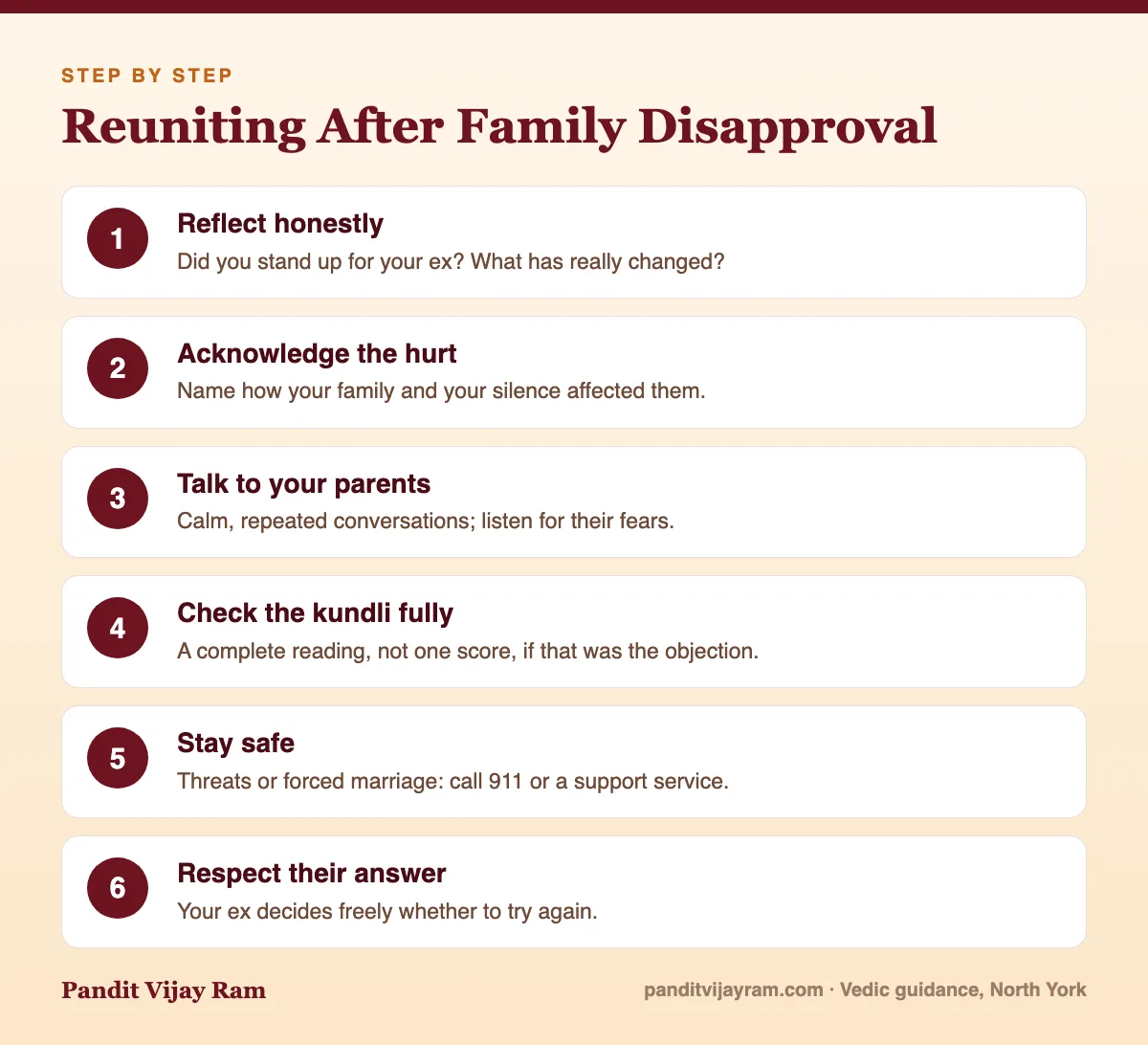
Before you reach out, think honestly about these questions:
- Did I stand up for them, or did I go quiet when my parents criticised them?
- Were they insulted or mistreated by my relatives, and did I acknowledge it?
- What has actually changed? Are my parents more open, or am I more willing to make my own choices?
- Am I ready for the consequences if my family still objects?
- Has my ex moved on, married, or made clear they want no contact?
If your honest answers show that nothing has changed at home or in you, reaching out may just reopen the same wound for both of you. If something real has shifted, a careful, respectful approach is fair.
Many couples in this position kept the relationship secret for a long time first. If that was your story, the guide on dating secretly from family explains why secrecy tends to make the eventual conflict harder, and how to move toward openness.

Why do families make couples break up?
Families object for many reasons: caste, religion, region, language, class, immigration status, a previous marriage, kundli concerns, or worry about community reputation. Underneath, there is often fear for a child's future or of losing cultural identity. Understanding these fears does not mean accepting them, but it helps you respond calmly.
In many diaspora families, marriage is seen as joining two families, not just two people. That is why objections can be intense even when parents like the person in principle.
Common reasons parents give:
- Caste or community. See the guide on inter-caste marriage and parents' approval.
- Religion. Hindu, Sikh, Muslim, Christian and other families may fear for traditions and children's upbringing. The article on interfaith marriage and family disapproval covers this.
- Kundli or manglik concerns. A low guna milan score or Mangal dosha.
- Status and background. Education, income, family reputation, region of origin.
- Previous marriage or children. Stigma around divorce persists in some circles.
- Fear of losing their child, whether to another culture, city or family.
Try to listen for the fear underneath the stated objection. A father who says they are not our people may be afraid his grandchildren will lose their language or faith. A mother who cites the kundli may be worried about a painful marriage she once saw.
You do not have to agree. But naming their fear back to them, I understand you are worried about…, often softens a conversation that would otherwise turn into a battle.
How do I approach my ex if my family was the reason we split?
Acknowledge plainly how your family's opposition hurt them and, if true, that you did not stand up for them enough. Explain what has changed, whether in your family or in your own readiness. Make no promises you cannot keep, do not ask them to fight your family for you, and accept their answer.
Your ex needs to hear two things: that you understand what they went through, and that this time would be different. Without the second, the first sounds like nostalgia.
A possible first message, adapted to your situation:
I have been thinking about how things ended. My family treated you unfairly, and I did not stand up for you the way I should have. I am sorry. I have talked honestly with my parents since, and I am in a different place now. I would like to talk if you are open to it, and I understand completely if you are not.
Only include the part about talking to your parents if you genuinely have. Saying it without doing it sets your ex up to be hurt again.
If they agree to talk, be ready to answer hard questions:
- Are your parents still opposed? What will you do if they are?
- Would we have to keep this secret again?
- Would your family be part of our wedding and our children's lives?
- How will you respond if your relatives insult me?
Do not expect your ex to win over your parents. That is your work. Their role is to decide whether they want to be with you, knowing what that involves.
Keep your first messages short and calm. The get ex love back consultation can help you think through the conversation in advance.
How do you handle parents who still disapprove?
Speak calmly and repeatedly, listen to their fears, involve a respected relative or counsellor if helpful, and give them time. Be clear about your decision without insulting them. Some parents soften over months; some never fully accept. You can stay respectful and loving toward them while still making your own adult choice.
Winning approval is rarely a single conversation. It is a series of calm, patient discussions, sometimes over a long time. Some approaches that help:
- Choose your moment. Not during a festival, a family crisis or an argument.
- Start with respect. I love you and I want you in my life. I also want to talk about someone important to me.
- Listen first. Let them say everything. Ask what they are most afraid of.
- Answer concerns with facts. Your partner's character, their family, your plans for faith and culture.
- Find an ally. An aunt, uncle, cousin or family friend whom your parents respect can sometimes open doors.
- Introduce gradually. A short, relaxed meeting can do more than many arguments.
- Hold your line kindly. I hear you. I have thought carefully, and this is my decision.
A family counsellor, ideally one who understands your culture, can help everyone speak without shouting. Your family doctor can suggest options.
The detailed guide on convincing parents for a love marriage goes further into these conversations. Vijay Ram ji's family problem guidance can support families looking for a calmer way forward, with prayer for harmony that everyone wants.
Acceptance may not be complete. Some parents attend the wedding but stay distant for a while. Warmth often grows with time, particularly once grandchildren arrive.
What if family pressure turns into threats or coercion?
If anyone threatens you, takes your passport or phone, confines you, arranges a marriage against your will, or threatens your partner, that is abuse, not disagreement. Forced marriage is a crime in Canada. Call 911 in danger, and contact police, a lawyer or a domestic-violence service for help and planning.
Most family disagreements are painful but safe. Some cross a line. Warning signs include:
- threats of violence toward you or your partner;
- taking your passport, identity documents, phone or money;
- stopping you from leaving the house or going to work or school;
- pressure to travel abroad where you fear a marriage will be arranged;
- threats to harm themselves to force your choice;
- relatives following or monitoring your partner.
If any of this is happening, your safety comes first:
- In immediate danger, call 911.
- Tell a trusted friend, teacher, doctor or employer.
- Keep copies of your important documents somewhere safe outside the home.
- Contact a domestic-violence or forced-marriage support service. The GTA guide to domestic violence help lists options.
- If you fear being taken abroad for marriage, speak to police and a lawyer before travelling.
It is a criminal offence in Canada to force someone into marriage or to help do so. You are not betraying your family by seeking help. You are protecting yourself, and often you are protecting them from making a terrible mistake.
If the strain is affecting your mental health, call or text 9-8-8, or see your family doctor.
Does a kundli mismatch mean my family was right?
Not necessarily. A low guna milan score or Mangal dosha is one consideration among many, and different astrologers weigh them differently. Many couples with modest scores have steady marriages. A full chart reading looks at the seventh house, Venus and dashas in both charts, and suggests remedies, rather than issuing a verdict.
Kundli concerns are a common reason families end relationships. Sometimes they are sincere worries; sometimes they give a respectable reason for an objection that is really about caste or status.
Points to understand:
- Guna milan scores the Moon signs and nakshatras of two people out of 36. It is one tool, not the whole picture. A low total does not, by itself, predict an unhappy marriage.
- Mangal dosha is interpreted differently across schools, and many classical and modern astrologers list cancellations and mitigating factors.
- A complete reading considers both charts: the seventh house, its lord, Venus, Jupiter, the Navamsa and the current dashas.
- Remedies exist for many concerns, traditionally including specific pujas, mantras and charitable acts.
If your family's objection centred on the kundli, a careful second reading can sometimes ease their mind. Vijay Ram ji's relationship compatibility service explains the factors honestly, including where texts and traditions differ, and offers a written summary families can review.
What a chart cannot do is decide for you. It describes tendencies and areas that may need care. Two adults who choose each other, communicate well and handle family stress together are building something no score can fully capture.
The bottom line
If you want to get ex back family disapproved, begin by acknowledging what your ex went through, including any time you failed to stand up for them. Handle your parents with patience and respect while holding firm to your adult choice. Treat any threats, confinement or forced marriage as safety issues and seek help immediately. Kundli concerns deserve a full, honest reading rather than a single score.
Key takeaways
- Reuniting after family disapproval is an adult choice both people must make freely.
- Acknowledge how your family's opposition, and your response, affected your ex.
- Winning over parents is your work, not your ex's, and it often takes time.
- Threats, confinement and forced marriage are crimes; seek help immediately.
- A low kundli score is one factor, not a verdict on the relationship.