
Finding a Pandit in the GTA for Weddings and Pujas: Questions to Ask

Booking a pandit in Toronto sounds simple until you start. A cousin recommends one priest, the temple office gives you another number, and the venue has its own list. Each one does things a little differently, quotes a different length of ceremony and expects different items to be ready, and you are not sure what to ask. Families in North York, Brampton, Scarborough and Richmond Hill come to me with this confusion before weddings, house-warmings and a baby's naming. Over forty years of Vedic practice I have worked alongside many priests, and the smoothest ceremonies almost always followed a clear, unhurried conversation a few weeks beforehand. This guide is about priestly services, not about choosing a spiritual healer, which is a different decision. It walks through where families usually find a pandit, how to match tradition and language, the questions to ask on the first call, who brings which samagri, and what to confirm in writing so the day runs calmly.
How do you find a Hindu priest in the GTA?
Most families find a pandit through their temple office, relatives who share the same regional tradition, community associations, or the venue's past experience. Start early for weddings, because popular muhurat days fill up. Speak with at least two priests so you can compare how clearly each explains the ceremony.
The GTA has priests from many lineages and regions, which is a blessing and a source of confusion. Good starting points include:
- Your own mandir. Temple offices often know which priests perform home and venue ceremonies.
- Family who share your tradition. A Gujarati, Tamil, Punjabi, Bengali or Indo-Caribbean family will usually point you to someone familiar with their customs.
- Community and cultural associations. Regional groups often keep informal lists.
- Your venue. Banquet halls that host Hindu weddings know which priests work smoothly with their staff and fire rules.
Online listings and social media can help, but treat them as a starting point. A priest with a polished profile is not necessarily the right fit for your family's rites.
Give yourself time. For weddings, many families begin the search as soon as a date window is agreed, because the most favoured muhurat days are shared by many couples. Our article on choosing a wedding muhurat in Canada explains how those days are worked out.
Does the pandit need to follow your family's tradition?
Ideally, yes. Hindu rites differ by region, community and sampradaya, from the number of pheras to who ties the mangalsutra. A priest who knows your family's customs will include the steps your elders expect. If two families' traditions differ, ask whether the priest is comfortable blending them.
A Hindu wedding in a Punjabi family, a Telugu family and an Indo-Caribbean family can look quite different, even though the core of agni, kanyadaan and saptapadi is shared. The same applies to griha pravesh, mundan and shraddh.
Ask about:
- Lineage and training. Which tradition did the priest learn in, and which communities do they usually serve?
- Arya Samaj or temple-style rites. These differ in emphasis and in which deities are invoked. Know what your family prefers.
- Regional steps. Haldi, mehndi, var mala, mangal pheras, sindoor and the elders' blessings all vary. Make a list with your parents.
- Blending two families. Some priests are very good at weaving two regional styles together. Others prefer to follow one.
There is no single correct form. What matters is that both families understand and accept the plan before the day. For wedding-day blessings and protection customs, see our guide to nazar at weddings, and for the deeper meaning of the main rites, read keeping Hindu wedding rituals meaningful.
What questions should you ask a pandit before booking?
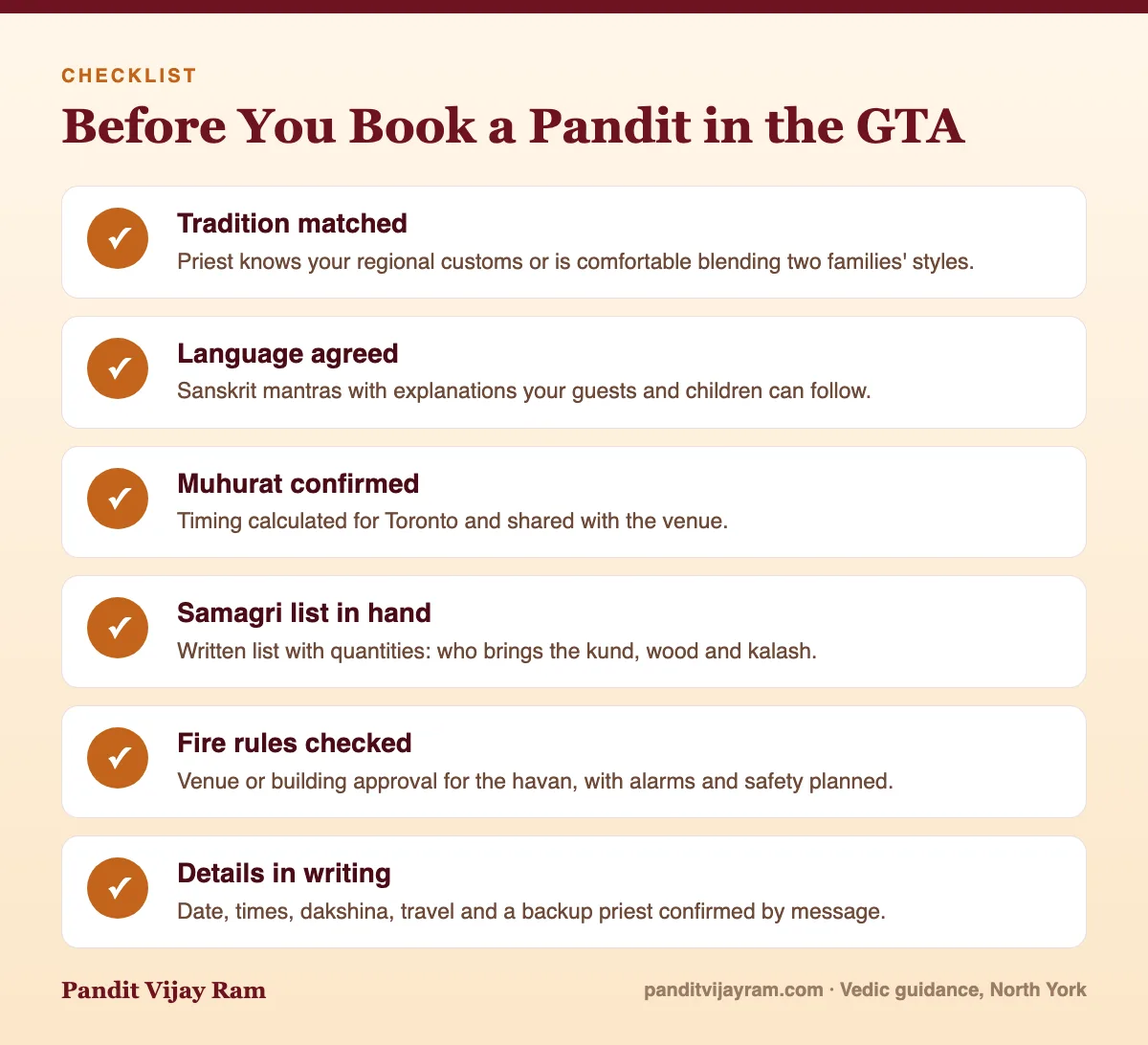
Ask about tradition, language, length of the ceremony, who supplies samagri, how the muhurat is calculated, arrival time, how the priest works with venue fire rules, what is included in the dakshina, travel, and who covers if they fall ill. Clear answers on the first call are a good sign.
Use this list on your first phone or video call. Write the answers down.
- Which tradition will you follow, and can you include our family's regional customs?
- Which language will you chant and explain in? Can you explain each step in English for guests and children?
- How long does the ceremony take, and can it be shortened without removing essential rites?
- How is the muhurat chosen, and will you calculate it for Toronto rather than an Indian city?
- What samagri do you bring, and what must we buy? Will you send a written list?
- How do you handle the havan at a venue with fire rules or at a condo with smoke alarms?
- What time will you arrive to set up, and how much space do you need?
- What does your dakshina include, such as travel, assistants or follow-up puja?
- What happens if you are unwell on the day? Do you have a trusted replacement?
- Can we meet or speak once more the week before?
A priest who welcomes these questions is usually one who prepares carefully. Hesitation about basic arrangements is worth noticing.
Who provides the puja samagri for a ceremony?
It varies. Some pandits bring a full kit of samagri, kund and utensils, others bring only specialised items and ask the family to buy flowers, fruit, sweets and ghee. Ask for a written samagri list at least a week ahead, and confirm who brings the havan kund and wood.
Samagri confusion is the most common cause of last-minute stress. A typical split looks like this, though every priest differs:
- Often brought by the priest: havan kund, havan samagri mix, sacred threads, kumkum, akshat, small idols or yantras for the ceremony, specific herbs and ritual vessels.
- Often bought by the family: fresh flowers and garlands, fruit, sweets for prasad, coconuts, betel leaves and nuts, ghee, a kalash, new cloth, rice and items specific to the bride or groom.
- Often unclear: wood, a lamp, a fire extinguisher at the venue, mango leaves and the mandap decoration.
Ask the priest to send the list in writing, with quantities. Many GTA Indian grocery stores sell pre-packed puja kits, but check them against the list.
After the ceremony, plan what happens to leftover flowers, ash and decorations. Venues and homes in the GTA cannot use rivers or the lake. Our guide to disposing of puja items respectfully in Toronto explains the options. If you want to understand the cleansing items themselves, see the Vedic cleansing toolkit.
Should you get a written agreement with your pandit?
Yes, for weddings and larger ceremonies. A short email or message confirming the date, start time, location, tradition, ceremony length, samagri responsibilities, dakshina and what it includes, travel and a backup plan protects both sides. It is a courtesy, not a sign of mistrust, and good priests are happy to confirm.
Many families feel awkward asking a priest to put anything in writing. In practice, a clear message helps everyone, including the priest, who may be juggling several ceremonies on a busy weekend.
A simple confirmation covers:
- Date, start time, arrival time and expected finish.
- Full address and a contact on the day.
- The ceremony and tradition being followed, including any blended customs.
- Samagri the priest brings and what the family buys.
- Dakshina, how and when it is offered, and whether travel or assistants are included.
- What happens if either side needs to change the date, and who covers if the priest is ill.
Be wary of anyone who presses for large sums for extra rituals at the last minute, uses fear to upsell or refuses to explain what a ceremony involves. Those patterns are discussed in our guide to choosing a genuine practitioner in Toronto.
If you also need a kundli reading or matching before the wedding, Vijay Ram ji's kundli and horoscope service can be arranged separately from the priest's booking.
The bottom line
Finding the right pandit in Toronto comes down to a good first conversation. Match the priest to your family's tradition and language, ask the ten questions above, and get the samagri list and arrangements in writing. With those three steps done, the ceremony can be about meaning rather than last-minute worry.
Key takeaways
- Temple offices, relatives and venues are the most reliable ways to find a GTA priest.
- Match the pandit's tradition and language to what your family expects.
- Ask about samagri, muhurat, timing, fire rules and a backup plan on the first call.
- A short written confirmation protects both the family and the priest.
- Fear-based upselling or vague answers are signs to keep looking.