
Getting Back Together After Years Apart

A name appears in your messages after a long silence. Or you run into someone at a wedding, a temple function or a school reunion, and an old warmth returns before you can stop it. Getting back together after years apart is one of the most hopeful and most confusing experiences a person can have. In North York and across the GTA, I hear these stories often: first loves from back home who now live in Brampton, couples separated by family pressure who meet again in middle age, divorced partners who have both grown. Each one asks a version of the same question: is this real, or just memory? This guide looks at how people change over long gaps, how to tell nostalgia from present-day love, which honest conversations matter most, and how families tend to respond. It also covers what a birth chart can and cannot add. After four decades of counselling couples, I believe second chances work best when both people meet as they are today, not as they were.
Can you really get back together with an ex after many years?
Yes, some couples reunite after long gaps and build strong relationships. Time can soften old wounds, bring maturity and clarify what each person wants. It can also hide how much someone has changed. A reunion is worth exploring when both people choose it freely and are willing to get to know each other again.
Long separations happen for many reasons: studies abroad, immigration, family opposition, a first marriage to someone else, or simply being too young to manage a serious relationship. When those circumstances shift, an old connection can seem possible again.
What makes a reunion after years different from getting back together after a few weeks is that you are, in many ways, two new people. That can be good news. Arguments that seemed huge at twenty-two may look small at forty. Patience, self-knowledge and life experience can make love calmer.
It also brings real complications:
- one or both of you may have children, former spouses or step-families;
- you may live in different cities or countries;
- health, finances or caring duties may shape what is possible;
- you may each have formed habits and routines that are hard to blend.
None of this rules out a second chance. It simply means the reunion is a new relationship that happens to have history, not the old one resumed. Treat the first months as a courtship. Meet, talk, notice, and give yourselves permission to slow down.
If this person was your first love, the companion guide on reuniting with a first love looks at that particular pull. If your past together was a long cycle of breaking up and making up, read on-and-off relationships before going further.
How do people change over years apart?
People change in values, priorities, faith, health, finances, family responsibilities and how they handle conflict. Some changes bring couples closer; others create quiet gaps. The person you remember may be very different now, and so may you. Getting to know each other again is essential before making any commitment.
Think of the years apart as two separate stories that each of you lived. Before the stories can merge, each needs to be heard. Areas that commonly shift:
- Values and faith. One person may have become more religious, or less. Views on family roles, money and lifestyle may have moved.
- Family situation. Marriages, divorces, children, ageing parents, or a duty to care for someone.
- Career and money. Debts, savings, business ventures, retirement plans, financial habits.
- Health. Physical or mental-health conditions, medication, or changes in energy.
- Where home is. A settled life in Canada, or ties to another country.
- Conflict style. Therapy, hard experiences or past relationships may have changed how each of you argues and makes up.
Some of these changes will delight you. Others may surprise or disappoint you. Both are useful information.
A practical approach is to ask open questions and listen without rushing to fit the answers into your old picture: What has the past decade been like for you? What matters most to you now? What did you learn from your marriage?
If either of you is coming from a marriage or divorce, the article on love after divorce or separation addresses the emotional and practical layers that come with it.
Is it nostalgia or real love when an old flame returns?
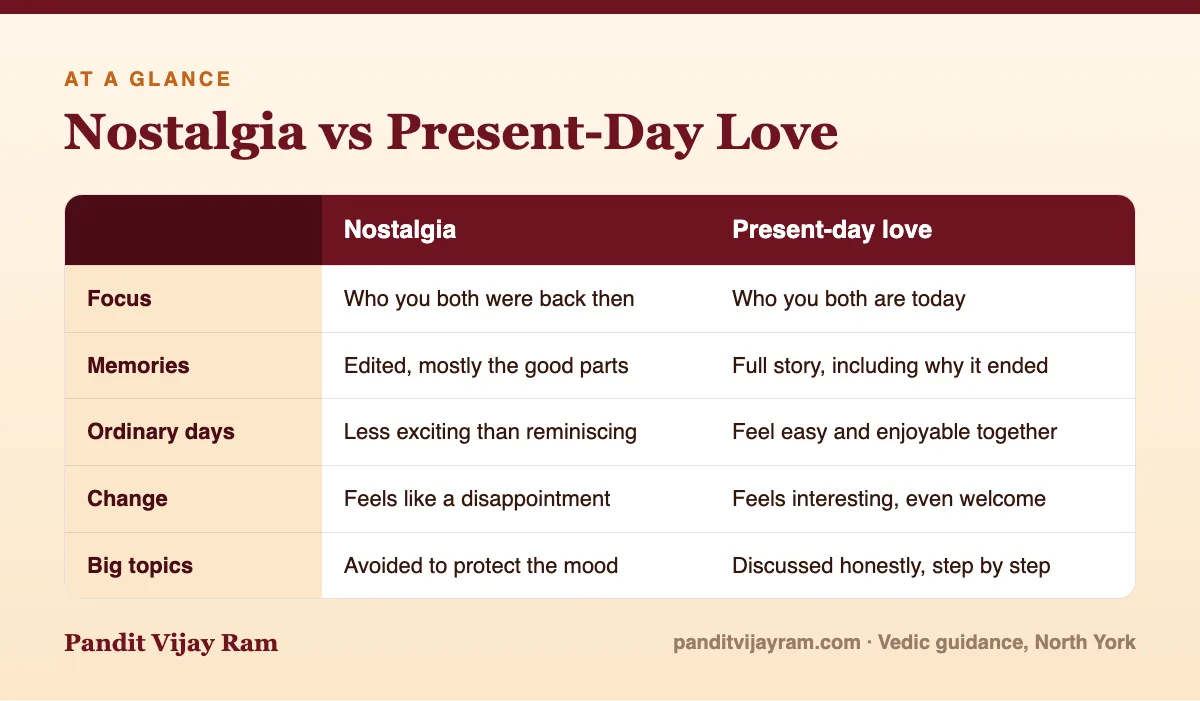
Nostalgia longs for a past moment; real love responds to the person in front of you today. If your feelings rest mostly on memories, music and who you both were, be cautious. If you enjoy who they are now, including the changes, and they treat you well in the present, the connection may be real.
Nostalgia is powerful because it edits the past. It keeps the summer evenings and drops the arguments. It can also attach to what the relationship represented: youth, freedom, a home country or a time before heavy responsibilities.
Use these questions to test what you feel:
- Would I be drawn to this person if we met today for the first time?
- Do I like how they live now, including their friends, work and habits?
- Am I hoping to recover a younger version of myself rather than build something with them?
- Is the timing tied to a hard period, such as a divorce, loss or loneliness, that might be shaping my feelings?
- Do I remember clearly why we ended, and has that reason truly gone?
If most of your answers point to the present, that is encouraging. If they point to the past, it does not mean you should walk away, but it does mean slowing right down.
Spend time together in ordinary settings: a grocery run, a family dinner, a rainy Sunday. Real compatibility shows up in plain days, not only in reminiscing. Keep your own friendships and routines strong during this stage, so the reunion is a choice rather than an escape.
What should you talk about before getting back together after years?
Talk honestly about why the relationship ended, what each of you has lived since, children and former partners, money, where you want to live, faith, family expectations and health, including sexual health. These conversations feel serious, but they prevent painful surprises and show whether your lives can truly fit together now.
Many reunited couples avoid hard topics because the reconnection feels fragile. In my experience, skipping them only delays the conflict. Here are the conversations that matter most, roughly in the order they tend to come up:
- Why it ended. Each of you describes it from your side, without debate. Listen for whether the cause is truly past.
- The years in between. Relationships, marriages, losses, achievements and regrets.
- Children and former partners. Custody, step-parenting, and how former spouses fit into family life.
- Money. Debts, support payments, property and attitudes to spending and saving.
- Where to live. City, country, and whether one person would have to give up work or community.
- Faith and family expectations. Religious practice, how you would marry if you choose to, and what each family expects.
- Health. Long-term conditions, mental health, and sexual health. After years apart, both partners getting a routine sexual health check is sensible and respectful, not an accusation.
You do not need every answer at once. Spread these conversations across weeks. What matters is that neither of you hides something important to protect the mood.
A couples counsellor can help with the heavier topics. If you want to explore compatibility from a Vedic angle as well, the relationship compatibility consultation looks at both charts when both people agree to it.
How do families react when former partners reunite years later?
Reactions vary widely. Some families are delighted, especially if they regret earlier opposition. Others worry about old hurts, previous marriages, children, or community talk. As adults, the decision is yours, but patient, respectful communication with family usually eases the transition, and any threats or coercion call for safety support.
In South-Asian, Caribbean and many other diaspora families, a reunion rarely involves only two people. Parents, siblings, children and sometimes community elders all have opinions, and they may remember the first breakup differently from you.
Common family concerns include:
- Old wounds. If the breakup hurt you, relatives may feel protective.
- Previous marriages. Divorce can still carry stigma in some circles, and families may worry about gossip.
- Children. Your children, or theirs, may need time to adjust, and their feelings deserve real weight.
- Caste, faith or regional differences that were part of the original opposition.
Some steps that help:
- Tell close family yourself, calmly, rather than letting them hear it from others.
- Introduce your partner gradually, in relaxed settings.
- Acknowledge their concerns without promising to obey them.
If family opposition ended your relationship the first time, the dedicated guide on getting an ex back when family disapproved covers that situation in depth. If either of you has been married before, second marriage astrology explains how charts are read in that case.
Any threats, pressure to marry against your will, or attempts to control your movements are not family disagreement. They are safety issues, and support is available through police and local services.
What does Vedic astrology say about reuniting after years?
In Vedic astrology, life unfolds through planetary periods called dashas, and a new period can bring new relationship themes. A reading of both charts can show tendencies around partnership and timing. It describes possibilities, not verdicts, and it cannot override either person's free choice about whether to reunite.
The Vimshottari dasha system divides life into major planetary periods of different lengths, from six years for the Sun to twenty for Venus. When someone moves from one major period into another, priorities can shift noticeably. That is one reason people sometimes feel ready, years later, for a relationship they could not sustain before.
In a reunion reading, Vijay Ram ji typically considers:
- the seventh house and its lord, describing partnership;
- Venus, representing love and harmony;
- Saturn, often associated with delays, maturity and commitments that arrive later in life;
- the current dashas of both people, if both agree to share birth details.
A chart might suggest a period that favours commitment or one that calls for patience. It never says a reunion must happen, and it cannot speak for the other person's heart.
Many couples also find meaning in a small shared prayer as they begin again: lighting a lamp together, or visiting a mandir, gurdwara or other place of worship to give thanks. That is prayer for harmony you both want, offered freely.
To explore this further, see the get ex love back consultation, which combines chart insight with honest counselling, and never promises a reunion or a timeline.
The bottom line
Getting back together after years apart can be a real second chance, but it works best when both people meet as they are today. Expect change in values, families, health and finances, and test whether your feelings respond to the present person rather than memory. Have the honest conversations early, involve family with patience, and treat astrology as insight into tendencies rather than a promise.
Key takeaways
- A reunion after years is a new relationship that happens to have history.
- Nostalgia remembers the past; real love responds to who the person is now.
- Talk early about children, money, faith, location and health, including sexual health.
- Family reactions vary; adult choice and safety come first.
- A new dasha can shift priorities, but charts show tendencies, not certainties.