
Kundli Matching for Love Marriage: Do Gunas Matter if You Are Already in Love?

You already know how your partner takes their tea, what makes them laugh and how they argue. Then a parent asks for birth times, and suddenly a number out of thirty-six feels like it could undo all of that. Kundli matching for love marriage is a question I hear constantly from couples in North York, Vaughan and around the GTA, usually with some anxiety about what the result will mean. This guide explains whether matching is actually necessary, what each of the eight kootas looks at, how a committed couple can read a result without panic, and what matters beyond the score. I also explain what to do if the matching shows real challenges. In more than forty years of practice I have matched charts for couples meeting for the first time and for couples who have been together for years. The second group needs a different approach. Their relationship is already real evidence, and the chart should be read alongside it, not above it.
Is kundli matching necessary for a love marriage?
No. Kundli matching is not required by law, and many Hindu, Sikh and Jain families marry without it. Couples in love usually choose it for three reasons: to reassure parents, to understand each other better, or to pick an auspicious wedding date. Each is valid, but none makes the result a condition for marrying.
Matching grew up alongside arranged marriage, where two families needed some way to judge an unknown match. In that setting a low score could reasonably mean "keep looking", because nothing had yet been built. A couple who have chosen each other are in a different position.
Good reasons to do it anyway:
- Family peace. If parents value astrology, a respectful reading lets them participate. Our guide to convincing parents for a love marriage explains how to use it as a bridge.
- Self-knowledge. Seeing where temperaments differ can explain recurring arguments and suggest ways through them.
- Timing. Your charts help a priest choose a wedding muhurat suited to both of you.
Less helpful reasons include hoping the chart will settle doubts you have not voiced to your partner, or letting a relative use it as a weapon against a match they dislike for other reasons.
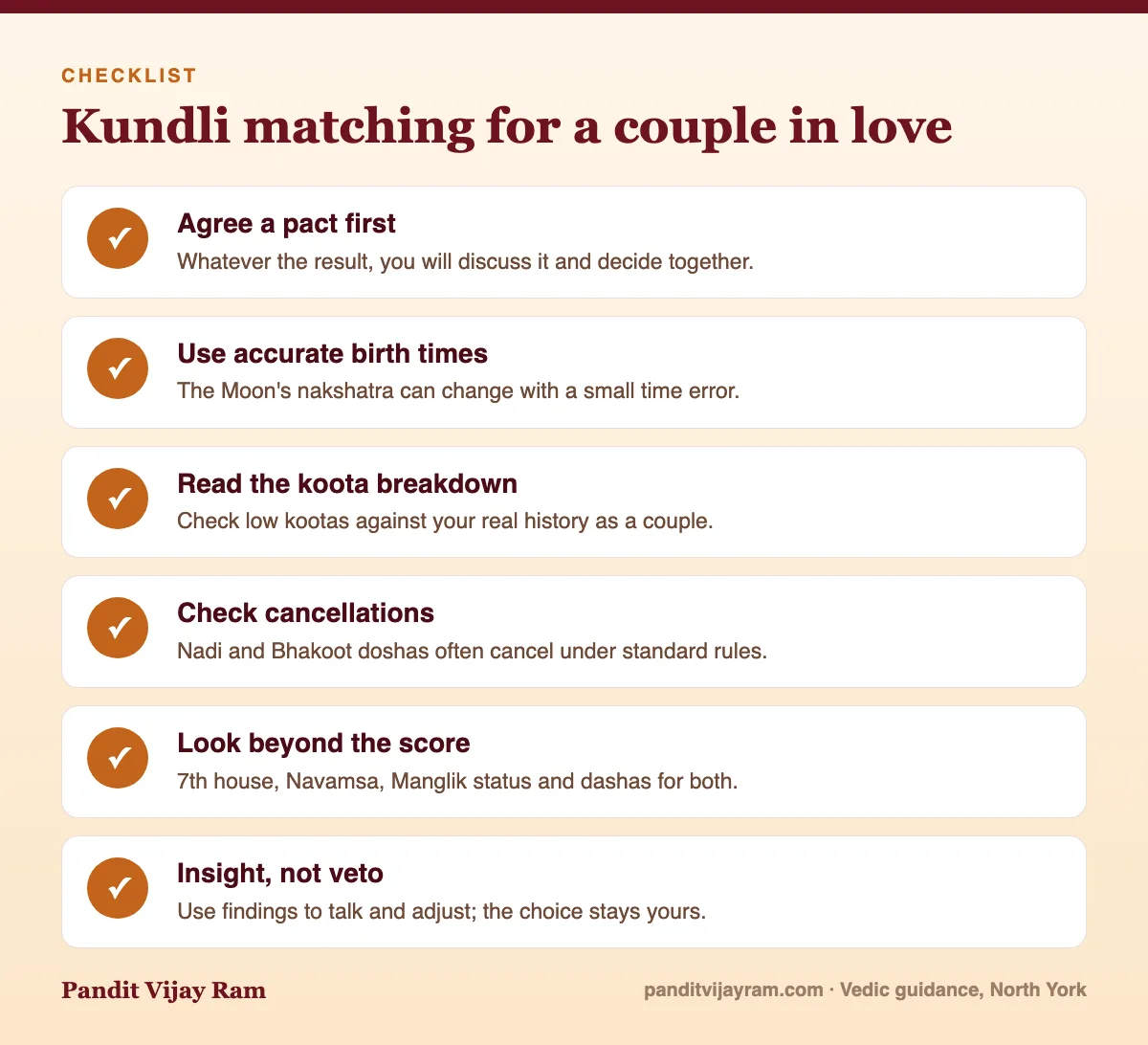
Before you share birth details, agree with each other what you will do with the result. A simple pact works well: "Whatever it says, we will talk about it together, and we will decide together." That one sentence prevents most of the distress I see.
If either of you does not know an exact birth time, our article on kundli matching without a birth time explains what can still be done and where precision drops.

What do the eight kootas in guna milan measure?
Ashtakoota matching compares the Moon's nakshatra and sign in both charts across eight factors worth one to eight points: Varna, Vashya, Tara, Yoni, Graha Maitri, Gana, Bhakoot and Nadi. The total out of 36 is the guna score. Higher-weighted kootas, especially Gana, Bhakoot and Nadi, carry the most meaning.
Here is what each koota is traditionally said to describe, with its maximum points:
- Varna (1): outlook and work temperament, by Moon-sign element. Not related to caste.
- Vashya (2): mutual influence and who tends to lead in the partnership.
- Tara (3): counted from one nakshatra to the other; read for well-being and fortune together.
- Yoni (4): each nakshatra has an animal symbol; the pairing describes physical and instinctive compatibility.
- Graha Maitri (5): friendship between the lords of the two Moon signs; mental wavelength and ease of understanding.
- Gana (6): Deva, Manushya or Rakshasa temperament; how each person reacts under pressure.
- Bhakoot (7): the distance between Moon signs; emotional rhythm, family and financial harmony.
- Nadi (8): Aadi, Madhya or Antya; traditionally linked to constitution and well-being of the couple and their children.
Because the system uses only the Moon, it measures emotional and instinctive fit. It does not look at the ascendant, the 7th house or the planets that describe marriage directly. That is why a guna score is the start of a reading, not the whole of it.
Bhakoot and Nadi have their own detailed explainers: Bhakoot dosha explained and Nadi dosha meaning and remedies. To see your own numbers before a consultation, try the free love and marriage tools.
How should a couple already in love read their guna milan result?
Read each koota as a description of how you work together, then compare it with what you already know. A low Gana score might match the fact that one of you explodes and the other goes quiet. Use those insights to talk and adjust. Your shared history is evidence the chart cannot see.
Couples who have been together a while can do something arranged-match couples cannot: check the chart against reality. I encourage them to sit down with the koota breakdown and ask a few questions together.
- Where did we score well, and does it ring true? Often a strong Graha Maitri matches the feeling of being understood without explaining.
- Where did we score low, and have we felt that? Low Vashya can match tussles over decisions; low Yoni, mismatched needs for closeness.
- What have we already learned to handle? A couple who argue loudly but repair quickly may already have solved the issue a Gana gap describes.
- What do we want to work on? Choose one area and agree a small, practical change.
This approach turns a number into a conversation. It also protects against two common mistakes: dismissing the whole reading because you dislike the score, and treating it as proof that a good relationship is doomed.
The score bands people quote online, such as 18 as a minimum pass, come from popular practice rather than one fixed classical rule. A low score deserves a closer look, which our low guna milan guide provides, including the cancellations that frequently apply.
What matters beyond the guna score in kundli matching?
A full matching also reads each person's 7th house and lord, Venus and Jupiter, the Navamsa chart, Mars for Manglik dosha, and the dashas both partners will run in the coming years. Many astrologers weigh this individual analysis more heavily than the guna total. Real-life factors like values and communication matter most of all.
A practical checklist I work through after the ashtakoota score:
- Each person's capacity for partnership. A well-supported 7th house in both charts is reassuring even with a modest score.
- Manglik status on both sides. One Manglik and one non-Manglik partner is not automatically a problem; cancellations are common. See our guide to Manglik and non-Manglik marriage.
- The Navamsa. Agreement between the two D9 charts often explains why a couple feels right together.
- Dasha overlap. If both partners enter difficult periods at the same time, that is a season to plan for, not a reason to part.
- Health of the Moon. A very stressed Moon in either chart suggests that emotional support and routine will matter.
Then there are the things no chart measures: shared values, how money is handled, attitudes to children and in-laws, faith practice, where you will live, and whether each of you feels safe to disagree. In my experience these decide far more marriages than the Yoni koota ever will.
The relationship compatibility consultation combines the chart analysis with these practical questions, so that a couple leaves with a clearer picture of both.
What if kundli matching shows problems after you are committed?
Do not panic or break up over a number. Ask the astrologer which kootas scored low and whether classical cancellations apply, consider a second opinion, and talk openly with your partner. Remedies such as prayer, charity and specific pujas exist for most doshas. The decision to marry remains yours as a couple.
When a committed couple brings me a worrying result, I usually find one of three situations:
- The problem cancels. Nadi or Bhakoot dosha often does not apply under standard exceptions, such as shared or friendly Moon-sign lords. Many "failed" matches look very different once these are checked.
- The problem is real but workable. A temperament gap or a demanding dasha that the couple can prepare for, with remedies and awareness.
- The chart echoes real-life concerns. Sometimes the reading confirms doubts that one partner already had. That is a conversation worth having honestly, ideally with a counsellor as well.
In each case the next step is talking, not deciding in a rush. A traditional remedy, whether a Mahamrityunjaya jaap, a Gauri-Shankar puja or a period of charity, gives the couple a shared practice that many find steadying.
What a result must never become is a tool to force a separation. If relatives threaten, isolate or pressure either partner because of a chart, that is coercion, and support from police or community services is appropriate. A chart describes. Two adults decide.
The bottom line
Kundli matching for love marriage is optional, and for a committed couple it works best as insight into how you relate rather than as a pass or fail verdict. The eight kootas describe emotional and instinctive fit through the Moon, while a full reading adds each person's 7th house, Navamsa, Manglik status and dashas. If problems appear, check cancellations, talk openly and consider remedies, remembering that the decision to marry belongs to the two of you.
Key takeaways
- Matching is optional for a love marriage and never a legal requirement.
- The eight kootas use only the Moon, so they show part of the picture.
- Read low kootas as conversation prompts, checked against your real history.
- Individual chart analysis and real-life values matter more than the total.
- A difficult result calls for cancellation checks and talk, not panic.