
Family and Newcomer Support in Toronto: Services, Helplines and Spiritual Care

When a family is under strain, the hardest part is often knowing who to call first. A newcomer couple arguing about money, a teenager who has stopped talking, an elder who is lonely in a high-rise flat: each needs a different door. This guide lists family support services Toronto residents can actually use, each checked on the organisation's own website or the City's pages. I am a Vedic astrologer and spiritual healer based in North York, and over forty years I have learned that my role begins after the practical help is in place, not before it. You will find where newcomers get settlement support, which crisis and mental-health lines serve the city, where to turn for counselling or abuse, how legal aid and police non-emergency routes work, and how prayer and a chart reading can sit beside all of this. None of these services are connected to me. I name them because I send people to them every week.
Where can newcomer families in Toronto get settlement help?
Start with 211, which connects people to social services, programmes and community supports across Ontario. Settlement.Org, run by the Ontario Council of Agencies Serving Immigrants, has a Find Services Near Me map. COSTI Immigrant Services, a long-established Toronto agency, offers employment, housing, English classes, family services and interpretation.
The first year in a new country brings a flood of forms, appointments and decisions. Families often wait too long before asking for help because they assume it costs money or is only for refugees. Neither is usually true.
- 211. The City of Toronto describes 211 as the number to call to be connected with local resources, with a multilingual centre that answers at any hour. It is a good first call when you do not know which agency fits.
- Settlement.Org. Managed by OCASI and funded by Immigration, Refugees and Citizenship Canada and the Province of Ontario, it explains housing, health, work and legal topics, and lists agencies by region and service type.
- COSTI Immigrant Services. It has served newcomers in the Greater Toronto Area for decades, with help finding work, settling into housing, learning English, mental well-being and family services, and a translation and interpretation bureau.
Settlement stress shows up at home. In my experience the person who feels it most is often the one who left the most behind. Our guide to feeling heavy after moving to Canada covers the emotional side, and the GTA-wide guide to settlement services across the GTA lists agencies in other regions.

Which mental health and crisis lines serve Toronto?
For suicidal thoughts, call or text 9-8-8 at any hour. For a non-emergency mental-health crisis, call 211 to reach the Toronto Community Crisis Service, a free, non-police mobile team for residents aged sixteen and over. Gerstein Crisis Centre and Distress Centres of Greater Toronto also answer around the clock.
Here are the lines I give families, each confirmed on its own website or the City's:
- 9-8-8 Suicide Crisis Helpline. Call or text 9-8-8 for a safe space to talk, every day of the year. If life is in immediate danger, call 911.
- Toronto Community Crisis Service. Reached through 211, it sends trained crisis workers in person, in a non-police-led, trauma-informed way, and follows up afterwards. It serves Toronto residents aged sixteen and older.
- Gerstein Crisis Centre. Offers telephone crisis support at 416-929-5200, a mobile crisis team and short-term crisis beds, available day and night.
- Distress Centres of Greater Toronto. Its 408-HELP line, 416-408-4357, offers emotional support and suicide prevention. It also runs a multilingual helpline whose volunteers include Hindi, Urdu and Punjabi speakers.
- Kids Help Phone. Young people can call 1-800-668-6868 or text CONNECT to 686868.
Stigma keeps many South Asian and Caribbean families silent. A prayer and a phone call are not rivals. For a longer list of culturally responsive services, see South Asian mental health support in the GTA, and for quieter seasonal heaviness read winter low mood in Toronto.
Where can Toronto families get counselling or help with abuse?
Family Service Toronto offers counselling for relationships, separation, parenting, stress and depression, including single-session walk-in counselling, and runs programmes for people affected by intimate partner abuse. If anyone is in immediate danger, call 911 first. Counselling and safety planning come before any spiritual remedy.
Family conflict in immigrant households is often about roles changing faster than people can adjust. A wife starts earning more, children speak the new culture better than their parents, an elder feels sidelined. Counselling gives words to these shifts.
Family Service Toronto lists several kinds of help on its website:
- Individual, couple and family counselling, including support during separation and divorce.
- Parenting support and youth counselling.
- Programmes on intimate partner abuse, including violence against women and services for male survivors of sexual abuse.
- Support for seniors and caregivers.
When abuse is present, I am direct. No mantra, puja or kundli remedy should keep someone in a dangerous home. Safety comes first, then legal advice, then spiritual healing. Our guide to domestic violence help in the GTA lists verified helplines.
Where conflict is painful but safe, prayer can soften the atmosphere while counselling does the deeper work. Our articles on marriage problems after immigration and teenagers and immigrant parents show how the two fit together.
Who helps Toronto families with legal problems and police matters?
Legal Aid Ontario helps eligible people with family law, legal clinic matters such as eviction and income support, duty counsel at court, and domestic violence issues, with a toll-free line at 1-800-668-8258. For non-urgent police matters in Toronto, call 416-808-2222 or *TPS (*877) from a mobile; emergencies go to 911.
Families sometimes come to me hoping a remedy will settle a custody dispute or an eviction. I always send them to proper legal help first. A chart can show a difficult period; it cannot argue your case.
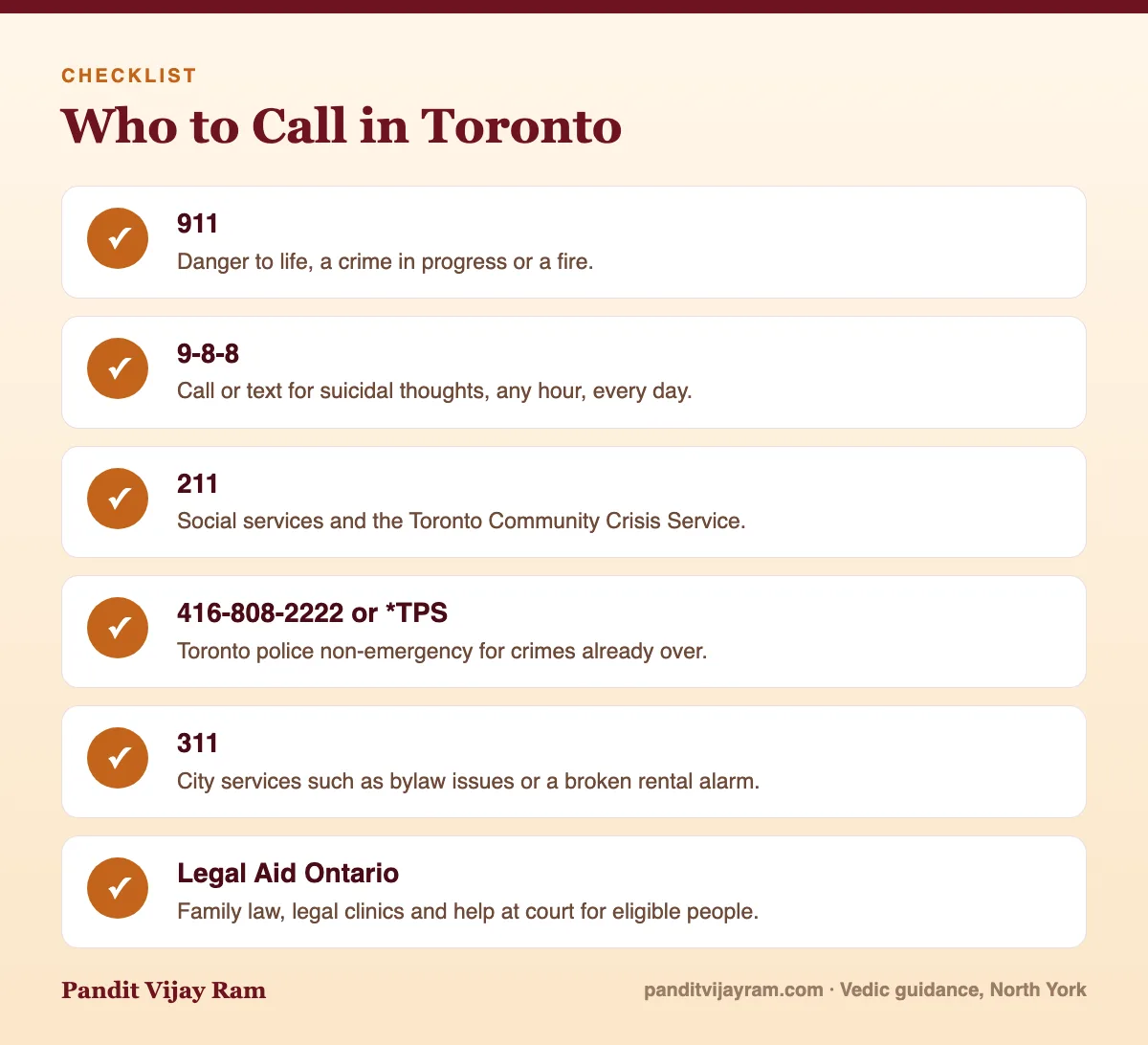
Use this simple decision rule for which number to call:
- Someone is in danger, a crime is happening or there is a fire. Call 911.
- A crime has already happened and no one is in danger. Call Toronto police non-emergency at 416-808-2222, or *TPS (*877) from a mobile phone.
- A City service problem, such as a broken alarm in a rental or noise. Call 311.
- You need a social service but do not know which one. Call 211.
- A legal question about family, housing or income. Contact Legal Aid Ontario, which explains eligibility and can refer you to a community legal clinic.
Legal Aid Ontario says its phone line offers help in many languages. For a fuller explanation of family law options, read legal aid for family matters in the GTA. Our family problem solution page explains the spiritual support that can sit alongside a lawyer's advice.
How does spiritual care fit alongside Toronto's support services?
Spiritual care adds meaning, calm and a sense of being held, while services provide safety, treatment, money and legal protection. Use both in the right order. Once practical help is underway, a daily prayer, a family puja or a chart reading can steady the household and help people take the next step.
I think of support in three layers. The first is safety and health: emergency lines, doctors, shelters. The second is practical: settlement help, counselling, legal aid, income support. The third is meaning: prayer, community and a sense that this hard season has a shape and an end.
Spiritual care belongs in the third layer. It cannot replace the first two, but it can make them easier to accept. A father who will not see a counsellor may agree to a family Hanuman Chalisa on Tuesday evenings, and in that quieter atmosphere he may finally pick up the phone.
What a consultation with me looks like for a Toronto family:
- We talk first about what help is already in place, and I suggest services if something is missing.
- I look at the relevant charts for timing and tendencies, never verdicts.
- I suggest a small daily practice the whole family can share, such as those in our guide to family peace prayers.
Vijay Ram ji meets people in person in North York and speaks with families across the city by phone, video or WhatsApp. The astrologer in Toronto page explains how to arrange this, and family support in North York lists services further north.
The bottom line
Family support services Toronto residents can use cover every layer of need: 211 and Settlement.Org for finding help, COSTI for newcomer support, 9-8-8 and the Toronto Community Crisis Service for mental-health crises, Family Service Toronto for counselling and abuse, and Legal Aid Ontario for family law. Knowing when to call 911, police non-emergency, 311 or 211 saves time in a hard moment. Spiritual care is most helpful once that practical support is in place.
Key takeaways
- 211 connects Toronto residents to social services and to the Toronto Community Crisis Service.
- Call or text 9-8-8 for suicidal thoughts; call 911 if life is in immediate danger.
- COSTI Immigrant Services and Settlement.Org help newcomers with work, housing, language and family services.
- Family Service Toronto offers counselling and intimate partner abuse programmes.
- Legal Aid Ontario and Toronto police non-emergency handle legal and non-urgent police matters.