
Should You Get Back With a Toxic Ex? A Clear Checklist

Missing someone is not the same as being good together, and the heart rarely makes that distinction on its own. If you are asking should I get back with my ex, you may be torn between real affection and a quiet voice reminding you how bad things became. Many people in North York who sit with me carry exactly this split: they love the person, yet they remember lying awake, anxious, editing every sentence before they spoke. This article gives you a structured way to think it through. It defines what toxic means in plain terms, sets out the signs that a second chance is reasonable, marks the lines where reconciliation becomes unsafe, explains why we are pulled back to people who hurt us, and shows where counselling and a reading can help. Over four decades of guiding families, I have learned that most people already know the answer somewhere inside; what they need is permission to trust it. Whatever the checklist shows, the decision belongs to you, and it is worth making slowly and with support.
What makes an ex toxic rather than just difficult?
A difficult ex might be moody, disorganised or poor at communicating, yet you still felt safe and respected. A toxic ex is one whose behaviour repeatedly left you smaller: constant criticism, contempt, lying, jealousy used as control, or making you doubt your own memory. The difference is a pattern of harm, not the presence of flaws.
Everyone brings flaws into a relationship. Someone can be stubborn, forgetful about birthdays or terrible with money without being toxic. The word is useful only when it describes a pattern that wears down the other person.
Ask yourself which of these were true for most of the relationship, not just at the end:
- You felt anxious before ordinary conversations, planning how to avoid setting them off.
- Your friends and family slowly disappeared from your life, often because your ex disliked them.
- Apologies came with conditions, such as "I am sorry you made me angry".
- Your memory was disputed so often that you began to doubt yourself.
- Your phone, money or movements were checked.
- Kindness arrived in bursts after hurtful episodes, then faded again.
If several of these apply, the problem was not simply incompatibility. Our guide to toxic relationship signs goes through each pattern with examples. A difficult ex can sometimes grow into a good partner. A toxic dynamic usually needs one person to do deep, sustained work, often with professional help, before trust is even possible.
It also helps to look at your own behaviour honestly. Toxic patterns can run both ways. If you recognise yourself in the list, that recognition is valuable whether or not you reunite.

When is getting back with an ex a good idea?
Getting back together can work when the breakup was driven by circumstances such as distance, timing, family stress or immaturity, and when both people have since changed in ways you can see. It also requires mutual respect, physical and emotional safety, and agreement about what will be different. Both of you must choose it freely.
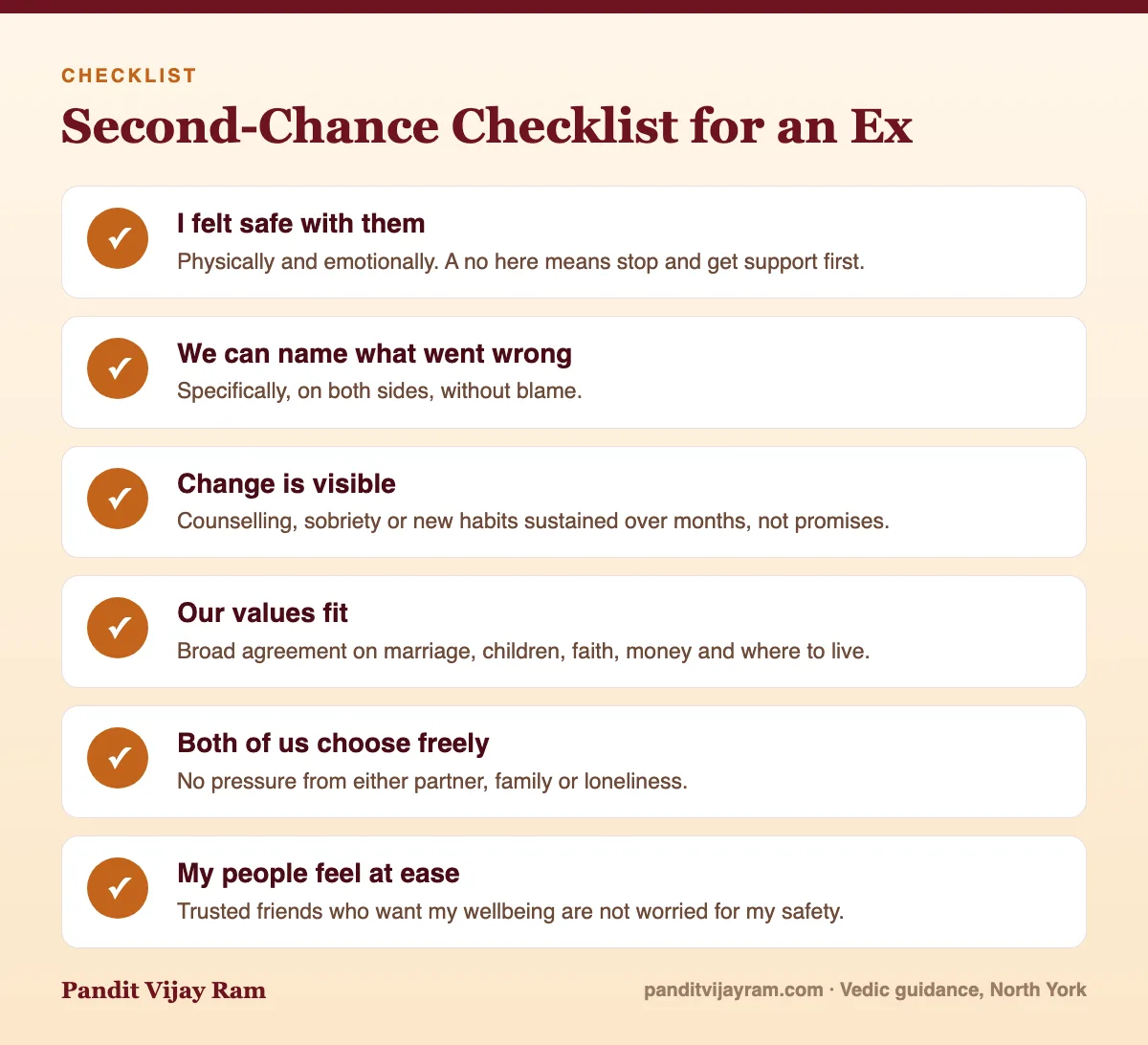
Use this second-chance checklist. Answer each question with a plain yes or no, and be strict with yourself:
- Did I feel safe with this person, physically and emotionally, during the relationship?
- Can we both name, specifically, what went wrong?
- Has my ex taken visible action on their part, such as counselling, sobriety or new habits, rather than only promising?
- Have I changed what I contributed?
- Do we broadly agree on the big questions: marriage, children, faith, money, where to live?
- Do the people who love me, and who are not simply anti-breakup or anti-marriage, feel comfortable with this?
- Am I choosing this from hope, not from loneliness, guilt or pressure?
- Is my ex choosing it freely, without me pushing?
Decision rule: a single no on question 1 means stop and get support before going further. Two or more other no answers suggest waiting and working on yourself. Mostly yes answers mean a careful, slow reconnection may be reasonable.
If the checklist looks hopeful, our pillar guide on how to get your ex back sets out a respectful step-by-step approach. Go slowly. A reunion built on months of small, steady proof is far stronger than one sparked by a single emotional evening.
When is reconciling with an ex unsafe?
Reconciliation is unsafe when the relationship involved physical violence, sexual pressure, threats, stalking, control of money or documents, or threats about children or immigration status. These patterns tend to return and often escalate after a reunion. In these situations the priority is a safety plan and specialist support, not a second chance.
Some red lines are not negotiable, however sincere an apology sounds. Please treat these as reasons to step back and get help:
- Any hitting, choking, pushing or restraining, even once.
- Forcing or pressuring you sexually.
- Threats to hurt you, themselves, your family or a pet if you leave.
- Tracking your phone, reading your messages or turning up uninvited.
- Taking your income, passport or other documents.
- Threats linked to sponsorship, status or custody.
These behaviours are often described as coercive control: a pattern of domination rather than a series of arguments. Our article on controlling partner signs explains it in detail.
Families sometimes push for reconciliation because separation feels shameful or because the ex has been charming to them. Their intentions may be good, but they are not the ones living with the risk. You are allowed to say no to them.
If you are afraid, call 911 in an emergency. Our guide to domestic violence help in the GTA lists shelters, helplines and how to make a safety plan. The period around leaving or returning can be especially dangerous, so plan with a trained worker if you can.
I will not suggest any remedy to reunite someone with a partner who has abused them. Prayer in that situation is for your strength and protection.
Why do I keep wanting to go back to a toxic ex?
People return to harmful exes for understandable reasons: the bond formed through highs and lows, loneliness, shared history, family or community pressure, money, and hope that the good version will stay. Wanting to go back does not mean you are foolish. It means the pull is strong, and that you deserve support while resisting it.
The pull towards a harmful ex can feel almost physical. It usually has several sources at once.
Intermittent warmth. When affection comes unpredictably, after cold or cruel periods, the relief of the good moments feels intense. Over time the brain links that person with comfort, even though they also caused the pain. This is part of what is called a trauma bond, which our guide on the on-and-off relationship cycle explores further.
Loneliness and identity. After a long relationship, your routines, friends and plans may all have centred on them. Leaving can feel like losing yourself.
Family and community. In many South Asian, Caribbean and Latino households, a breakup can bring gossip or questions about marriage prospects. Some people go back simply to stop the questions.
Practical ties. Shared rent, a car loan, a sponsorship application or children can make separation feel impossible.
Hope. You saw who they could be, and you want that person back.
Write down the three worst moments of the relationship and keep the list where you can see it. When longing peaks, read it. Talk to a counsellor, ideally one who understands your culture; our page on mental health support for South Asian families is a good starting point. If low mood becomes persistent, see your family doctor.
Can counselling or an astrology reading help me decide about my ex?
Individual counselling is usually the best first step, because it helps you see the relationship clearly without your ex in the room. Couples counselling suits relationships without abuse. A Vedic reading can offer timing context and self-understanding, but it cannot judge your ex's character or tell you whether you will be safe.
A good counsellor will not tell you what to do. They will help you notice patterns you have been too close to see, and help you trust your own judgement again. Look for a registered psychotherapist or social worker; your family doctor or workplace assistance programme can help you find one.
Couples counselling can help two people who both want to repair a relationship with ordinary problems. It is generally not recommended where one partner has been abusive, because the sessions can become another place for control.
Where does astrology fit? In a reading I may look at:
- The seventh house and Venus for how you tend to approach partnership.
- The Moon for emotional patterns, such as a tendency to cling or to withdraw.
- Current dashas for whether this is a season of endings or of rebuilding.
These are tendencies, never verdicts. No chart can tell you that a person who hurt you has changed. Be wary of anyone who claims a planet makes a reunion destined, or sells you an expensive ritual to fix your ex.
Through a get ex love back consultation I help people weigh a reunion honestly, with prayer for clarity rather than for any outcome. For a broader decision guide that also applies within marriage, see whether a relationship is worth saving.
The bottom line
Answering should I get back with my ex means weighing evidence rather than longing. A second chance is reasonable when you felt safe, both people have shown real change and you share broad direction. Violence, threats, stalking and coercive control are red lines that call for a safety plan, not a reunion. Counselling helps you decide clearly, and a reading can add context, but the choice remains yours.
Key takeaways
- A difficult ex has flaws; a toxic ex shows a repeated pattern of harm.
- Safety is the first question, and a no on safety ends the checklist.
- Visible change matters more than promises or emotional apologies.
- The pull back to a harmful ex is real and deserves support, not shame.
- Charts show tendencies; they cannot certify that someone has changed.