
Hindu Weddings in the GTA: Keeping the Rituals Meaningful
Couples planning GTA Hindu wedding rituals juggle more than the guest list. One family is Gujarati, the other Tamil. A grandmother wants the full ceremony, the couple has a three-hour banquet hall slot, and the venue has questions about an open fire under its sprinkler system. Families in North York, Mississauga and Markham sit with me in exactly this place, wondering how much can be kept, what can be adapted and what it all really means. In over forty years of Vedic practice, I have seen that the rituals stay powerful when the couple understands them, even if the ceremony is shorter than it would be in India. This article explains the core rites and their meaning, what the seven vows of saptapadi say, how kanyadaan is understood today, a practical way to blend two families' customs, what venues usually ask about the havan kund, and how to help guests follow along.
What are the main rituals in a Hindu wedding ceremony?
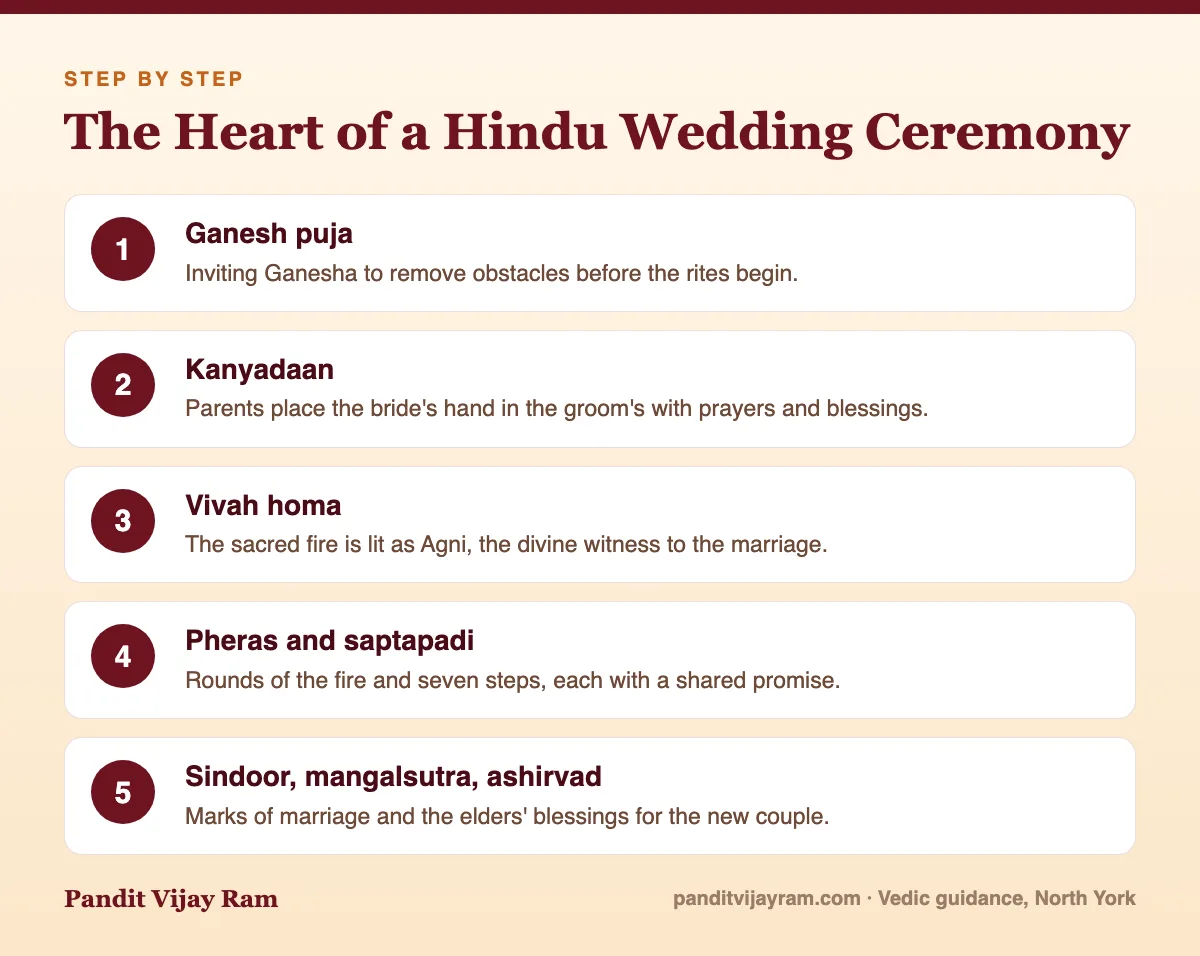
Most Hindu weddings include Ganesh puja to remove obstacles, the exchange of garlands, kanyadaan, the vivah homa or sacred fire, panigrahana or the joining of hands, the pheras or saptapadi around or beside the fire, sindoor and mangalsutra, and the elders' blessings. Order and names vary by region.
Underneath the regional variety sits a shared structure. Knowing it helps you decide what is essential and where flexibility exists.
- Ganesh puja: the ceremony begins by inviting Ganesha to remove obstacles.
- Var mala or jaimala: the couple exchange garlands, accepting each other publicly.
- Kanyadaan: the bride's parents place her hand in the groom's, with prayers for the new household.
- Vivah homa: the sacred fire is lit. Agni is the witness to the marriage, which is why the fire is so central.
- Panigrahana: the groom takes the bride's hand as a pledge of partnership.
- Pheras and saptapadi: circling the fire, taking seven steps together, or both, depending on tradition.
- Sindoor and mangalsutra: marks of the married state in many communities.
- Ashirvad: blessings from elders and guests.
Before and around the ceremony, many families add haldi, mehndi, sangeet, a protective tika for the couple and vidaai. These customs carry deep feeling, but the fire, the joining of hands and saptapadi form the legal and spiritual heart in most traditions. For blessing customs that protect the couple from envy, see our article on nazar at weddings.

What do the seven vows of saptapadi mean?
Saptapadi means seven steps. With each step the couple make a promise, commonly explained as nourishment, strength, prosperity, happiness and family harmony, children, health through every season, and lifelong friendship. After the seventh step, many traditions consider the marriage complete. Wording differs between priests and regions.
The seven steps are one of the most beautiful moments in any Hindu wedding, and also one of the easiest to rush. A common modern explanation runs like this:
- Food and nourishment. We will provide for and care for each other.
- Strength. We will grow strong in body, mind and spirit together.
- Prosperity. We will earn honestly and share our wealth.
- Happiness and family. We will build harmony with each other's families.
- Children. We will raise any children we are blessed with in love and dharma.
- Seasons and health. We will stand by each other through every season of life.
- Friendship. We will be true companions for life.
Different priests use different verses, and some traditions emphasise particular promises. Ask yours to explain the version they will use so the couple can say each vow with meaning.
A practical tip from many GTA ceremonies: ask the priest to pause briefly after each step so a family member can read the English meaning aloud. Guests suddenly understand what they are witnessing. Couples who are still at the compatibility stage may find our guide to kundli matching for love marriage helpful before reaching the mandap.
What is the meaning of kanyadaan, and do couples still include it?
Kanyadaan is the rite in which the bride's parents place her hand in the groom's, entrusting her to the new household with prayers and blessings. Many GTA families keep it as a moment of deep parental love, while some adapt the wording or include both sets of parents. Discuss it openly beforehand.
Kanyadaan often brings tears, especially to the bride's father. In the traditional understanding it is described as the greatest gift a parent can give, offered with water, flowers and the hope that the daughter's new life will be full of dharma and happiness.
Some couples raised in Canada feel uneasy with the language of giving a daughter away. That conversation deserves respect on both sides. Common approaches include:
- Keeping the rite as it is, while the priest explains it as blessing rather than transfer.
- Inviting both sets of parents to place their hands together over the couple's joined hands.
- Adding a few words in English about welcoming each other into both families.
Whatever you choose, agree it with parents before the day, not at the mandap. Surprises during the ceremony hurt feelings that take years to mend.
When families from different backgrounds or faiths are joining, these conversations can be harder. Our article on interfaith marriage and family disapproval offers gentle ways to approach them, and Vijay Ram ji's love marriage guidance is available for couples who want support with both families.
How do you blend wedding traditions from two families?
List the rites each family considers essential, agree which shared core will lead the ceremony, then place regional customs into pre-wedding events or short add-ons. Choose a priest comfortable with blending, and let both mothers or elders review the final order. Agreement beforehand matters more than length.
The GTA brings together Punjabi, Gujarati, Marathi, Bengali, Tamil, Telugu, Malayali, Indo-Caribbean and many other families, and mixed weddings are now common. A simple process keeps everyone heard:
- Each side writes its must-haves. Ask elders for the three or four steps they could not imagine leaving out.
- Find the shared core. Ganesh puja, the fire, kanyadaan, the joining of hands and saptapadi usually appear on both lists.
- Move regional customs to other events. Haldi, mehndi, a South Indian kashi yatra, a Gujarati mameru or an Indo-Caribbean matikor can each have their own moment before the wedding day.
- Pick one priest to lead, and ask whether a second priest from the other tradition can perform one rite.
- Share the final order in writing with both families at least a couple of weeks ahead.
Tension often has little to do with ritual and much to do with feeling respected. Naming each family's customs aloud during the ceremony goes a long way. Finding a priest who can do this well is covered in our guide to finding a pandit in the GTA.
Are havan kunds allowed at GTA wedding venues?
Many GTA banquet halls and hotels host Hindu weddings with a small havan kund, but each venue sets its own conditions. Some require advance approval, a particular kund size, limits on ghee and samagri, or other arrangements with fire safety staff. Ask the venue's events team in writing early in planning.
A wedding fire inside a hall is a real open flame under ceilings full of detectors and fabric. Venues are right to ask questions, and their requirements may involve your priest, the decorator and sometimes the local fire service.
Questions to put to the venue:
- Do you allow an open-flame havan, and what approvals are needed?
- Are there limits on kund size, fuel, ghee or samagri?
- Where may the mandap stand relative to detectors, sprinklers and exits?
- Do you require a fire extinguisher at the mandap, and who provides it?
- Is there a policy for outdoor ceremonies on the property?
Practical safety on the day:
- A metal kund on a tray or bricks with a sand layer, never directly on carpet or the stage.
- Mandap drapes, flowers and the bride's dupatta kept well clear of the fire.
- Dry wood and modest offerings, so the flame stays small and the smoke light.
- An adult assigned to watch the kund from lighting until it is out.
For timing, which the venue will also need, see our article on wedding muhurat in Canada.
The bottom line
GTA Hindu wedding rituals stay meaningful when the couple understands the core rites, especially the sacred fire, kanyadaan and saptapadi. Agree how to blend both families' customs before the day, help guests follow each step, and confirm the venue's havan kund rules early. A shorter ceremony done with understanding carries more weight than a long one no one follows.
Key takeaways
- The fire, the joining of hands and saptapadi form the heart of most Hindu weddings.
- Ask the priest to explain the seven vows so the couple say them with meaning.
- Agree on kanyadaan and other sensitive rites with parents well before the day.
- Blend families by finding the shared core and moving regional customs to other events.
- Each venue sets its own havan kund rules, so ask early and in writing.