
How to Apologise to an Ex Sincerely

Regret can sit in the chest for months after a relationship ends, especially when you know you hurt someone you cared about. Learning how to apologise to an ex properly is one of the most decent things you can do with that regret, whether or not the relationship ever resumes. Clients in North York and the wider GTA often ask me to help them find the words, and the first thing we usually discover is that the apology they drafted is really a request in disguise. This guide separates the two. It explains the elements that make an apology genuine, how to say sorry without hoping for a reunion, which format suits your situation, what to leave out, and how to make amends when words alone fall short. There is also a step-by-step method for writing the apology itself. Across forty years and more of guiding people through endings, I have found that a clean apology frees the person who gives it as much as the person who receives it. It is an act of dharma, done because it is right, with the result left in other hands.
What makes an apology to an ex genuine?
A genuine apology has four parts: a clear statement of what you did, recognition of how it affected the other person, responsibility without excuses or blame, and a description of what you are changing. It is short, specific and focused on them. Anything that shifts attention back to your pain or your wish to reunite weakens it.
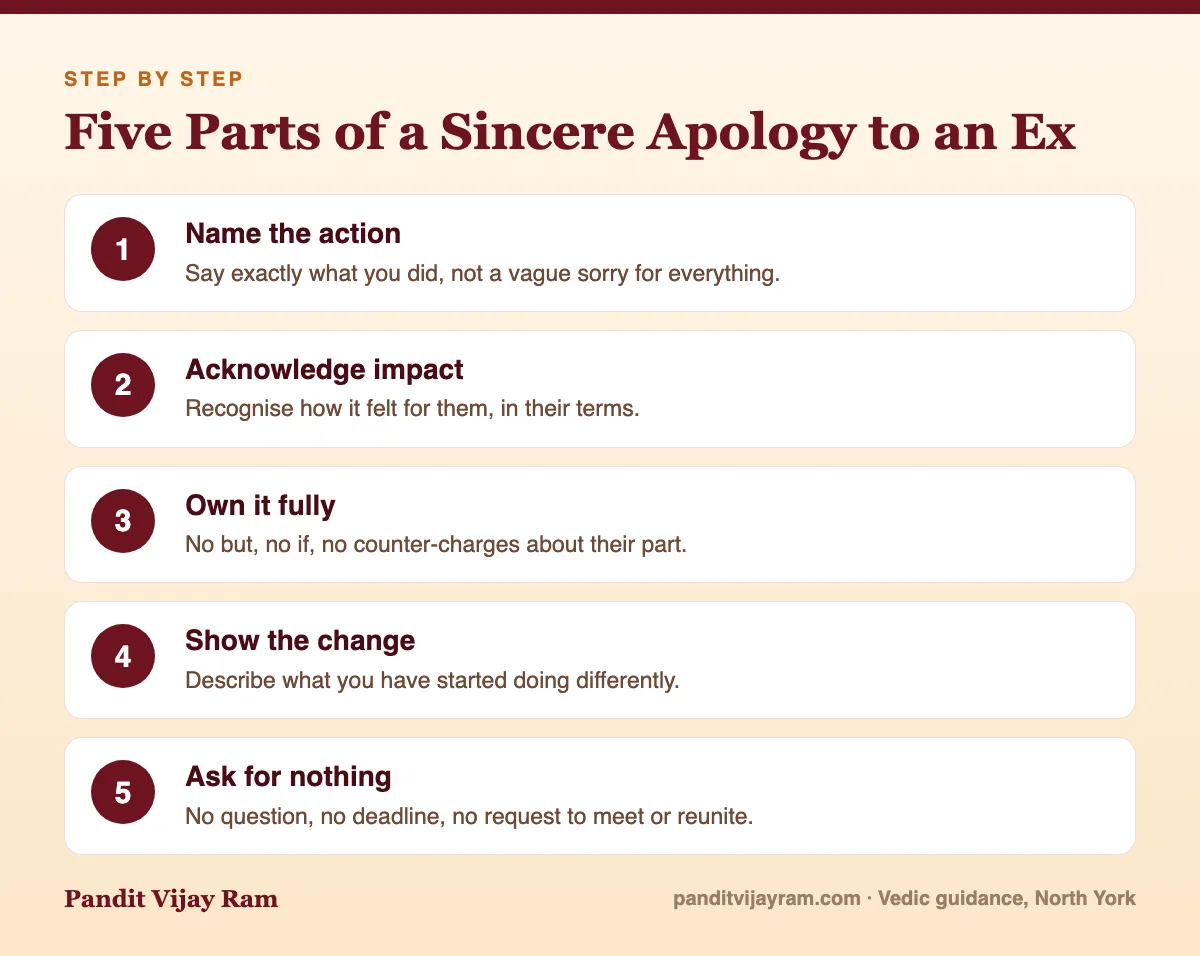
People often recognise a fake apology instantly but struggle to write a real one. It helps to break it into parts.
- Name the action. "I read your messages without asking" is an apology. "I am sorry for everything" is too vague to mean much.
- Acknowledge the impact. "That told you I did not trust you, and it must have felt like a violation of your privacy."
- Own it fully. No "but", no "I was stressed", no "you also". Context can come later, if they ask.
- Describe the change. "I have started counselling about my jealousy" shows more than "it will never happen again".
- Release them. "You do not need to reply. I wanted you to hear this from me."
Notice what is missing: any request. A genuine apology does not ask to meet, does not ask whether there is still a chance and does not ask to be forgiven. Those questions put the hurt person to work managing your feelings.
If your wrong was infidelity, the apology needs extra care, including honesty about sexual health where relevant. Our guide on seeking an ex back after you cheated covers that situation. If it was words said in a heated moment, see getting back together after a big fight for the anger side of repair.

How do you say sorry to an ex without expecting to get back together?
Check your motive before you send anything. If you would still apologise knowing for certain the relationship is over, you are ready. Write the apology as a complete message in itself, with no question at the end, and decide in advance that their silence is an acceptable answer. The aim is truth, not reunion.
Most of us want two things at once: to make things right and to be loved again. Both are human. The trouble is that when the second wish leaks into the apology, the other person can feel it, and the apology becomes another form of pressure.
Try this honest motive test before you write:
- Would I still send this if they were engaged to someone else? If not, it is a reunion request.
- Am I hoping this message makes them miss me? If yes, wait.
- Will I feel resentful if they do not respond? If yes, you are not finished grieving.
- Is this for them, or mainly for my guilt? Both can be true, but they should come first.
It can help to make a quiet resolution beforehand, perhaps before a lamp at home: "I offer this apology and I let go of the result." The Bhagavad Gita teaches action without attachment to its fruit, and an apology is a very practical place to practise that teaching.
If you later wish to explore reconciliation, that is a separate conversation, and only if they open the door. Our pillar guide on how to get your ex back explains what that respectful process looks like. Keep the two steps apart, with real time between them.
Should you apologise to an ex by text, letter or in person?
A written message or letter usually works best, because the other person can read it privately, take their time and choose whether to reply. In-person apologies suit situations where you are still in regular, friendly contact. Never apologise through mutual friends or family unless your ex has asked for that, and never contact someone who has blocked you.
The right format depends on your current contact and their wishes. A simple guide:
- Text or private message. Good for a short apology when you are still on speaking terms. Keep it under a few short paragraphs.
- Email or handwritten letter. Best for a fuller apology after a serious hurt. It gives them control over when and how they read it.
- Phone call. Only if they have agreed to talk. A surprise call can feel like an ambush.
- In person. Suitable if you see each other anyway, for example in co-parenting, and they are comfortable. Choose a calm, neutral setting.
- Through relatives or friends. Usually unwise. It spreads private matters and can feel like pressure from all sides.
If you are blocked or asked not to make contact, do not find another route. A block is a boundary, and a new account or a message through a cousin crosses it. Our guide on what to do when your ex blocked you explains why. In that case, write the letter anyway, read it aloud to yourself or a counsellor, and keep or burn it safely as a private act of release.
Timing matters too. Avoid birthdays, festivals and anniversaries, when an apology can feel like a bid for attention. An ordinary weekday is kinder.
What should you never say when apologising to an ex?
Avoid conditional phrases such as sorry if you were hurt, any sentence containing but, blaming stress or alcohol, comparing your faults with theirs, and declarations that you cannot live without them. Leave out gifts, guilt and deadlines. These turn an apology into a negotiation and often reopen the wound you are trying to acknowledge.
Certain phrases undo an apology even when the rest is heartfelt. Watch for these:
- "I am sorry if..." The word if suggests the hurt might not be real.
- "I am sorry, but..." Everything after but cancels what came before.
- "You know I was going through a lot." Context is not responsibility.
- "We both made mistakes." Possibly true, but not yours to say in your apology.
- "I cannot live without you." This places a heavy burden on them and can sound frightening.
- "I have changed, so you should give me another chance." Change does not create an obligation.
- "Please reply by Friday." Deadlines are pressure.
Also leave out flowers, gifts, long poems and public posts. Grand gestures shift focus to you and can embarrass the other person in front of friends or family. Our article on what to say to your ex has more wording guidance for later conversations.
If you find yourself thinking of harming yourself because the relationship is over, please do not put that in a message to your ex. Call or text 988, Canada's Suicide Crisis Helpline, and tell someone close to you. You deserve support that does not depend on their response.
How do you make amends when an apology is not enough?
Making amends means repairing practical harm where you can: repaying money, returning belongings, correcting lies you told about them, and changing the behaviour that caused the hurt. Where direct repair is impossible or unwelcome, living amends, meaning becoming a person who would not repeat the harm, is the honest path. Prayer can support that inner work.
Some harm is concrete. If you owe your ex money, repay it on clear terms. If you kept their belongings, return them without conditions, ideally through a neutral route they agree to. If you spoke badly about them to friends or family, correct the record with those people, even if it is uncomfortable.
Other harm cannot be undone with a transfer or a parcel. In those cases, amends become a way of living. You stop the behaviour, get help for its roots and treat the next person you love better. That counts, even if your ex never sees it.
Vedic tradition speaks of prayashchitta, often translated as atonement or expiation. In its healthy form it is not a payment to cancel guilt. It is sincere reflection, a resolve not to repeat the wrong, and acts of service or charity offered with humility. Some people take a short vow, such as a weekly fast on a day linked to their chosen deity, alongside counselling. If you fast, keep it gentle and check with your doctor if you have a health condition.
Forgiveness is a separate matter, and it belongs to the person you hurt. Our guide on forgiving an ex looks at it from the other side. If you would like help reflecting on your chart and choosing a prayer practice for this season, a get ex love back consultation can focus entirely on your own repair, without any attempt to influence your ex.
The bottom line
Knowing how to apologise to an ex sincerely comes down to three things. Name what you did and its impact without excuses, describe real change, and ask for nothing in return. Choose a format that leaves them in control, and respect any request for no contact by keeping your apology private. Where words are not enough, practical amends and steady personal change complete the repair.
Key takeaways
- A real apology is specific, owns the impact and contains no excuses.
- If an apology ends with a question, it has become a request.
- Written messages usually give the other person the most control.
- A block or no-contact request means the apology stays private.
- Amends include repaying, returning, correcting and changing behaviour.