
Getting an Ex Back After a Long-Distance Breakup

A long-distance relationship can end in a strange, quiet way. There may be no single fight, just missed calls across time zones, a visa that never came, a visit cancelled once too often, and one tired conversation where you both admit it is too hard. Afterward, many people wonder whether they gave up on love or simply on geography. If you are hoping to get your ex back long distance, from Toronto to Vancouver, Delhi, London or Port of Spain, this guide is for you. Clients in North York and across the GTA often bring me this question, especially families with roots in two countries. Below, we look at why long-distance relationships end, how to tell whether the distance was the real problem, what has to change before trying again, how to reach out across time zones, and what the Vedic chart may show about distance and separation. In more than forty years of practice, I have seen long-distance couples reunite well, but only when they replaced hope with a plan.
Why do long-distance relationships end?
Long-distance relationships commonly end because there is no clear end date to the distance, communication becomes tiring, time zones or work make contact hard, immigration or money block visits, families object, or partners slowly grow apart. Understanding which of these ended yours is the first step in deciding whether reconnecting makes sense.
The earlier guide on long-distance relationship problems looks at keeping a relationship strong while it is still going. This section looks back at why one has ended.
Common reasons long-distance couples break up:
- No end date. Without a plan to live in the same place, hope runs out.
- Communication fatigue. Daily calls start to feel like a duty rather than a joy.
- Time zones and schedules. One person is always tired, rushed or waking up.
- Immigration delays. Visa refusals, long processing times or uncertainty about status.
- Money. Flights and long-distance phone plans add up.
- Family pressure. Relatives on either side push for a local match or question the future.
- Growing apart. Separate daily lives slowly shape separate values and friendships.
- Jealousy and trust. Without shared daily life, small doubts can grow.
Write down which of these applied to you, honestly. Then ask: was the distance the cause, or did it simply make other problems harder to ignore? A couple who loved each other but could not solve geography is in a different position from a couple who used distance as a gentle way to end a relationship that was already struggling.

Can you get back together after a long-distance breakup?
Yes, many couples reconnect after a long-distance breakup, especially when the obstacle was practical rather than emotional. A job change, a visa approval, graduation or a family move can make a second try realistic. If the breakup came from fading feelings or trust problems, solving the distance alone will not be enough.
Long-distance breakups are unusual because the love may still be intact. Sometimes both people ended things not because they wanted to, but because they could not see a way forward. When circumstances shift, that way can open.
Situations where reconnection often makes sense:
- one of you has finished studies, a contract or a posting abroad;
- immigration status has changed, or a sponsorship is now possible;
- a job, transfer or remote work now lets one person relocate;
- family circumstances, such as caring for a parent, have changed.
Situations where reconnection is less likely to work:
- one person has lost interest and the distance was a polite reason;
- there were repeated trust problems or betrayals;
- neither person is genuinely willing to move;
- your ex has a new partner or has asked you not to contact them.
If your ex moved abroad and you are still here in Canada, the companion guide on when your ex moves abroad covers that situation specifically. If your relationship was with someone still living in India, see the guide to a relationship with someone in India, which addresses family, visas and cultural expectations.
What has to change before trying long distance again?
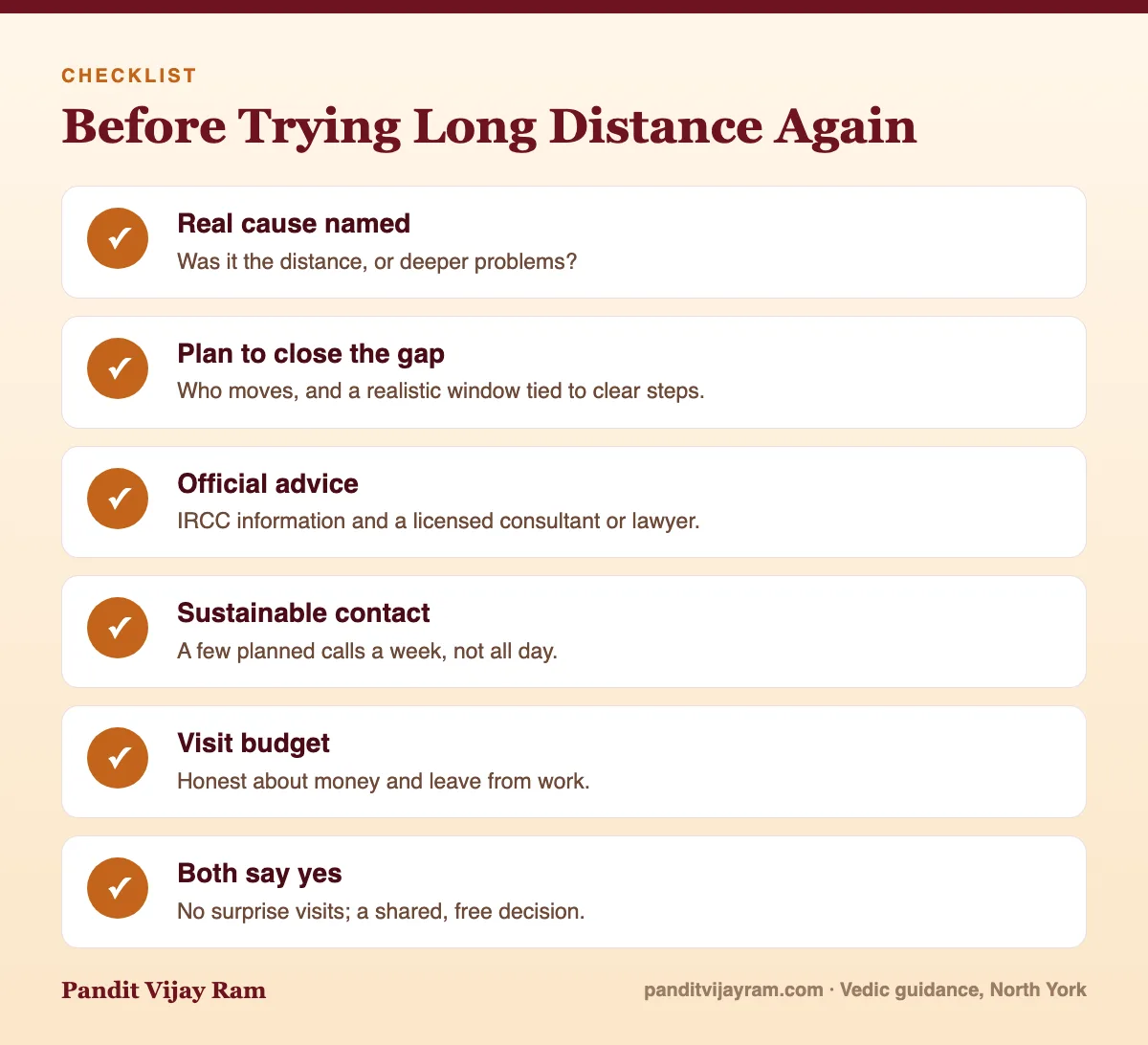
Before trying again, you need a concrete plan for closing the distance, including who might move, roughly when, and what immigration or work steps are involved. You also need a communication rhythm both can sustain, a realistic visit budget, and honest agreement about what went wrong last time. Hope without a plan rarely survives a second round.
Use this decision rule: if you cannot answer most of the questions below together, wait.
- Who will move, and is that person genuinely willing? Consider jobs, family duties and community ties on both sides.
- Roughly when? Not a fixed date, but a realistic window tied to steps you can name, such as finishing a degree.
- What immigration steps apply? Rules change, so check official information from Immigration, Refugees and Citizenship Canada, and speak with a licensed immigration consultant or lawyer. Do not rely on rumours or social media.
- How often will you talk, and how? Agree on a rhythm, such as a few planned calls a week, that does not feel like a chore.
- How often can you visit? Be honest about money and leave from work.
- What went wrong last time? Name it and agree on what you will each do differently.
- What do your families think? If they objected before, how will you handle it now?
It can help to put the plan in writing, even as a shared note. Review it every few months together. Plans change, and that is fine, but having one means you are both working toward the same future.
If either of you is worried about immigration or legal matters, get proper advice. No astrologer, Vijay Ram ji included, can predict a visa decision.
How do you reach out to an ex who lives far away?
Send a short message at a reasonable hour in their time zone, keep it warm and pressure-free, and let them choose whether to reply. If they respond positively, suggest a video call. Never travel to their city unannounced to surprise them; it can feel like pressure and puts them in a difficult position.
Distance adds a few extra considerations when reaching out:
- Check the time difference. A message that arrives at three in the morning can feel urgent or worrying.
- Use the platform you both used to use, unless they have blocked you or asked you to stop. Do not switch to a new app to get around a block.
- Keep it light. Hi, I have been thinking about you and hope life over there is treating you well. I would be glad to catch up sometime if you are open to it.
- Respect their new routines. They may have a different job, friends or schedule now.
If they reply warmly, a video call is the natural next step. Long-distance couples often feel closer through video than through text, and it lets you both read each other's faces and tone.
One firm rule: do not fly to see them unannounced. A surprise visit might feel romantic to you, but it can corner someone who has not chosen to see you, and it can be frightening if the breakup was difficult. Any visit should be discussed and agreed in advance.
For broader advice on wording and what to avoid, the guide on what to say to your ex is a good companion.
When should you let go of a long-distance ex?
Let go if your ex has said clearly they do not want to try again, has a new partner, or if neither of you is willing to move. Also step back if the relationship involved control, threats or repeated dishonesty. Respecting their answer is painful, but it frees both of you to build lives where you are.
Some long-distance relationships end because the love was real but the circumstances were not. Others end because, deep down, one person was ready to leave. If your ex is the second kind, no plan will bring them back.
Signs it is time to let go:
- they have told you clearly, more than once, that they do not want to reconcile;
- they have started a new relationship;
- they are unwilling to discuss any plan to close the distance;
- they have blocked you or asked you not to contact them;
- the relationship involved monitoring, threats or control, even from far away.
Control can cross borders. Demands to share your location, constant checking-up calls or threats to tell your family things can all be part of an abusive relationship. If any of this applies, the GTA guide to domestic violence help lists support services.
Letting go is grief, and long-distance grief has its own shape. You may not have the usual reminders, such as a shared café or a neighbourhood, but you may have years of messages and call logs. Archiving them can help. Lean on local friends, keep your routines, and see your family doctor if low mood lasts. You can also call or text 9-8-8 any time you feel overwhelmed.
What does Vedic astrology say about distance in relationships?
In Vedic astrology, the twelfth house relates to foreign lands, expenses and separation, the ninth house to long journeys, and Rahu is often linked with foreign connections. A chart can show whether distance is a recurring theme in your life. It describes tendencies, not fate, and cannot decide whether your ex returns.
When a client describes a long-distance relationship, Vijay Ram ji often looks at:
- The seventh house and its lord, for partnership. If the seventh lord sits in the twelfth house, some astrologers read a link between partnership and foreign places or distance.
- The twelfth house, associated with foreign lands, retreats and separation.
- The ninth house, linked with long journeys, higher learning and fortune.
- The fourth house, for home, mother and settledness.
- Rahu, often linked with foreign cultures and unconventional paths.
- Current dashas for both people, which can show periods that favour travel or relocation.
These factors can help explain why distance keeps appearing in your story, and they can suggest periods better suited to big moves. They do not override the practical steps, the immigration rules or, above all, either person's choice.
Couples who reconnect across distance sometimes keep a shared prayer: lighting a lamp at the same moment in their different time zones, or reciting the same mantra on a chosen weekday. It can be a sweet ritual of togetherness, offered by two people who both want it.
The get ex love back consultation combines this chart insight with practical counselling. Toronto-area readers can also see the Toronto ex-back page for local session details.
The bottom line
Getting your ex back long distance depends on whether the obstacle was geography or the relationship itself. If both of you still want to try, build a concrete plan for closing the gap, a communication rhythm you can sustain and an honest account of what went wrong. Reach out gently and respect their answer, and treat any chart insight as guidance on tendencies rather than a promise.
Key takeaways
- Work out whether the distance itself or deeper problems ended the relationship.
- A second try needs a concrete plan for who moves and roughly when.
- Check official IRCC information and a licensed professional for immigration questions.
- Message at a reasonable hour in their time zone, and never visit unannounced.
- The twelfth house and Rahu describe distance themes, not certainties.