
Planning a Hindu Wedding in North York: Licences, Venues and Rituals
Every Hindu wedding North York families plan starts with joy and quickly turns into a long list. Families want the rites done properly, the paperwork done legally, and the banquet hall happy about a fire in the middle of the room. Those three goals sit in different offices and different hands, and couples often learn the order the hard way. This guide puts them in sequence. You will learn where the licence comes from, who may legally solemnise the marriage in Ontario, what to ask a venue about the havan kund, how a muhurat is fixed for Toronto, and what the main rituals actually mean. In more than forty years of guiding families, I have seen weddings go smoothly when the couple sorted the legal side first and the ritual side second, because a calm mind on the day comes from paperwork that is already finished. I am based in North York and meet couples here in person, and I speak with families elsewhere by phone or video.
Where do North York couples get a marriage licence?
The City of Toronto issues marriage licences by appointment only, at two counters: North York Civic Centre at 5100 Yonge Street and City Hall downtown. Couples complete the online application first, print and sign it, then book one appointment. Walk-ins are not served, and at least one partner must attend in person.
For most families in North York, the Civic Centre beside Mel Lastman Square is the natural choice because it sits on Line 1, a short walk from North York Centre station. The process has a fixed order, and skipping a step is the usual reason people are turned away.
- Apply online. The City form gives you an application number. Print it and sign it in ink; if you cannot print at home, both partners must come to sign.
- Book one appointment per couple. Extra bookings are cancelled.
- Bring original identification. Each partner needs two valid, government-issued pieces of ID. Photocopies, phone images and expired cards are refused, and the City lists health cards and SIN cards among those it does not accept.
- Bring divorce papers if they apply. A Canadian divorce needs the original or court-certified certificate. A divorce granted abroad needs a Foreign Divorce Authorization from the Office of the Registrar General before you book.
Timing matters. The City asks couples to apply within ninety days of the wedding, and Ontario says the licence is valid for three months from the date it is issued, anywhere in the province. So a North York licence works equally well for a ceremony in Vaughan or Mississauga. Our wider guide to getting a marriage licence anywhere in the GTA compares the other municipal counters.
Who can legally perform a Hindu wedding in Ontario?
Ontario recognises a religious marriage when it is performed by an officiant registered with the province, meaning a person recognised by their religious body as entitled to solemnise marriages. After the rites, the couple, the witnesses and the officiant sign the licence, and the marriage is then registered so a certificate can be issued.
This is the point families most often assume rather than check. A learned priest is not automatically a registered officiant. Ask the pandit or the temple directly whether they are registered in Ontario, and ask who will send the signed documents in afterwards. A good priest will answer plainly and will not be offended by the question.
Some couples choose a short civil ceremony as well, either for scheduling reasons or because a relative abroad needs a civil record quickly. The City holds civil weddings in a wedding chamber at North York Civic Centre, with a City officiant and two witnesses aged sixteen or older who attend in person. The Hindu rites can then take place on the chosen muhurat, with full meaning and no legal pressure on the day.
Either way, remember the age rule: Ontario requires both partners to be at least eighteen, with narrow exceptions that need consent or a court order. Our checklist of questions to ask a pandit in the GTA covers registration, language, length of the ceremony and how the priest handles mixed traditions.
Can a North York banquet hall allow a havan kund?
Many halls allow a small havan kund, but the decision belongs to the venue and its fire-safety obligations, not to the family or the priest. Ask in writing about the kund size, the fuel, smoke detectors near the mandap and who will stand by with an extinguisher. Outdoor fires are a separate matter under Toronto rules.
Indoor and outdoor ceremonies follow different rules, so settle early which one you are planning.
Indoors. A banquet room has detectors, sprinklers and an insurer. The hall manager may ask for a metal kund on a heat-proof tray, a limited amount of ghee and samagri, no camphor towers, and a staff member present during the fire. Some halls ask for a smokeless electric flame or a small diya instead. Agni is honoured by sincerity, not by the height of the flame.
Outdoors. Toronto says open-air burning is not permitted, which includes bonfires and fire pits. Toronto Fire Services handles requests for a fire connected with a specific cultural or religious practice through a Cultural Fire Authorization, and inspects the site before anything is approved. A garden or park ceremony with a live havan therefore needs that conversation well in advance.
Ask the hall these five things and keep the replies in an email thread:
- May we light a havan kund, and what size and fuel do you allow?
- Where may the mandap stand relative to detectors and exits?
- Will staff be present while the fire burns?
- Is there a time limit on the fire?
- What happens if a detector is triggered?
Our page on keeping Hindu wedding rituals meaningful in the GTA suggests ways to shorten the fire portion without losing its heart.
How is a wedding muhurat chosen for a North York ceremony?
A muhurat is an auspicious window calculated from the panchang, using Toronto sunrise, local time and the nakshatra, tithi and lagna in force. Because these depend on location, an Indian calendar printed for Delhi or Chennai will not give the right times here. A Toronto panchang or a priest working from local data should be used.
The calculation usually runs in layers. First the astrologer looks at both kundlis for compatibility and timing, then narrows the season, then finds days whose tithi and nakshatra are favourable for marriage, and finally picks the lagna, the rising sign, that will be in force when the key rite happens. In most families the key rite is the saptapadi or the pheras, so that is what the muhurat is built around rather than the reception.
Practical life comes in too. A beautiful window at a time when the hall is already booked is no help. I usually give couples two or three acceptable windows and let them match those against venues, travel for elders and the licence timing. Regional customs differ: some communities avoid certain months entirely, while others focus mainly on the lagna. Neither is wrong, and the family's own tradition should lead.
Detailed rules, and the reasons a Canadian date can differ from one quoted by relatives abroad, are in our guide to choosing a wedding muhurat in Canada. If one partner is manglik, read manglik and non-manglik marriage before anyone panics, and the kundli and horoscope consultation page explains how a full matching is done.
What do the main Hindu wedding rituals mean?
Most Hindu weddings share a core: Ganesh puja to clear obstacles, kanyadaan, the joining of hands, offerings into the sacred fire with Agni as witness, and the saptapadi, seven steps or circuits each carrying a vow. Many traditions treat the saptapadi as the rite that completes the marriage. Other customs vary by region and family.
Guests in North York often come from several traditions at once: Gujarati, Punjabi, Tamil, Telugu, Bengali and Indo-Caribbean families may all sit in the same hall. A short printed card or a few words from the priest before each step helps everyone follow.
- Ganesh puja. The ceremony opens by inviting Ganesha, the remover of obstacles.
- Kanyadaan. Parents place the bride's hand in the groom's. Some modern couples reword this rite; discuss it with parents early.
- Panigrahana. The joining of hands, a public promise of partnership.
- Vivah homa. Offerings into the fire; Agni is the divine witness.
- Saptapadi. Seven steps or circuits, each with a vow covering nourishment, strength, prosperity, family, children, health and lifelong friendship.
- Sindoor and mangalsutra. Common in many North Indian and South Indian weddings, with different forms.
Couples who feel watched or anxious on the day sometimes ask about protective customs; our note on nazar at weddings for the bride and groom explains them calmly. When I prepare a couple, I ask them to learn the meaning of the seven vows in their own words. That single step changes how the ceremony feels.
What order should North York couples plan things in?
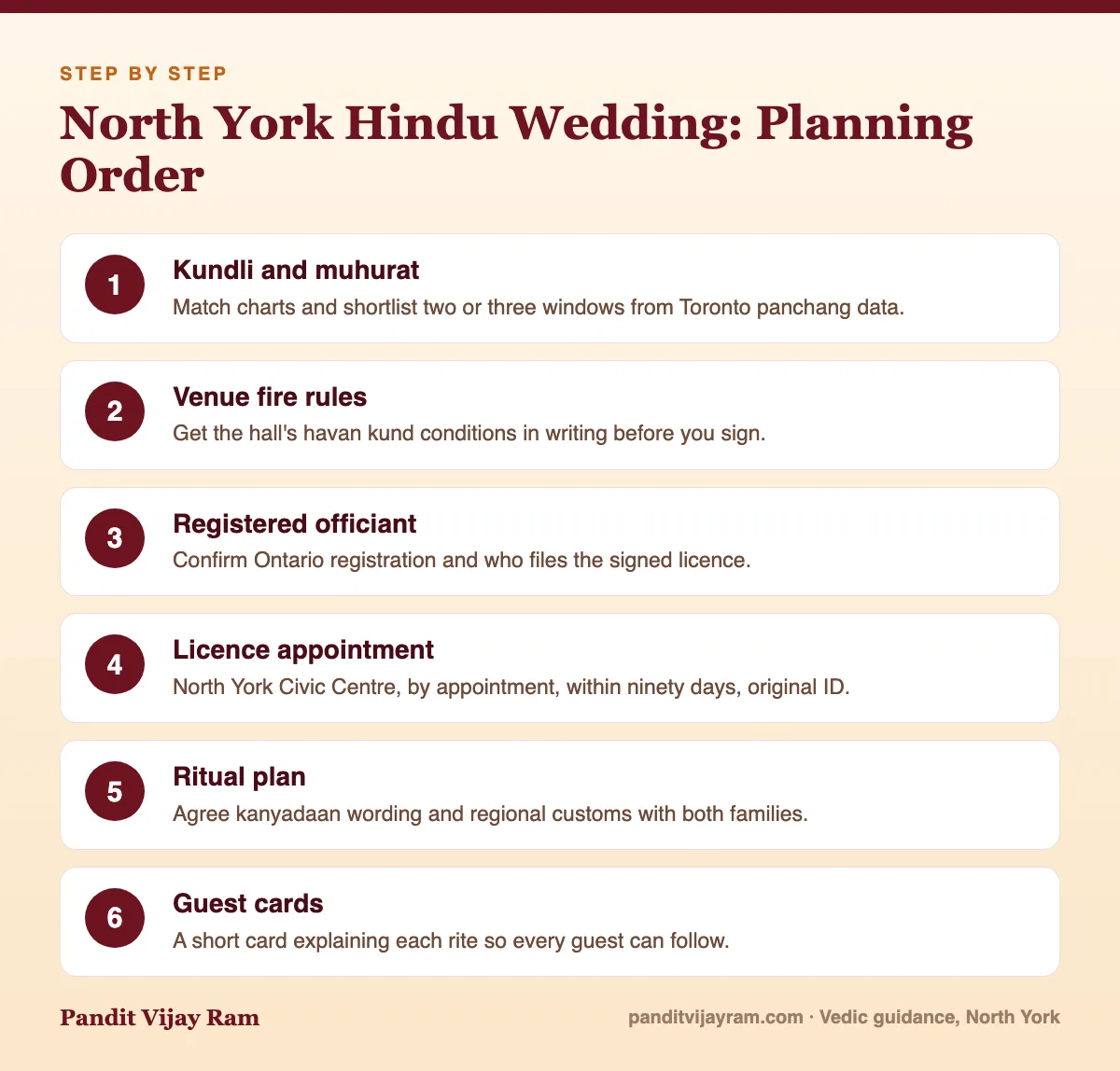
Work from the fixed items to the flexible ones. Settle kundli matching and a shortlist of muhurat windows, then the venue and its fire rules, then the officiant's registration, then the licence within the ninety-day window, and finally the ritual details and guest cards. This order prevents most last-minute crises.
A simple decision rule helps: anything that can stop the wedding legally or physically comes before anything that only changes how it looks.
- Kundli and muhurat shortlist. Two or three windows, not one.
- Venue booking. Choose a hall whose fire rules you have in writing.
- Officiant. Confirm Ontario registration and who files the signed licence.
- Licence. Book at North York Civic Centre within ninety days of the date, with original ID and any divorce documents.
- Ritual plan. Agree on kanyadaan wording, regional customs and timing with both families.
- Guest support. A card explaining the rites, and seating for elders near the mandap.
When the two sides disagree about customs, calm counselling helps more than pressure; the love marriage guidance in North York page and the North York astrologer page describe how an in-person consultation works. Couples marrying elsewhere in the city may also find our Toronto Hindu wedding guide useful.
The bottom line
A Hindu wedding in North York goes smoothly when the legal, physical and spiritual pieces are handled in order. Get the licence by appointment at North York Civic Centre within the ninety-day window and confirm your officiant is registered in Ontario. Settle the venue's fire rules in writing before you fix the ritual plan. Then choose a muhurat from Toronto data and learn the meaning of the seven vows, so the rites feel like yours.
Key takeaways
- North York Civic Centre issues Ontario marriage licences by appointment only, after an online application.
- Each partner needs two original government-issued IDs, and the licence lasts three months.
- A religious ceremony is legal only when the officiant is registered in Ontario.
- Indoor havan rules belong to the venue; outdoor fires need Toronto Fire Services approval.
- A muhurat for Toronto must be calculated from local sunrise and time, not an Indian calendar.