
Wedding Muhurat in Canada: Choosing a Date With a Toronto Panchang

Most couples start wedding planning with two lists: venues that are free, and dates the family considers lucky. The trouble begins when the lucky dates come from a relative's calendar printed in India, and the venue in Mississauga or Markham is booked on every one of them. Finding a wedding muhurat Canada families can rely on is a slightly different task from choosing one in Delhi or Ahmedabad, and many families in North York only discover this when the priest gently corrects the time on the invitation. This article explains what a muhurat actually is, why it has to be calculated for Toronto rather than copied, which periods many families avoid, and how to balance tradition with weekends, venue contracts and guests flying in. It also covers what to do when the ideal window is simply not available. In more than forty years of practice, I have found that a well-chosen muhurat reduces family tension more than it adds. When everyone trusts the timing, the day itself feels calmer.
What is a wedding muhurat and how is it chosen?
A muhurat is an auspicious span of time for beginning an important act. For a wedding, the priest checks the five limbs of the panchang, namely tithi, vara, nakshatra, yoga and karana, together with the rising sign at the ceremony and both partners' charts. The result is a window for the core rites, not a whole day.
The Hindu panchanga, literally 'five limbs', is the almanac every muhurat starts from.
- Tithi: the lunar day. Many traditions avoid the 4th, 9th and 14th of each fortnight, and the new Moon, for weddings.
- Vara: the weekday. Several days are favoured, though regional customs differ.
- Nakshatra: the Moon's lunar mansion. Rohini, Mrigashira, Magha, Uttara Phalguni, Hasta, Swati, Anuradha, Mula, the Uttara nakshatras and Revati are widely listed as suitable for marriage.
- Yoga and karana: finer divisions that remove some otherwise good windows.
On top of the almanac, a careful priest adds:
- The lagna, or rising sign, during the ceremony, ideally strong and free from harsh influences.
- Both partners' Moon signs, so the day's nakshatra suits them.
- Any dasha or transit concerns that suggest moving the date.
The window usually covers the central rites, such as kanyadaan, the pheras or saptapadi, and the sindoor or mangalsutra moment. The reception can happen whenever it suits.
If the couple's charts have not been matched yet, that usually comes first. Our guide to kundli matching for a love marriage explains what matching adds, and the kundli and horoscope service covers both readings together.

Why can't you use an Indian panchang for a Toronto wedding?
Panchang timings depend on location. The Hindu day starts at local sunrise, tithi and nakshatra end at fixed moments that must be converted to Eastern Time, and the rising sign changes with latitude and longitude. A muhurat printed for India can fall on the wrong day or the wrong hour in Toronto.
Three things shift when the wedding moves from India to Canada.
1. The time difference. Toronto is roughly nine and a half to ten and a half hours behind Indian Standard Time, depending on daylight saving. A tithi that ends in the afternoon in India may end before dawn in Toronto.
2. Sunrise. Many rules depend on which tithi or nakshatra is running at local sunrise. Because sunrise in Toronto happens at a different absolute moment, the 'day' of a tithi can move by a full calendar date.
3. The rising sign. The lagna changes roughly every two hours, but the exact pattern depends on where you are. At Toronto's latitude some signs rise noticeably faster or slower than they do in India. A lagna window that suits the ceremony in Jaipur may not exist at the same clock time here.
What this means in practice:
- Use a panchang calculated for Toronto, or ask your priest to calculate one.
- Do not convert an Indian muhurat by simply subtracting hours; the lagna will not match.
- If relatives in India are watching online, give them the Toronto time and let them convert it.
For couples marrying elsewhere in Canada, the same principle applies: Vancouver, Calgary and Halifax each need their own calculation. Vijay Ram ji prepares muhurat for any Canadian city through his love and marriage guidance.
Which months and periods are avoided for Hindu weddings?
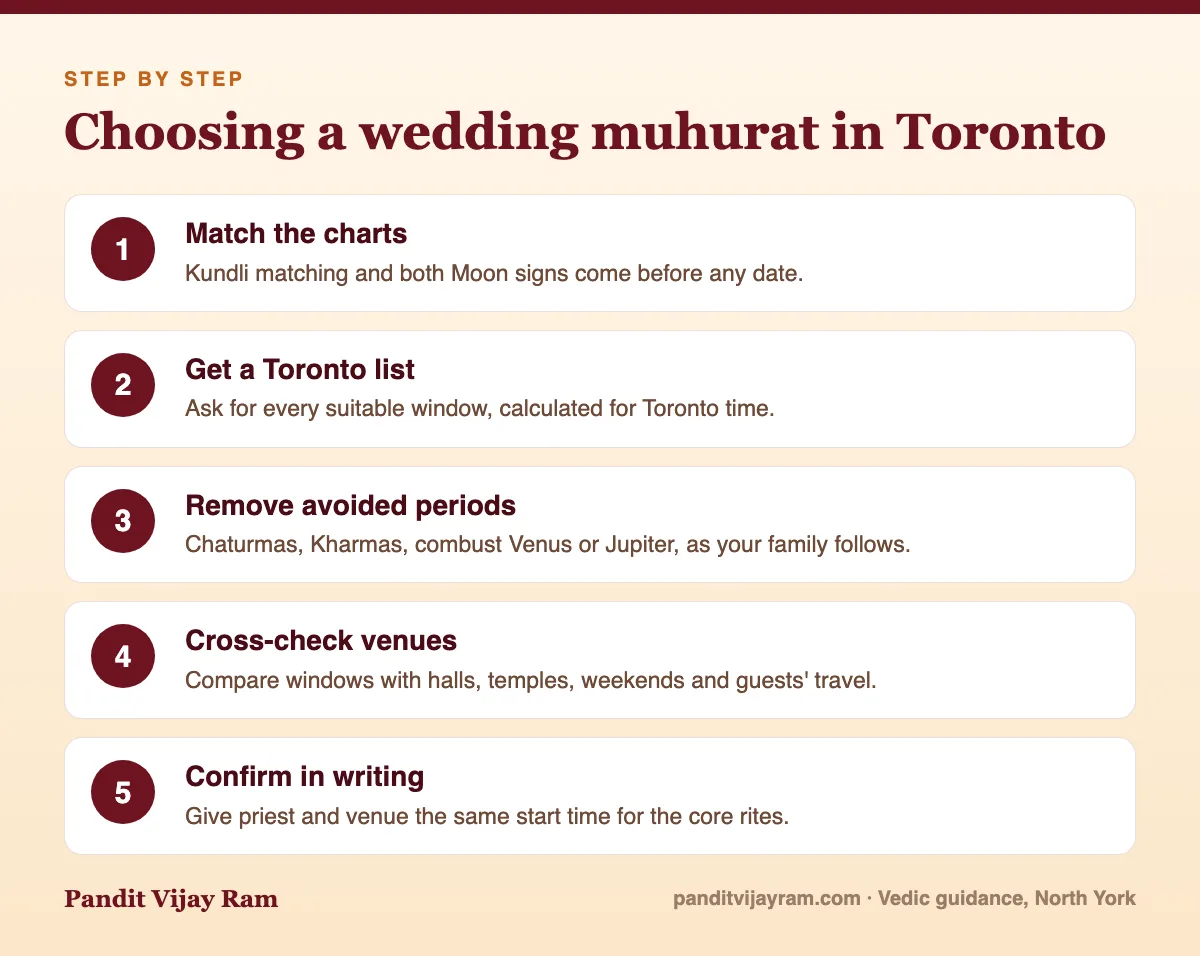
Many families avoid Chaturmas, the four months from Devshayani to Devuthani Ekadashi; Kharmas, when the Sun is in Sagittarius or Pisces; periods when Venus or Jupiter is combust; Pitru Paksha; and, in some families, Holashtak. Customs vary by region, and some South Indian traditions follow different rules, so ask your own priest.
These are the periods most often mentioned, with the reason behind each.
- Chaturmas — roughly the four monsoon months, when Vishnu is said to rest. Many North Indian families do not hold weddings until Devuthani Ekadashi.
- Kharmas or Malmas — the month the Sun spends in Sagittarius and the month it spends in Pisces. Considered unsuitable for new beginnings.
- Shukra asta — when Venus, the planet of marriage, is too close to the Sun and treated as combust.
- Guru asta — the same for Jupiter, the planet of blessing and wisdom.
- Pitru Paksha — the fortnight for honouring ancestors, kept free of celebrations.
- Holashtak — eight days before Holi, avoided in some North Indian families.
- Adhik maas — an extra lunar month that appears every few years, often avoided for weddings.
Taken together, these remove a large share of the calendar, which is why good Saturdays fill quickly. Check a Toronto panchang for when each period falls this season, rather than relying on a list from another city.
Regional practice matters. Tamil, Telugu, Bengali, Gujarati and Punjabi families each have their own emphasis, and mixed-heritage couples sometimes need two priests to agree. That conversation is easier early. Our guide to Hindu wedding rituals in the GTA covers how families blend regional customs.
How do you balance muhurat with venue bookings and weekends?
Start with the muhurat windows for the season, then match them against venue availability, guests' travel and weekends. Because only the core rites need the auspicious window, a Friday evening or Sunday morning ceremony can often fit. Book the venue only after the priest confirms the window, and leave time for setup and the havan.
A practical order of work many GTA families follow:
- Ask for a list, not a single date. Request every suitable window over the season you are considering.
- Cross-check venues. Banquet halls, temples and hotels often book a year or more ahead for popular weekends.
- Look beyond Saturday. Friday evenings and Sunday mornings frequently carry good windows and better availability.
- Fit the ceremony, not the party. Only the central rites need the muhurat. The baraat, photos and reception can sit around it.
- Build in buffer. Allow time for the mandap setup, late arrivals and the havan before the window opens.
- Confirm in writing. Give the venue and the priest the same start time, in Toronto time.
Venue rules affect the plan too. Many halls restrict open flame or require a small, contained havan kund, and hotels may need notice for smoke detectors. Check with the venue and the local fire service early.
Weather is a real factor in Canada. A summer outdoor muhurat may meet heat or rain; a winter evening may meet snow on the roads. A slightly less ideal window that keeps elderly guests safe is a sensible trade.
Remember the legal side is separate. Check the provincial rules on marriage licences and officiants well before the day.
What if no good muhurat fits your wedding date?
Priests have long offered fallbacks. The Godhuli lagna, the dusk window when cattle return home, is traditionally accepted when other windows fail. Abhijit muhurat near midday is another. Families can also hold the core rites at the best available time and celebrate later. A sincere ceremony on a reasonable day is better than lasting family conflict.
Sometimes the venue is fixed, the visa dates are fixed, or a grandparent's health sets the timeline. In those cases, tradition is more flexible than people expect.
- Godhuli lagna. Literally 'cow-dust time', around sunset. Many texts accept it as broadly auspicious for marriage when no better window exists. In Toronto it shifts noticeably across the seasons, so it must be calculated locally.
- Abhijit muhurat. A short window around local midday, often used for important beginnings.
- Split ceremonies. A small family ceremony at the ideal window, with the larger celebration on a convenient weekend.
- Remedial prayer. A Ganesh puja or Navagraha prayer before the rites to ask for a smooth day.
What matters most is that both families feel heard. A muhurat argument can quietly sour the months before a wedding. A priest who explains the options calmly often settles it faster than any calendar.
If the date is being pushed back repeatedly and families suspect something more than bad luck, read our guide to marriage delay and its ordinary causes before assuming the worst. A Ganesh puja before the wedding can be arranged through the Ganesha puja service.
The bottom line
A wedding muhurat in Canada has to be calculated from a Toronto panchang, because sunrise, time zone and the rising sign all change with location. Many families also avoid periods such as Chaturmas, Kharmas and the combustion of Venus or Jupiter, which narrows the calendar. Only the core rites need the auspicious window, so Friday evenings, Sunday mornings and the Godhuli lagna give real flexibility around venues and travel. A calm, shared decision matters as much as the timing itself.
Key takeaways
- A muhurat must be calculated for the city where the ceremony happens.
- Indian timings cannot simply be converted by subtracting hours.
- Chaturmas, Kharmas and combust Venus or Jupiter are commonly avoided.
- Only the central rites need the auspicious window.
- Godhuli lagna and split ceremonies are accepted fallbacks.