
Getting Back Together After a Fight That Went Too Far

Some relationships fade slowly. Others end in a single evening, when a disagreement turns into shouting and one of you says something that cannot be unsaid. If you want to get your ex back after a big fight, you are probably replaying those words and wishing you could take them back. People in North York and across the GTA often come to me a day or a week after such an argument, asking whether the damage is final. This guide looks at that question honestly. You will learn why one explosive fight can end a relationship, how long to let things settle, what real repair after angry words involves, how to work on your own temper, and where a fight stops being a fight and becomes abuse. In more than forty years of practice I have watched couples recover from terrible arguments, and I have watched others discover that the argument was only the surface of something deeper. Either way, the first move is the same: slow down, take responsibility for your share, and accept that the other person decides for themselves.
Why can one big fight end a relationship?
One fight rarely ends a relationship on its own. Usually it releases resentment that has been building for months, or it crosses a line such as insulting family, mocking a weakness or making threats. The breakup is often less about that night and more about what the night revealed about safety, respect and unresolved hurt.
When people describe the fight that ended things, a few themes come up again and again. The argument began over something small, such as a late reply, a cancelled plan or a comment from a parent. Within minutes it was about everything: old disappointments, money, who gives more, whose family interferes.
Relationship researchers describe a state called flooding. The heart races, thinking narrows and the body prepares for a fight. In that state people say the cruellest thing they can find, because the brain is defending rather than connecting. The psychologist John Gottman named four patterns that do lasting damage: criticism, contempt, defensiveness and stonewalling. Contempt, meaning mockery, eye-rolling and insults about who someone is, tends to hurt the most.
Some words carry extra weight in our communities:
- Remarks about a partner's parents, caste, colour or background.
- Threats to tell family secrets or expose private photos.
- Comments about immigration status, income or education.
- Saying you never loved them, or that you regret ever meeting them.
If your ex walked away after hearing one of these, they may not be punishing you. They may be protecting themselves from a version of you they did not know existed. Understanding that is painful, but it is where honest repair starts. Couples who fight often rather than once will find a fuller reset plan in our guide to constant arguments with a partner.

How long should you wait after a breakup argument before reaching out?
There is no fixed waiting period, but most people need at least several days, and often a few weeks, before a calm conversation is possible. A useful rule is to wait until you can describe your own part without the word but. If your ex has asked for no contact, honour that request completely.
The body settles faster than the heart. Racing thoughts and adrenaline usually ease within hours. The hurt, embarrassment and defensiveness take much longer. Reaching out while those feelings are still hot often turns an apology into round two of the same fight.
Before you send anything, check yourself against this simple decision rule:
- Can I name what I said? Exactly, not vaguely as "things got heated".
- Can I describe the impact on them without explaining what they did first?
- Would I be at peace if they replied no, or did not reply at all?
- Has my ex asked me for space? If yes, the answer is to wait, however long that is.
- Am I sober, rested and calm? Late-night messages after a drink rarely help.
If you answer yes to the first three, no to the fourth and yes to the fifth, a single respectful message may be appropriate. If not, keep waiting and keep working on yourself. Our guide to whether you should text your ex covers the wider decision in more detail.
Waiting is not a strategy to make them anxious. It is time for both of you to see clearly. Use it to sleep properly, talk to a trusted friend, and notice what you would do differently. If your ex reaches out first, answer kindly and briefly, without pushing for a full reunion in the first exchange.
How do you fix things after saying hurtful things in anger?
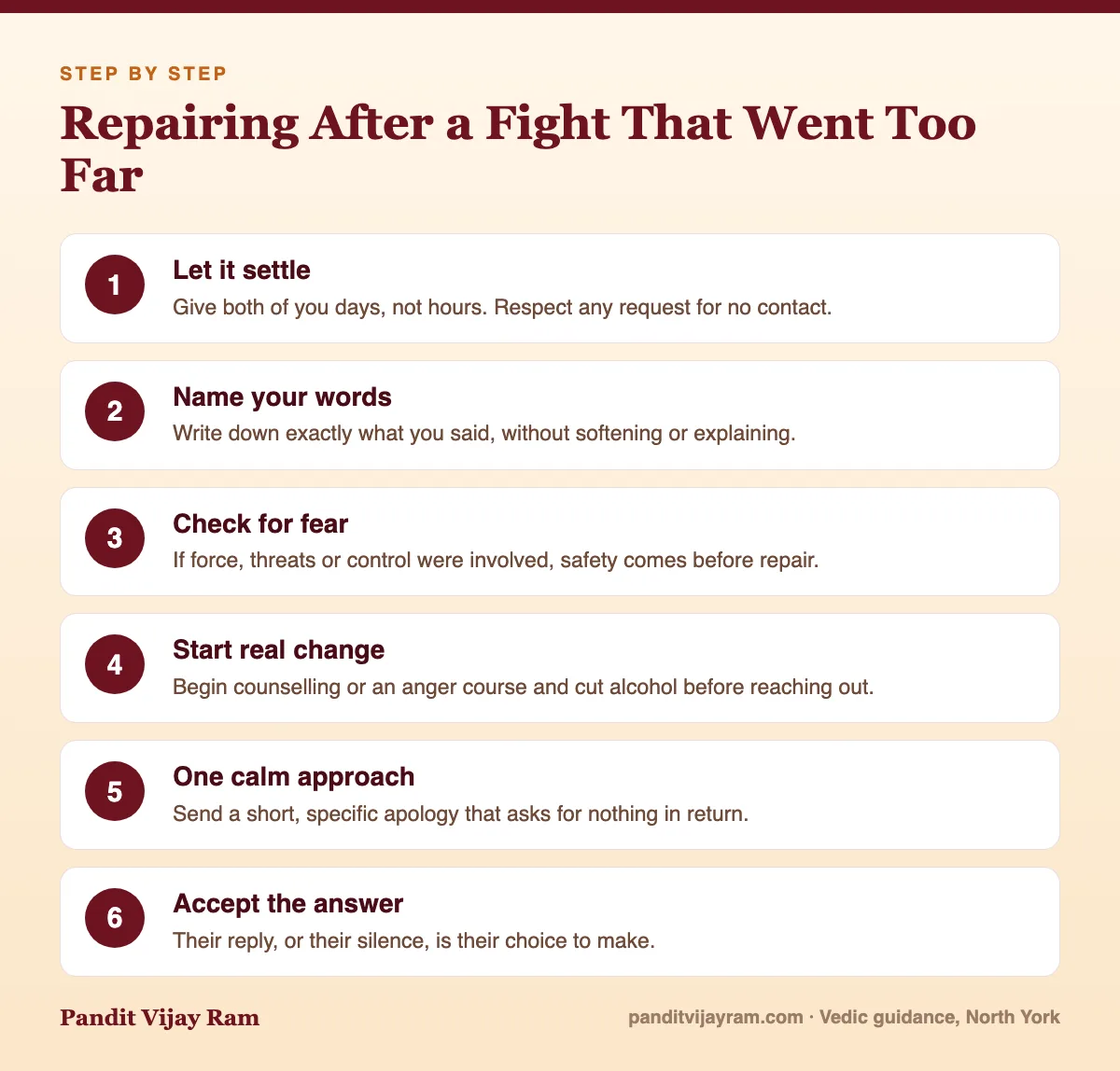
Repair after hurtful words means naming exactly what you said, acknowledging how it landed, and explaining what you are doing so it does not happen again. It does not mean blaming the other person's behaviour, minimising the words as a joke, or expecting forgiveness because you apologised. The other person decides what happens next.
Many people try to repair a fight by re-arguing it more politely. That rarely works. A repair conversation is different from a debate about who started it. It has a few clear parts:
- Specific ownership. "I called your mother a liar and said you were pathetic. That was cruel."
- Impact, in their terms. "I imagine you felt humiliated, and maybe frightened by how loud I got."
- No counter-charges. Their part in the argument can be discussed later, if at all, and only if they want to.
- Change, not promises. Describe what you have already started doing, such as counselling, an anger course or stopping drinking.
- Freedom to decline. Make it clear that you are not asking for an answer.
The full structure of a sincere apology, including what to avoid, is set out in our guide on how to apologise to an ex. If the fight damaged trust in a wider way, through broken promises or long neglect, the slower work described in winning back trust after a breakup will also apply.
Repair is shown over time rather than in one message. If your ex agrees to talk, keep the first conversation short. Listen more than you explain. A person who has been shouted at needs to see calm repeated many times before they relax.
How can I control my anger so it does not ruin my next chance?
Anger itself is a normal emotion; the damage comes from how it is expressed. Learning your early warning signs, taking agreed time-outs, cutting alcohol, sleeping properly and working with a counsellor or anger management programme all help. Spiritual practice such as slow breathing and daily prayer can support that work, but it does not replace it.
If you want another chance, the most convincing thing you can offer is evidence that you have changed how you handle anger. Start by noticing the pattern. Most people have warning signs: a hot face, a clenched jaw, a sudden urge to win, a voice getting louder. When those appear, the conversation needs a pause.
- Time-outs that are agreed, not stormed. "I am getting heated. I need twenty minutes and I will come back." Then actually come back.
- Watch the triggers. Hunger, exhaustion, alcohol and work stress shorten everyone's fuse.
- Get proper help. Your family doctor can refer you to counselling, and many community agencies run anger management groups.
- Address what sits underneath. Anger often covers fear, shame, grief or depression. Our guide to mental health support for South Asian families in the GTA lists culturally aware services.
In Vedic astrology, Mars is associated with drive and heat, and the Moon with the mind and emotional tides. A reading may show that a demanding Mars or Moon period coincides with a stormy season in your life. That is context, not an excuse. Remedies I suggest are for your own steadiness: slow breathing before speaking, recitation of the Hanuman Chalisa for courage and restraint, and a short evening prayer to review the day honestly.
Through a get ex love back consultation I can look at your chart and help you plan these practices, but I will not perform any ritual aimed at changing your ex's feelings.
When is a fight actually abuse rather than a normal argument?
An argument becomes abuse when one person uses fear, force or control. Hitting, pushing, blocking a doorway, breaking objects, threatening harm, threatening to expose or report someone, and repeated degrading insults are abuse, not a bad fight. If this describes what happened, reconciliation is not the priority. Safety and accountability are.
Ordinary arguments can be loud and painful. Both people may say regrettable things. But both remain free, and neither is afraid of what the other might do. Abuse is different in kind, not just in degree.
Signs a fight crossed that line:
- Someone was physically hurt, restrained or prevented from leaving.
- Objects were thrown or smashed to intimidate.
- There were threats to harm, to take children, to share private images or to report immigration status.
- This was not the first time, and each episode was followed by intense apologies and promises.
- One partner now feels afraid of the other.
If you were harmed, you owe no one a second chance. Please do not let family pressure or guilt push you back. Call 911 if you are in danger, and see our guide to domestic violence help in the GTA for shelters and safety planning.
If you were the one who frightened your partner, the honest path is to stop contact if asked, seek professional help for violence and anger, and accept that the relationship may be over. Change is possible, but it must happen for its own sake, not as a bargaining chip.
I will not offer remedies to bring back someone who left because they were afraid. What I can offer is prayer and guidance for the person trying to become safer and calmer, whatever the outcome.
The bottom line
Trying to get your ex back after a big fight starts with understanding what the fight revealed, not just regretting how loud it got. Give both of you time to settle, then offer specific ownership and visible change rather than pressure or promises. Work on your anger with real help, and keep spiritual practice as support for your own steadiness. If the fight involved fear or force, safety comes first and reconciliation may not be the right goal.
Key takeaways
- A single big fight usually exposes older resentment or crosses a line of respect.
- Wait until you can describe your own part without justifying it.
- Repair means naming the exact words, acknowledging impact and showing change over time.
- Anger management, sleep, sobriety and counselling matter more than any ritual.
- Fear, force, threats or control mean abuse, and safety outranks reconciliation.