
Hindu Temples and Community Centres in Toronto: A Respectful Visitor's Guide
Walking into a mandir for the first time can feel strangely nervous, even for someone raised Hindu. You wonder where to leave your shoes, whether you may sit anywhere and what the priest expects. This guide to Hindu temples in Toronto is written for that moment. I am a Vedic astrologer based in North York, and families from downtown, the west end and the suburbs ask me which temple suits them, how to behave there and what to bring home. In more than forty years of practice I have watched temple life steady people far more than any single remedy. Here you will find three long-established places of worship in the city, a plain etiquette checklist, an explanation of how different traditions run their temples, and a section on carrying the temple's rhythm into your own prayer corner. I have no connection with any temple named here. I simply point people towards them, because a living community is something no private consultation can replace.
Which Hindu temples in Toronto are well known for welcoming visitors?
Three long-standing places stand out for newcomers. ISKCON's Hare Krishna Temple occupies a former church at 243 Avenue Road. The BAPS Shri Swaminarayan Mandir on Claireville Drive is a hand-carved stone mandir with a heritage museum. The Vedanta Society of Toronto on Emmett Avenue follows the Ramakrishna Order.
Each of these offers a different doorway into Hindu worship, so it helps to know what you are walking into.
- Hare Krishna Temple (ISKCON Toronto). The building on Avenue Road was put up as a Gothic Revival Presbyterian church and was later bought by the International Society for Krishna Consciousness. Expect kirtan, chanting and a strong devotional mood. The temple's own directions page points visitors to Rosedale station on Line 1 as the closest subway stop.
- BAPS Shri Swaminarayan Mandir. Run by the BAPS Swaminarayan Sanstha, it was assembled from thousands of pieces of marble, limestone and pink stone carved in India. A carved wooden haveli serves as the cultural centre, and the Heritage Museum presents an exhibition on Hindu dharma. Monks perform the daily worship.
- Vedanta Society of Toronto. A branch centre under the spiritual guidance of the Ramakrishna Order, it keeps meditation, evening prayer, a Sunday service and study classes, plus volunteer work at a soup kitchen and food bank.
These are starting points, not a ranking. Scarborough and Etobicoke hold many more temples, including Tamil Shaiva kovils and Caribbean-founded mandirs, and our guides to temples in Scarborough and the wider temples across the GTA list them by region. Programme times change, so always check a temple's own website before you travel.
What should you wear and do on your first visit to a mandir?
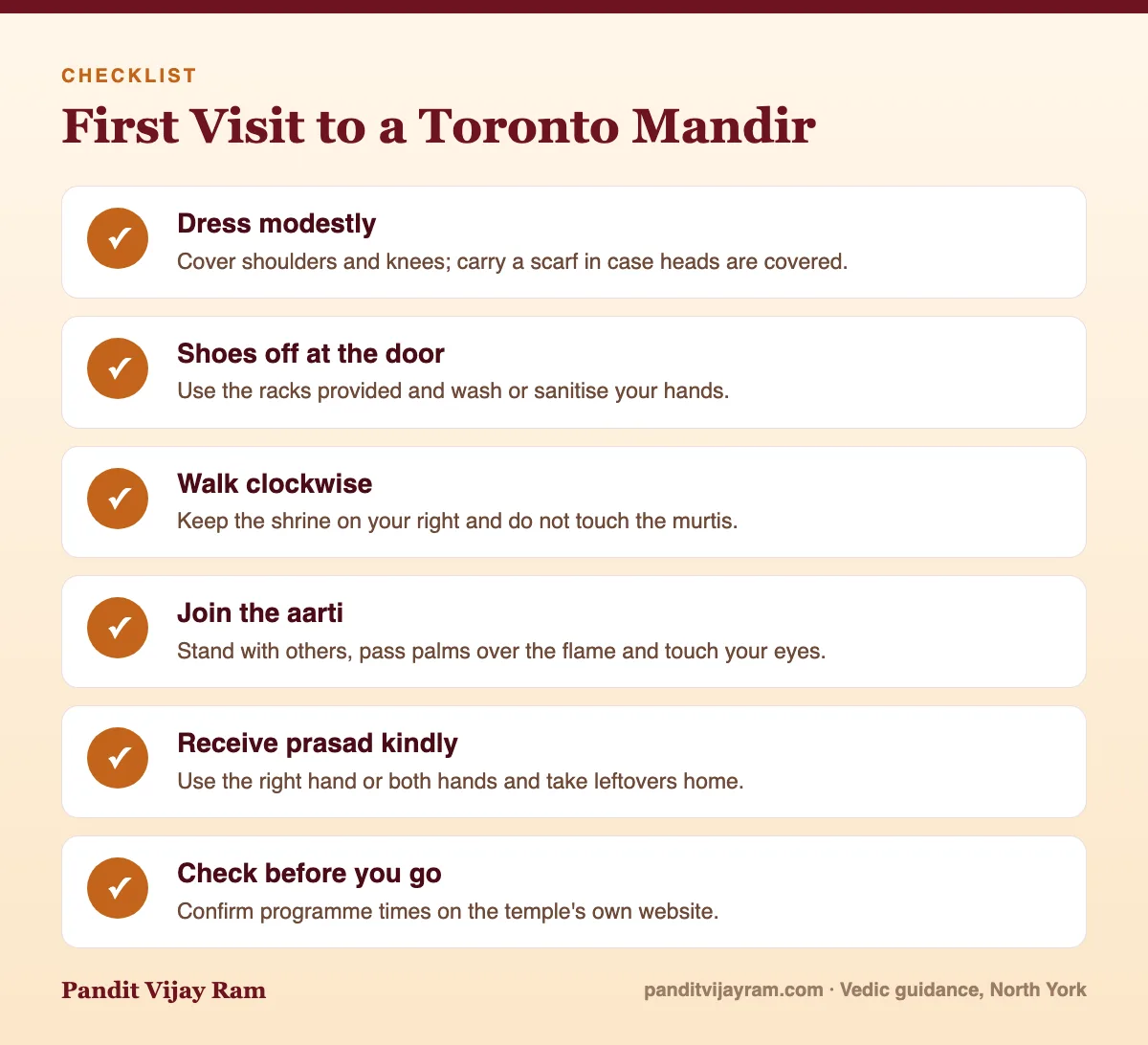
Dress modestly with shoulders and knees covered, take off your shoes where others do, and wash or sanitise your hands. Speak softly, silence your phone, ask before photographing inside, and receive prasad with your right hand or both hands. When unsure, watch the regulars or ask a volunteer politely.
Temple etiquette is mostly common courtesy, but a few customs are easy to miss. This short sequence covers a typical first visit.
- Before you leave home. Choose loose, covered clothing. Some families avoid wearing leather inside; a scarf is handy if a temple asks women or men to cover their heads.
- At the entrance. Shoes go on the racks provided. Many people ring the bell once on entering, as a way of collecting attention.
- In the main hall. Do not touch the murtis unless a priest invites you. Walk around shrines clockwise, keeping the deity on your right.
- During aarti. Stand when others stand. When the lamp comes round, pass your palms over the flame and touch them to your eyes.
- Receiving prasad. Accept it with the right hand or cupped hands, and do not throw away what is left; take it home.
- Leaving. Many people sit quietly for a minute before stepping out, rather than rushing back to the car park.
Customs differ between traditions. A Swaminarayan mandir may separate seating for men and women, and an ISKCON temple welcomes guests to join the chanting. Neither is more correct. Respect the house you are visiting, the way you would in someone's living room.
How are temples and Hindu community centres in Toronto different?
A temple centres on consecrated murtis and daily worship led by priests or monks. A Hindu community centre or society focuses on study, meditation, cultural classes and service, sometimes with a small shrine. Toronto has both, and many families use a temple for festivals and a society for weekly learning.
The difference matters when you are choosing where to go regularly.
In a consecrated mandir, the murti has been installed with prana pratishtha, and the priests offer worship to it through the day. People arrive for darshan, aarti, festivals and life ceremonies such as a child's naming or a first rice-feeding. The atmosphere is busy and devotional.
A society such as the Vedanta Society of Toronto feels closer to a study circle with a shrine. Its rhythm is meditation, a talk, a class on scripture and a volunteer roster. Children's cultural education runs alongside. People who want to understand the philosophy, or who find a crowded festival overwhelming, often settle well in this kind of setting.
Many cultural associations in Toronto also rent halls for garba nights, bhajan evenings and language classes. These gatherings are less formal but still carry real devotion. If you want a priest for a ceremony at home, our checklist on questions to ask when finding a pandit in the GTA helps you compare options. And when a temple asks for older murtis or framed pictures to be brought in, our guide to disposing of puja items respectfully in Toronto explains how to prepare them.
How does a temple visit connect with prayer at home?
The temple sets the pattern; the home keeps it alive. People learn an aarti, a mantra or a festival method at the mandir, then repeat it daily in a small prayer corner. Prasad brought home, a lamp lit at dusk and the same prayer said each morning link the two spaces.
When someone tells me their home feels spiritually flat, I first ask when they last went to a temple. Often the answer is years. What lifts that flatness is rarely an exotic ritual. It is usually rhythm.
Here is how I suggest people bring the temple home:
- Copy one practice. Notice the aarti sung at your temple and learn its words. Sing it at your own shrine at the same time each evening.
- Share the prasad. Give a little to each family member, including those who stayed behind. It carries the visit into the household.
- Keep the shrine clean. Our guide to cleansing a puja room and home mandir covers the weekly routine.
- Mark festivals twice. Attend the public celebration, then do a short puja at home so children see both sides.
For larger observances, such as a havan for a new house or an anushthan before a difficult period, a temple priest or a family pandit is the natural choice. Our page on puja, havan and anushthan explains how those longer rites work.
When should you look beyond the temple for spiritual guidance in Toronto?
Look further when a question is personal rather than ceremonial: a recurring family conflict, a chart question, or a sense that something in your home feels wrong. Temple priests are often stretched during festivals. A one-to-one consultation gives time for detail, but medical, legal and mental-health needs always come first.
A temple is a community, and communities are busy. On a festival weekend a priest may be serving hundreds of families. That is not the moment to unpack a long story about a marriage or a run of bad luck.
People in Toronto usually come to me for three kinds of question:
- Chart questions. Timing, compatibility or a planetary period that seems heavy. These need a calm reading, not a quick word after aarti.
- Home and energy worries. A house that feels tense since a move or a loss. I always ask about sleep, health, damp and money stress first.
- Remedies to practise. A mantra, a fast or a simple puja that fits a working week.
Vijay Ram ji, as clients call me, sees people for in-person consultations in North York and speaks with everyone else by phone, video or WhatsApp. The astrologer in Toronto page explains how that works for city residents, and the kundli and horoscope service describes a chart reading. A consultation is meant to send you back to your temple and your family with more clarity, not to replace them.
The bottom line
Hindu temples in Toronto offer very different doorways, from ISKCON's chanting on Avenue Road to the carved stone of the BAPS mandir and the quiet study of the Vedanta Society. Basic etiquette, covered clothing, shoes off and a soft voice, makes any first visit comfortable. The deeper benefit comes when one temple practice is carried into a daily prayer at home. Personal questions are better suited to an unhurried consultation, alongside your doctor and your community.
Key takeaways
- ISKCON's Hare Krishna Temple, the BAPS Shri Swaminarayan Mandir and the Vedanta Society of Toronto are long-established places to start.
- Modest clothing, shoes removed and a silent phone cover most temple etiquette.
- A mandir centres on consecrated worship; a Hindu society centres on study, meditation and service.
- Learning one aarti or mantra at the temple and repeating it at home builds lasting rhythm.
- Always confirm programme times on a temple's own website before travelling.