
Legal Clinics and Legal Aid in the GTA for Family Matters

Separation, a custody disagreement or a support dispute can leave a family frightened and unsure where to turn. When people search legal aid GTA family services late at night, they usually want one thing: a trustworthy first step that does not cost money they do not have. I am not a lawyer and this article is not legal advice. What I can offer, after more than forty years of sitting with families in North York and across the region, is a plain map of the public and non-profit services that exist. Many couples who come to me for a kundli reading are really carrying a legal question underneath, and the kindest thing I can do is point them to the right door. Below you will find what Legal Aid Ontario provides, how courthouse information centres and duty counsel work, what community legal clinics do, how the Law Society Referral Service can connect you with a lawyer, and where spiritual support fits.
What family law help does Legal Aid Ontario provide?
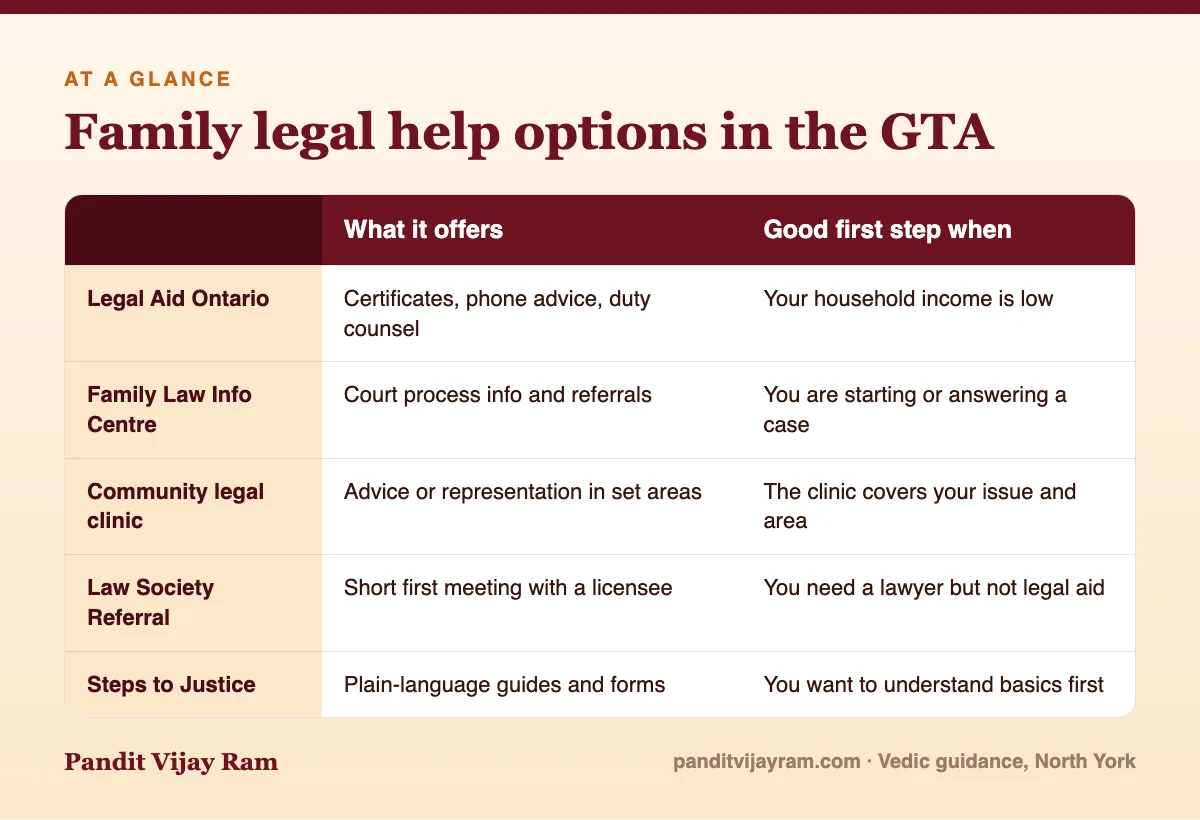
Legal Aid Ontario can issue certificates that pay a family lawyer for eligible clients, provide advice lawyers and duty counsel at courthouses, offer summary legal advice by phone, and run settlement conferences and mediation in some areas. Eligibility depends on household size and income, with exceptions for urgent domestic abuse or child protection situations.
Legal Aid Ontario, usually called LAO, is the provincial body that funds legal help for people with low incomes. For family matters its own pages describe several kinds of help:
- Certificates. If you qualify, LAO may issue a certificate that pays a private family lawyer to advise and represent you.
- Advice lawyers. At a courthouse Family Law Information Centre, an advice lawyer can give a short session of general legal advice.
- Duty counsel. Lawyers at court who can explain the process and review forms on the day.
- Summary advice by phone. Brief legal advice through LAO's toll-free line.
- Settlement conferences and mediation. Facilitated, out-of-court options, offered in some areas, including Brampton and Peel for mediation.
LAO also notes that a legal aid lawyer can help someone experiencing domestic violence seek a restraining order. In extremely urgent or high-risk situations involving abuse or child protection, it may help people above the usual income limits.
To ask whether you qualify, call LAO toll-free at 1-800-668-8258, or 416-979-1446 in Toronto. LAO says help is offered in many languages.

What is a Family Law Information Centre and duty counsel?
Family Law Information Centres are free provincial services, reached through Ontario courthouses and online, that explain separation, divorce, child protection, mediation and court steps. Information and referral coordinators help you understand options but do not give legal advice. Duty counsel lawyers funded by Legal Aid Ontario can advise, explain laws and review forms, but cannot represent you.
If you are about to start or answer a family court case, the courthouse is often the best first stop. The Ontario government describes Family Law Information Centres, known as FLICs, as places to learn about:
- separation, divorce and related issues,
- child protection and family justice services,
- mediation and other ways to settle without a trial,
- court processes, forms and the Mandatory Information Program.
There are two kinds of people you may meet there. Information and referral coordinators help you work out what you need and refer you to services, including mediation. They do not give legal advice. Duty counsel are lawyers provided by Legal Aid Ontario. They can explain the law that applies, review your court forms and speak with you about next steps, but they cannot take on your whole case.
Courthouses serve each part of the GTA, and services may be offered in person and online. Use the province's court locations page to find the one that handles family matters where you live.
Prepare before you go. Write a short timeline, bring any court papers you received and list your questions. It keeps a brief meeting focused.
Do community legal clinics in Toronto handle family law?
Community legal clinics are non-profit offices funded by Legal Aid Ontario that give legal information, advice or representation to low-income people. Each clinic sets its own focus, so ask whether it handles family matters. Specialty clinics, such as the South Asian Legal Clinic of Ontario, may offer advice and referrals on family issues.
LAO describes a legal clinic as a community-based organisation it funds to provide legal services. Clinics are spread across Toronto, Peel, York and Durham, and you can find the nearest one with LAO's Find a Legal Clinic tool by entering a postal code.
Clinics differ. Some focus on housing, income support or employment; others include immigration or family-related work. Call first and ask:
- Which areas of law do you cover?
- Do I live in your service area?
- Is there an income test, and what should I bring?
- If you cannot help, who can?
Specialty clinics serve particular communities. The South Asian Legal Clinic of Ontario, known as SALCO, says it supports low-income South Asian people in Ontario, with work on gender-based violence, immigration and family matters, and it refers people to Legal Aid Ontario for fuller family representation. SALCO's site also has a section on forced marriage.
Family conflict often spills into property and inheritance. Our guides to family property disputes and in-law problems look at the emotional side, while the legal side belongs with a clinic or lawyer.
How does the Law Society Referral Service work in Ontario?
The Law Society Referral Service, run by the Law Society of Ontario, gives Ontario residents the name of a lawyer or licensed paralegal who will offer an initial consultation of up to half an hour at no charge. Any further work is paid. Ontario's government lists the service's toll-free number as 1-800-268-8326.
If you do not qualify for legal aid but cannot afford to shop around, the Law Society Referral Service, often shortened to LSRS, is a sensible next step. You make a request, usually online, and you are matched with a lawyer or paralegal who practises in the area you need.
That first conversation helps you understand your rights and options. After it, you decide whether to hire that person, look elsewhere or continue on your own with court help. Ask about fees clearly before you agree to anything, and ask whether limited-scope help is possible, where a lawyer assists with one part of a case.
Other trustworthy information sources include:
- Steps to Justice, a plain-language site led by Community Legal Education Ontario, with family law topics from separation and support to restraining orders, plus guided court forms.
- Your courthouse FLIC, for procedure and mediation referrals.
- Legal Aid Ontario, for eligibility checks.
Be wary of anyone who is neither a licensed lawyer nor a licensed paralegal yet offers to handle your family court case for a fee. Our guide on facing a false accusation also stresses getting real legal help early.
Where does spiritual guidance fit when a family goes to court?
Spiritual guidance can help a person stay calm, think clearly and treat the other side with dignity, but it does not decide custody, support or property. Get legal information first, follow your lawyer's or duty counsel's advice, and use prayer or counselling to carry the emotional weight. No ritual changes a court's decision.
Families sometimes ask me for a puja to win a custody case. I understand the fear behind that request. My honest answer is that the court decides on evidence and the law, and the best support I can give is help with steadiness, sleep and calm speech.
What helps in practice:
- Separate the two tracks. Legal questions go to Legal Aid Ontario, a clinic, duty counsel or a lawyer. Emotional and spiritual questions can come to counselling, your faith community or a practitioner.
- Protect the children. Keep adult conflict away from them and keep routines steady.
- Look after your health. See your family doctor if stress affects sleep or appetite.
- Choose words carefully. Messages to an ex-partner may be read in court later.
If you want a chart reading for timing and patience, our article on court case astrology explains what a kundli can and cannot show. Vijay Ram ji's family problem guidance focuses on peace at home, not on outcomes. If there is abuse, use the safety resources in our domestic violence help guide, and for community supports by area see family support in North York.
The bottom line
Families facing separation or custody questions in the GTA have more public options than most people realise. Legal Aid Ontario, courthouse Family Law Information Centres and duty counsel are the first stops for low-income households. Community and specialty clinics, Steps to Justice and the Law Society Referral Service help others find information and a lawyer. Keep legal decisions with legal professionals, and let spiritual practice support your calm rather than replace advice.
Key takeaways
- Legal Aid Ontario offers certificates, duty counsel and phone advice to eligible families.
- Family Law Information Centres explain court steps and refer to mediation but do not give legal advice.
- Community legal clinics each choose their focus, so ask whether they handle family matters.
- The Law Society Referral Service connects Ontario residents with a lawyer or paralegal for a short first consultation.
- Spiritual guidance supports calm and dignity; it never decides a family court case.