
Religious Accommodation in Ontario: Festivals, Work and School

Every autumn, workers and students across the GTA face the same quiet worry: can I take Diwali off, leave early for Navratri garba, or skip an exam on Eid without trouble? Many people never ask because they fear seeming difficult. Religious accommodation Ontario law provides is not a special favour, but it works best when requested early and politely. Families in North York, Brampton and Markham often ask me how to approach a manager or teacher without causing tension. In more than forty years of practice, I have found that a calm, specific request made in good time usually meets a helpful answer. This guide explains, in plain language, what the Ontario Human Rights Code and the Ontario Human Rights Commission's creed policy say about festivals, prayer, dress and school, how to ask politely, and where to get free legal advice if things go wrong. It is general information, not legal advice; for your own situation, speak with the Human Rights Legal Support Centre or a lawyer.
What does the Ontario Human Rights Code say about creed?
The Code prohibits discrimination based on creed in employment, services, housing, contracts and vocational associations. It does not define creed, but tribunals usually read it to include religious beliefs and practices and some non-religious belief systems. The Ontario Human Rights Commission's creed policy explains how the duty to accommodate works.
The Ontario Human Rights Commission (OHRC) explains on its creed page that the Code does not define creed. Courts and tribunals have generally understood it to cover religious beliefs and practices, and it can also cover non-religious belief systems that shape a person's identity, worldview and way of life.
Protection applies in these social areas:
- Employment, including hiring, scheduling and dress codes.
- Goods, services and facilities, which include schools, hospitals and stores.
- Housing, such as rentals and condominium rules.
- Contracts.
- Membership in unions and vocational associations.
The OHRC's Policy on preventing discrimination based on creed sets out what accommodation means. Key ideas:
- The belief needs only to be sincerely held. It does not have to be essential to the religion or endorsed by religious officials.
- Requests should generally be taken in good faith, with limited questioning and confidentiality.
- Protection does not cover practices that incite hatred or violence or break criminal law.
This matters for Hindu, Sikh, Muslim, Jain and Christian families alike. A household that keeps Ekadashi fasts, a Sikh student who wears a kirpan, a Muslim employee who prays at midday: each is protected under the same principle. Customs at home, such as lamps in a rented unit, raise related questions covered in puja or havan in a rented Ontario home.

Can I get time off work for Diwali, Navratri or Eid in Ontario?
The OHRC says organisations have a duty to accommodate sincerely held creed observances, including religious holidays, up to undue hardship. Employers should explore options that avoid lost pay, such as shift swaps, lieu time or compressed weeks. Forcing an employee to use vacation instead of exploring other options would likely be discriminatory.
The OHRC's guidance on creed-based holidays and leave sets out several points that help workers in the GTA:
- Options without lost wages. Scheduling changes, overtime, lieu time and compressed work weeks are suggested ways to accommodate a holy day.
- Vacation is not the default. The policy says forcing vacation use instead of exploring other options would likely be discriminatory.
- Paid religious days are not automatic where a workable scheduling process exists, though other options should be explored if scheduling does not work.
- No penalty. People should not lose bonuses, benefits or opportunities because they were accommodated.
- Lesser-known observances count. Lists of common holidays are not exhaustive. An employer may reasonably ask for more information about an unfamiliar observance.
Festivals follow the lunar calendar, so dates shift each year. Check a Toronto panchang early and give notice weeks ahead. Our guide to Diwali, Navratri and Holi in Toronto lists the main festivals, and Navratri in the GTA explains fasting days you might mention to a manager.
Undue hardship, according to the OHRC, is assessed mainly on cost and health and safety. Business inconvenience, employee morale and other people's preferences are not valid reasons to refuse.
What accommodation can students expect at Ontario schools?
The OHRC's creed policy gives school examples: scheduling exams to avoid fasting periods or allowing deferrals, considering prayer when planning tests and trips, offering private prayer space, respecting faith days, adjusting dress for physical education, and not banning kirpans outright. Families should raise needs early with the teacher or principal.
The OHRC uses education examples to show how creed accommodation works in practice:
- Exams and fasting. Scheduling exams when most students are not fasting, holding them earlier in the day, or allowing fasting students to defer.
- Prayer and scheduling. Teachers should consider prayer observances when scheduling exams, tests, class outings and overnight trips. Private prayer space may be offered.
- Faith days. A board that recognised only some significant faith days was found to discriminate. The policy suggests presuming leave for known faith days and verifying lesser-known ones.
- Dress. Options such as alternative clothing, private changing or alternate swimwear that meets pool safety rules.
- Kirpans. School policies may not prohibit wearing kirpans, though conditions can be imposed.
- Activity exemptions. Students may be excused from events such as a Halloween parade, with equally meaningful alternatives.
Ask whether your school board publishes a faith or observance calendar. If your family's festival is not on it, explain it briefly to the teacher; lesser-known observances are protected too.
Teenagers sometimes feel embarrassed to ask. Our guide on teenagers and parents in immigrant families offers ways to talk about faith and identity at home first. For other student supports, see youth and student support services in the GTA.
How do you ask for religious accommodation politely?
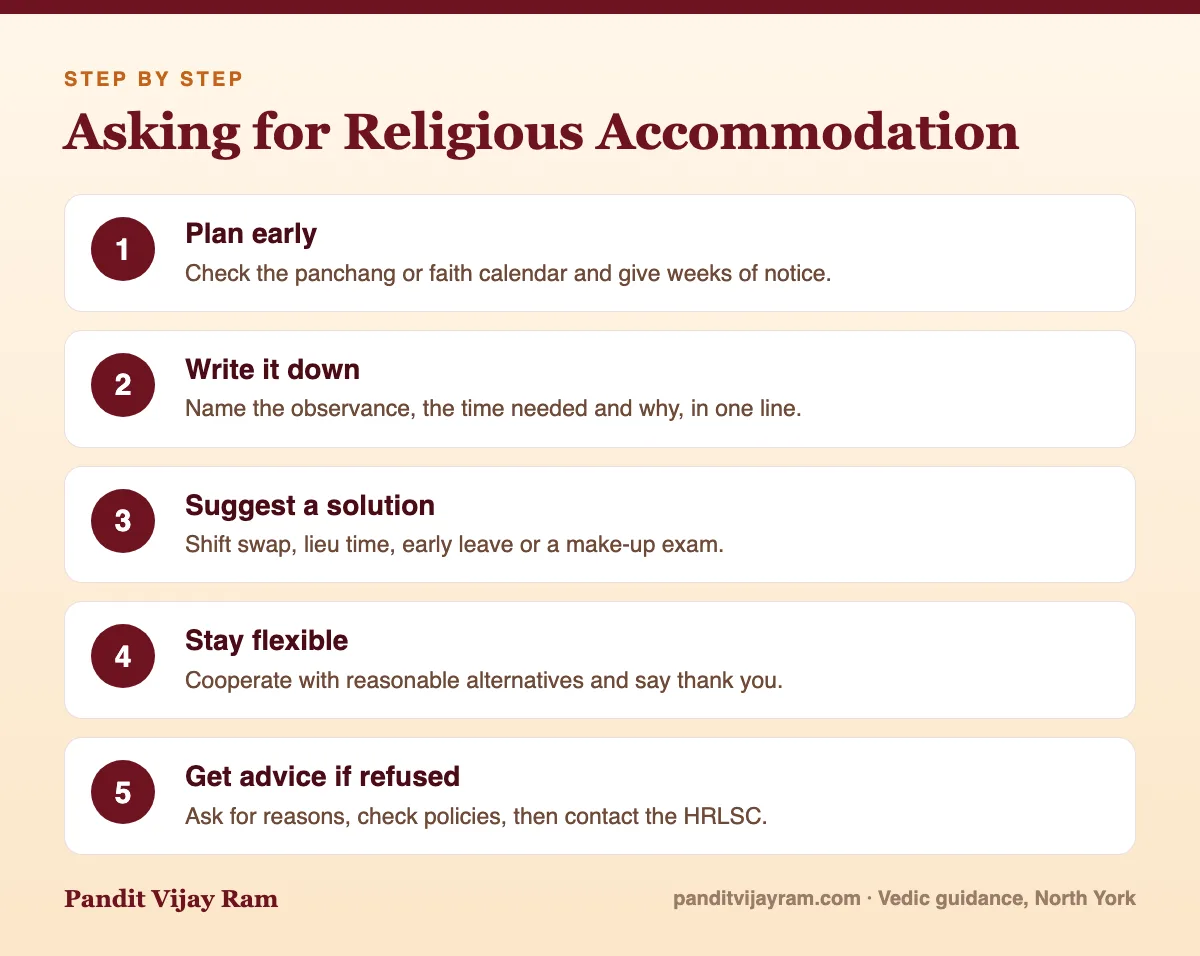
Ask early, in writing, and be specific: name the observance, the date or time needed, and a practical solution such as a shift swap or make-up exam. Offer flexibility, keep the tone friendly, and thank the person. The OHRC says people seeking accommodation must cooperate in the process, so stay open to alternatives.
A good request makes it easy to say yes. Use this five-part template for an email to a manager or teacher:
- Greeting and purpose: I am writing to request a religious accommodation for Diwali.
- What and when: the observance and the date or hours involved.
- Why, briefly: one sentence, such as It is the main festival of my faith, and my family performs Lakshmi puja that evening.
- A suggested solution: I can swap shifts with a colleague, work an extra shift that week, or take lieu time.
- Openness and thanks: I am happy to discuss other options. Thank you for considering this.
Tips that keep relations warm:
- Ask weeks ahead, not the day before.
- Keep a copy of the request and the reply.
- Offer to cover for colleagues during their holidays.
- If you need regular prayer time, suggest a specific short break rather than a vague request.
The OHRC describes accommodation as a shared process. The organisation leads it, but the person seeking accommodation must cooperate. If you refuse every reasonable option, the organisation may have met its duty.
For a calm mind before a difficult conversation, a short prayer from our family peace prayers helps many people. A career reading can also look at workplace timing, though it never replaces your rights.
What can you do if a religious accommodation request is refused?
First ask, politely and in writing, for the reasons and whether other options were considered. Check any workplace or school board policy and union contract. For free legal advice, contact the Human Rights Legal Support Centre. Human rights claims are decided by the Human Rights Tribunal of Ontario. Time limits may apply, so act promptly.
Most refusals come from misunderstanding rather than ill will. Before escalating, try these steps:
- Ask for a meeting to understand the concern. Is it cost, safety or staffing?
- Offer a different solution. If a whole day is impossible, perhaps leaving early or swapping a later shift works.
- Check policies. Many employers and school boards have written accommodation policies. Unionised workers can speak with a steward.
- Put concerns in writing and keep copies.
If the matter is not resolved:
- The Human Rights Legal Support Centre provides free legal advice and support to people experiencing discrimination under the Code, including help filing an application and representation at mediations and hearings. The HRLSC, not the OHRC, takes calls about individual cases.
- The Human Rights Tribunal of Ontario resolves claims of discrimination and harassment under the Code.
I cannot give legal advice, and nothing here should be read as a prediction about any case. For broader free legal help, our guide to legal clinics and legal aid in the GTA lists community clinics.
A refusal can feel like a rejection of your faith. Try not to let resentment take root. In our tradition, standing firm with courtesy is a form of tapas. Many families find steadiness through Hanuman puja at home while the practical process runs its course.
The bottom line
Religious accommodation in Ontario rests on the Human Rights Code's protection of creed and the OHRC's guidance that sincerely held observances be accommodated up to undue hardship. At work, that usually means flexible scheduling rather than forced vacation; at school, it can mean deferred exams, prayer space and respect for faith days. Ask early, politely and specifically, cooperate with reasonable options, and turn to the Human Rights Legal Support Centre if a fair request is refused.
Key takeaways
- Ontario's Human Rights Code protects creed in work, services, housing and more.
- A belief needs only to be sincerely held to be protected, per the OHRC.
- Employers should explore shift swaps or lieu time before requiring vacation.
- Schools can defer exams, offer prayer space and respect faith days.
- The Human Rights Legal Support Centre gives free legal advice if a request is refused.