
Puja or Havan in a Rented Ontario Home: Talking to Your Landlord
Many tenants worry about doing a puja in rented home settings, especially a griha pravesh havan in a new basement apartment or townhouse. You want to start well in the new space, but you also do not want a soot mark on the ceiling, a fire alarm at the neighbours' or an awkward letter from the owner. Families from North York to Brampton bring me this question, and I always tell them that devotion and good tenancy can sit together comfortably. In more than four decades of guiding households, I have seen most landlords respond kindly when tenants explain the ceremony before it happens rather than after. This article separates ordinary daily worship from fire rituals, gives you a simple way to start the landlord conversation, sets out smoke-free and low-smoke options, lists the fire safety steps that matter in a small kund, and suggests what to do if the answer is no.
Do you need a landlord's permission to do a puja in a rental?
A simple daily puja with prayer, flowers, a bell and one small lamp is ordinary household use for most tenants, though some leases restrict open flame. A havan is different because it uses fire and creates smoke. Read your lease, and for anything involving a kund or heavy smoke, ask first.
It helps to sort ceremonies by how much fire and smoke they involve, because that is what landlords actually worry about.
- Low impact: mantra jaap, path, bhajan, offering flowers and fruit, a single ghee diya watched by an adult. Most leases do not touch this, though some prohibit candles entirely.
- Medium impact: incense, dhoop and camphor aarti. These can trip alarms and leave smells in carpet and paint.
- High impact: a havan with a kund, samagri and repeated ghee offerings. This is the one to discuss.
I am not a lawyer, and the details of your rights and duties as a tenant depend on your lease and Ontario law. If something is unclear, check your lease and the Landlord and Tenant Board's guidance, or speak with a legal clinic. What I can say is that clear, early communication prevents most disputes.
Shared houses add another layer. Housemates, a family upstairs or a shared furnace system all feel the smoke, so include them in the conversation too.

How do you ask your landlord about doing a havan?
Message your landlord a week or two ahead. Explain that a havan is a short Hindu prayer around a small contained fire, give the date window and duration, describe your safety steps, and offer to answer questions. Keep the tone friendly and factual, and get the reply in writing.
Many owners have never seen a havan and imagine a bonfire in the living room. A calm explanation changes that picture. A message might cover these points:
- What it is. A short prayer ceremony around a small metal or copper fire pot, often done when moving into a new home.
- How long. Usually an hour or two, with the fire itself lit for part of that time.
- How big. A kund about the size of a mixing bowl, a few pieces of dry wood, a modest amount of ghee and herbs.
- Where. A room you name, on a tiled or protected floor, with windows open and the range hood running.
- Safety. Smoke alarms working and untouched, a fire extinguisher and water nearby, an adult watching at all times.
- Cleanup. Ash cooled and removed, the room aired, any marks cleaned.
Ask whether there is anything the owner would like you to do differently. Some will ask you to use the garage, the backyard or a smaller version, and that is a fair compromise. The first-home ceremony itself is explained in our guide to cleansing a new house before moving in.
Can you do a havan without smoke in an apartment or basement?
A truly smokeless havan is not possible, but you can reduce smoke a great deal by using a small kund, very dry wood or cow-dung cakes, little samagri and short sessions. Or you can do a fire-free puja at home and have the havan performed at a temple or by a priest on your behalf.
Most smoke in a home havan comes from damp wood, too much samagri thrown at once and ghee poured onto a cold fire. A few changes help:
- Use a small copper or iron kund rather than a large one.
- Choose very dry mango wood or a few cow-dung cakes, and build a hot fire before offerings start.
- Offer samagri in small pinches with each swaha, not handfuls.
- Keep the session short: a shorter mantra cycle with full attention is better than a long smoky one.
- Skip camphor and heavy guggul in a basement with low ceilings.
If even that is too much for your building, keep the home part fire-free. Do kalash sthapana, Ganesh puja, Vastu prayer, path and a single lamp, then let the fire ritual happen elsewhere. Vijay Ram ji can perform the havan with your sankalp through his puja, havan and anushthan service while your family joins by video. Our guide to the cleansing havan explains what the fire ritual itself involves.
What fire safety steps should you follow for a havan in a rental?
Place the kund on bricks or a thick metal tray over a non-flammable floor, keep it away from curtains, cupboards and the smoke detector, open windows, run exhaust fans, keep water and an extinguisher within reach, and never leave the fire. Let ash cool completely before removing it.
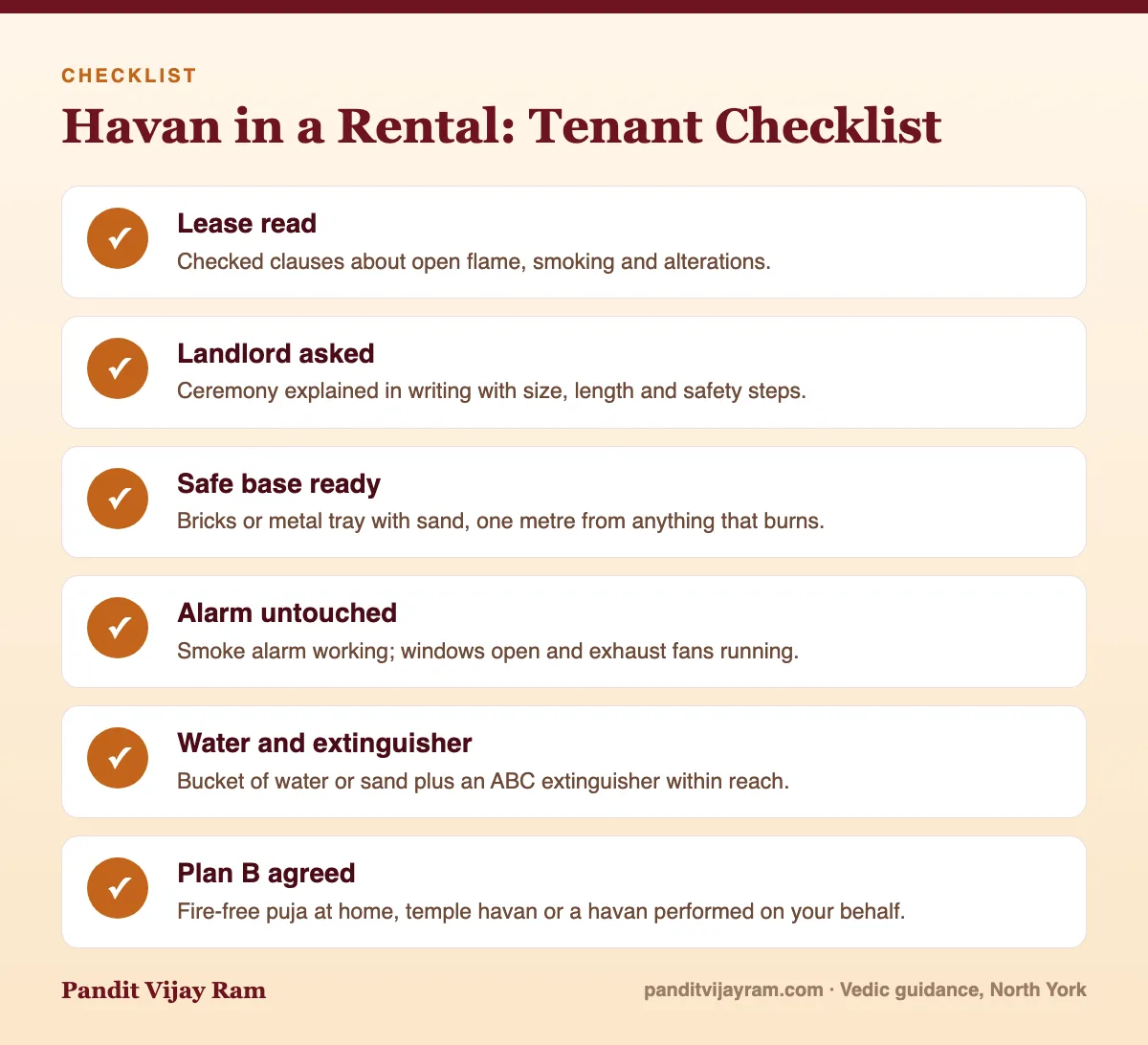
A havan is still an open fire, and rented homes often have low ceilings, carpet and small rooms. Use this checklist:
- Base: two or three bricks or a heavy metal tray with a layer of sand under the kund. Never set it straight on carpet, laminate or wood.
- Clearance: at least a metre from curtains, fabric, paper and furniture, and nothing overhead.
- Alarm: do not cover or disable the smoke alarm. Hold the havan in a room away from it if possible.
- Air: open two windows on opposite sides if you can, and turn on the kitchen and bathroom fans.
- Ready to hand: a bucket of water or sand, a damp cloth and an ABC extinguisher.
- People: children seated back from the kund, loose sleeves and dupattas tucked away, pets in another room.
- After: let embers die naturally, then leave ash in the metal kund for several hours before disposal.
If anything catches beyond the kund, leave, close the door and call 911. Your local fire service's home safety pages are a good read before any indoor fire ritual.
What if your landlord says no to a havan?
Respect the answer and adapt rather than doing it quietly. Hold a fire-free puja at home, ask whether a backyard or garage version would be acceptable, book the havan at a temple, or have it performed on your behalf. Devotion is not reduced because the fire happens somewhere else.
A refusal can feel personal, especially for a family that has always marked a new home with fire. Try not to read it as disrespect for your faith. Owners often worry about insurance, past damage from other tenants or simply the unknown.
Options that keep the ceremony intact:
- Fire-free griha pravesh: Ganesh puja, kalash, boiling milk on the stove, a lamp at the shrine, and mantra in every room.
- A temple havan: many GTA mandirs host family havans. Phone ahead to ask how they arrange them.
- A havan on your behalf: the priest performs it with your names in the sankalp while you take part online.
- Later, in your own home: some families keep a full havan for when they buy.
Going ahead anyway after a clear no risks your tenancy and your relationship with the owner. If you believe a refusal or a lease clause is unfair, check the Landlord and Tenant Board's guidance or get legal advice rather than arguing it at the door. Those planning a wedding or larger family ritual may also find our article on finding a pandit in the GTA useful.
The bottom line
A puja in rented home settings is usually simple, but a havan deserves a conversation with your landlord first. Explain the ceremony plainly, keep the fire small and well protected, and never interfere with smoke alarms. If the answer is no, a fire-free home puja and a havan performed at a temple or on your behalf keep the ritual whole.
Key takeaways
- Daily puja with prayer and one watched lamp rarely concerns a landlord.
- A havan uses open fire and smoke, so ask in writing before the ceremony.
- Small kund, dry wood, short sessions and pinches of samagri cut smoke a lot.
- Bricks or a metal tray, clearance, ventilation and an extinguisher are essential.
- For lease questions, check your lease and the Landlord and Tenant Board's guidance.