
Family Peace Prayers: Simple Daily Practices for a Calmer Home

Most homes do not need a grand ritual to feel calmer. They need a few minutes each day when everyone stops, breathes and turns toward something larger than the latest disagreement. A family peace prayer gives that pause a shape. Parents in North York often tell me they want ghar mein shanti but cannot fit long pujas around shifts, homework and commutes. In more than forty years of Vedic practice, I have watched small, regular habits outlast elaborate plans almost every time. This guide is about practice, not diagnosis. If your home has constant fights and you want to understand why, start with our separate article on causes. Here you will find four simple anchor points for the day, the meaning of each verse so children and teens understand what they are saying, ideas for mixed-faith households, and a step-by-step plan for starting this week. Nothing here replaces counselling or medical care; it sits gently alongside them.
What is the best prayer for peace in the family?
There is no single best prayer, but the Shanti Path from the Yajurveda and Om Sahana Vavatu from the Upanishads are the two most widely used for household peace. Both are short, end with om shanti shanti shanti, and ask for harmony rather than for any one person to change.
Choose a verse your family can actually learn. Meaning matters more than perfect pronunciation.
- Om Sahana Vavatu. From the Taittiriya and Katha Upanishads. It asks that we be protected together, nourished together, work together with energy, that our learning be bright, and that we never hold hatred for one another. The last line, ma vidvishavahai, is a family peace prayer in two words.
- The Shanti Path. Beginning Om dyauh shantih, antariksham shantih, it asks for peace in the sky, the space between, the earth, the waters, the plants and trees, the gods, and finally in us. Families find it moving that peace in the home is placed inside a much larger peace.
- Sarve bhavantu sukhinah. A widely recited verse wishing that all be happy, all be free from illness, all see goodness and none suffer.
- Om shanti, three times. Many teachers read the three shantis as peace from troubles within, troubles from other beings and troubles from nature.
If you prefer one mantra repeated, Om Namah Shivaya or a simple Om chanted together for a minute works well. Our list of protective mantras and their meanings covers others.

How do you build a daily family prayer routine that lasts?
Anchor prayer to moments the family already shares: waking, the evening meal, lighting the lamp at dusk, and bedtime. Keep each to two to five minutes, rotate who leads, and let absence go without guilt. A routine survives when it is short, predictable and welcoming rather than strict.
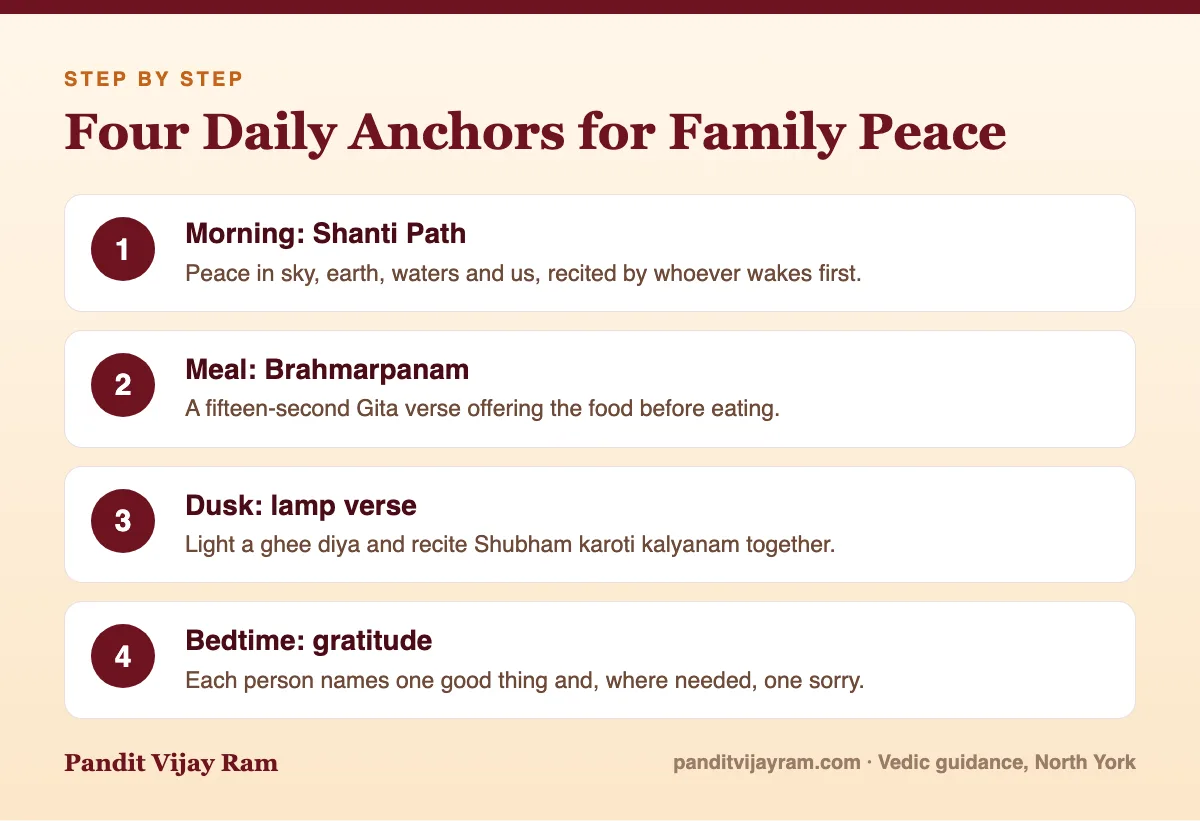
Here is a four-anchor pattern I suggest to busy households. Pick two to start.
- Morning. Whoever is up first lights incense or simply opens a window and recites the Shanti Path. Others join as they pass.
- Mealtime. Before the main meal, the verse from the Bhagavad Gita, brahmarpanam brahma havih, offers the food as sacred. It takes fifteen seconds.
- Dusk lamp. At sunset, light a ghee lamp and say Shubham karoti kalyanam, the traditional lamp verse asking for wellbeing and freedom from ill will.
- Bedtime. Each person names one thing they are grateful for and, where needed, says sorry for one thing. This is the hardest anchor and often the most healing.
Rotating the leader matters. A teenager who leads the lamp verse on Fridays owns it in a way a reluctant listener never does. Young children love ringing the bell or carrying the flower.
Shift workers can keep their anchor at any hour. The point is a fixed moment in their own day, not the clock on the wall. For guidance on lamp timing and auspicious days, see our panchang timing guide.
Which mantra brings peace at home during tense times?
When tension is high, a short mantra repeated quietly works better than a long text. Om Shanti, Om Namah Shivaya, or the Gayatri Mantra chanted eleven times together can lower the temperature. Some families add the Hanuman Chalisa on Tuesdays. Choose calm over volume, and pause the practice if it becomes another argument.
Tense weeks need lighter practices, not heavier ones. A few principles help.
- Lower the count. Eleven repetitions done with attention beat 108 done through clenched teeth.
- Chant softly. Volume can feel like a challenge to the person you are upset with.
- Sit side by side. Facing the lamp together, rather than each other, eases eye contact during a strained period.
- Separate prayer from conflict. Never use the prayer time to raise a grievance or lecture. Settle disagreements at another time.
- Invite, do not require. A family member who stays away today is still part of the household's prayer.
The Gayatri Mantra asks for the light of understanding to inspire our minds. Many parents find it a natural choice when the household needs clearer thinking rather than more feeling. It is traditionally recited at dawn, noon and dusk, but any calm moment is fine for a family practice.
If fights are frequent or frightening, prayer alone is not enough. Our article on why some homes have constant fights walks through the causes, and Vijay Ram ji's family problem guidance pairs remedies with practical next steps.
How can mixed-faith or less religious families pray together for peace?
Choose shared elements that respect everyone: a lit lamp, a minute of silence, a gratitude round, and a universal verse such as Sarve bhavantu sukhinah. Members of other faiths can offer their own short prayer in the same moment. Peace grows from inclusion, not from asking anyone to give up their beliefs.
GTA households often blend traditions. A Hindu and Sikh marriage, a Christian grandparent, a Muslim in-law, or a teenager who is unsure about religion at all. A peace routine can hold all of them.
- Shared silence. Sixty seconds of quiet before a lit lamp belongs to no single faith.
- Parallel prayer. One person recites the Shanti Path, another an Ardas line or a short dua, another the Lord's Prayer. Each listens to the others.
- Gratitude round. Everyone names one good thing from the day. This works for the least religious member as well as the most devout.
- Service. Once a week, do something kind together, such as preparing food for a neighbour or volunteering at a community kitchen.
Respect also means not using prayer to win a family argument about religion. If one person feels pressured, the practice stops being peaceful. Our guide to interfaith marriage and family disapproval covers the wider conversation.
Elderly parents can lead even if they cannot kneel or sit on the floor. A chair beside the altar is perfectly acceptable, and their blessing carries weight for younger family members.
When is a family peace prayer not enough?
Prayer cannot replace safety, counselling or medical care. If anyone at home is being hurt, threatened or controlled, call 911 in an emergency or reach a local shelter or helpline. Persistent depression, addiction or a child in distress need a family doctor, counsellor or school support. Prayer then continues alongside that help.
A calm routine can soften ordinary friction. It is not a tool for enduring abuse, and I say this plainly to every family I meet.
Get outside help when you notice:
- Physical harm, threats, or fear of going home.
- One person controlling money, phones or movement.
- Heavy drinking, drug use or gambling driving the fights.
- A family member who talks about not wanting to live. In Canada, call or text 9-8-8 any time.
- Children who are withdrawn, anxious or struggling at school for weeks. Speak to the school and your family doctor; our article on children who are not listening covers the parenting side.
Family counselling is often available through community agencies and employee assistance programmes. A counsellor and a pandit can work in the same direction, one with tools for communication and one with practices for calm.
When the situation is safe but heavy, a family puja can mark a fresh start. Vijay Ram ji arranges a Ganesh or Satyanarayan puja for households that want a shared beginning, through his puja and anushthan service.
The bottom line
A family peace prayer works through repetition, not grandeur. Anchor short verses such as the Shanti Path and Om Sahana Vavatu to moments you already share, and rotate who leads. Make room for every member, including those of other faiths or none. When safety, health or addiction is involved, get outside help first and let prayer support it.
Key takeaways
- Om Sahana Vavatu and the Shanti Path are the classic household peace verses.
- Tie prayer to waking, meals, the dusk lamp and bedtime.
- Short and regular beats long and occasional.
- Invite every family member, but never pressure anyone.
- Abuse, addiction or crisis need professional help before prayer.