
Indo-Caribbean Hindu Traditions in the GTA

Drive through parts of Scarborough, Richmond Hill or Brampton and you may notice tall bamboo poles with bright triangular flags in a backyard. Those are jhandi, and they tell you an Indo-Caribbean Hindu family lives there. When people look up Indo Caribbean Hindu Toronto traditions, they are often second- or third-generation Canadians wanting to understand their grandparents' practice, or neighbours curious about the flags. Many families with Guyanese, Trinidadian and Surinamese roots come to me in North York for kundli readings and pujas, and over forty years I have learned as much from their bhajans as they have from my readings. Their faith carried the Ramayan across oceans through hardship and kept it alive in new lands. This guide explains where these traditions came from, what jhandi mean, how Phagwah and chowtal are celebrated, the role of satsang and the mandir, and how families in the GTA are keeping the practice strong for children born here.
Who are Indo-Caribbean Hindus and how did they come to the GTA?
Indo-Caribbean Hindus descend largely from Indians, mostly from eastern Uttar Pradesh and western Bihar, who went to the Caribbean under the indenture system. They form the largest ethnic group in Guyana, Trinidad and Tobago and Suriname. Many later migrated to Canada, and the Toronto area became one of the main centres of that diaspora.
Between the abolition of slavery and the early twentieth century, the British, Dutch and French colonies recruited labourers from India to work on sugar estates. Most of those who went to the English-speaking Caribbean came from the Bhojpur and Awadh regions of the Hindi belt, and they carried their language, songs and rites with them.
Over generations a distinct Caribbean Hindu culture formed. It blended village customs from different parts of India, adapted to estate life and absorbed local influences, while holding firmly to the Ramayan, the Gita and core samskaras.
Later migration brought many Indo-Caribbean families to Canada, the United States and the United Kingdom. In the GTA, communities grew in Scarborough, Richmond Hill, Brampton, Mississauga, Pickering and beyond. Many families are multifaith, with Hindu, Muslim and Christian branches, and they share food, music and celebrations across those lines.
Indian Arrival Day, which marks the first ships reaching the Caribbean, is observed in Trinidad and Tobago, Guyana, Suriname and other countries, and many GTA families remember it with talks and cultural programs.
Families exploring the wider landscape can read our guide to Hindu temples across the GTA.

What do the jhandi flags in Indo-Caribbean yards mean?
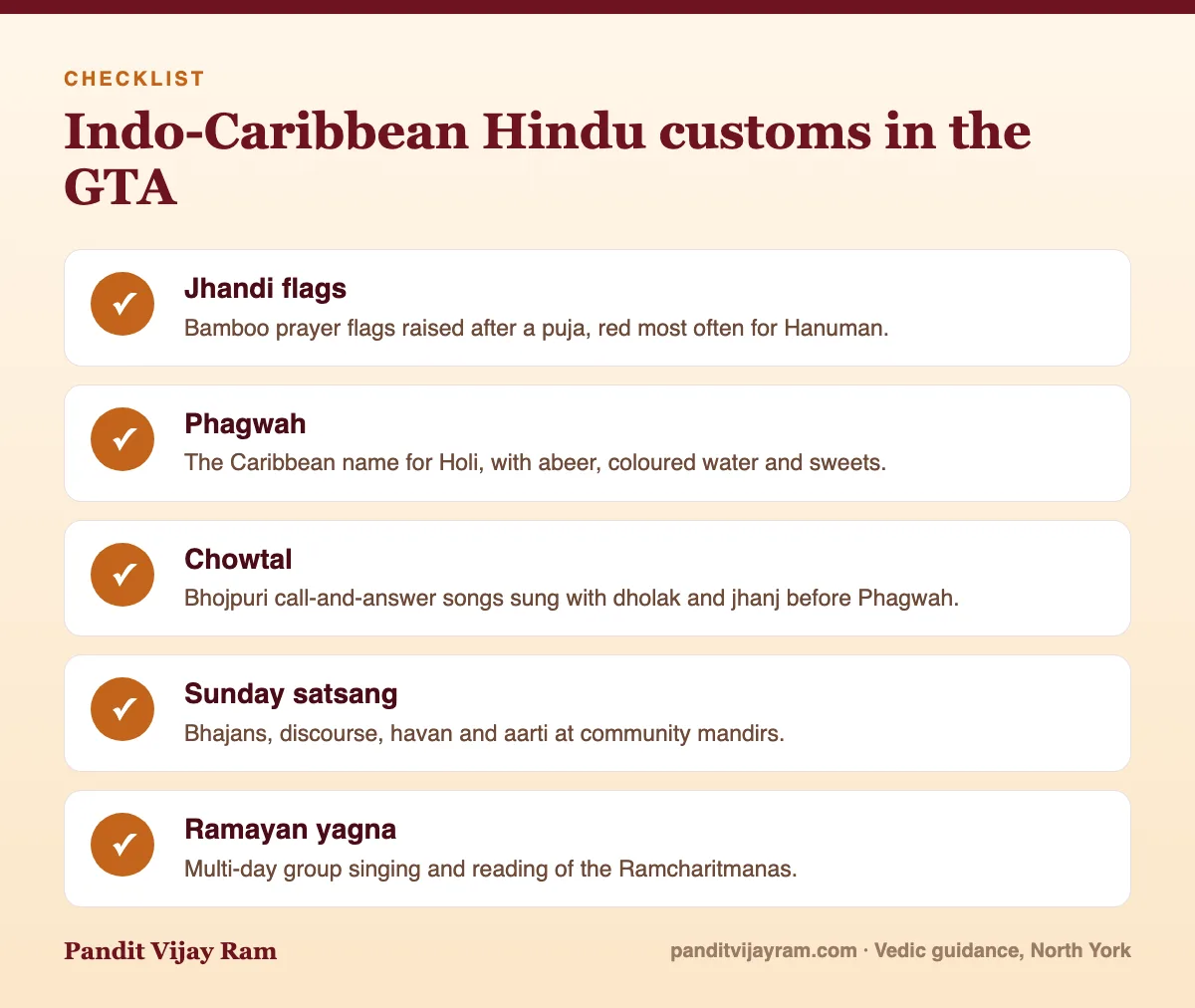
Jhandi are prayer flags on bamboo poles raised at the end of a puja. Each flag honours a deity, most often Hanuman with a red flag, and stays in the yard as a sign of blessing and protection. Families add new flags after each major puja, so a cluster of jhandi records a household's devotion.
In Indo-Caribbean practice a puja, often a Hanuman puja, Satyanarayan katha or Durga puja, usually ends with the raising of one or more jhandi. The priest blesses the flag, the family offers prayers, and the pole is planted, commonly toward the front or side of the home.
Colours carry meaning, though families and priests vary:
- Red is widely linked with Hanuman, the protector.
- Yellow or orange is often offered for Vishnu, Krishna, Surya or Ganesh.
- White may honour Shiva or Saraswati.
- Pink, red or other colours may be raised for forms of Devi.
A jhandi is not removed casually. When an old one fades, many families replace it at the next puja and dispose of the old flag respectfully. In GTA suburbs, check any rules your condo board or homeowners' association has about poles, and keep them secure in strong winds.
Neighbours who notice jhandi are seeing an act of prayer. Hanuman devotion runs deep in these homes, and our guides to Hanuman puja at home and the Satyanarayan puja explain the rites behind many jhandi. Vijay Ram ji's Hanuman puja and havan page describes how he performs it.
How is Phagwah celebrated, and what is chowtal singing?
Phagwah is the Indo-Caribbean name for Holi, the spring festival of colour celebrating the victory of devotion over arrogance in the story of Prahlad. In the weeks before it, groups sing chowtal, energetic Bhojpuri folk songs with dholak and jhanj. On the day, families throw abeer powder and coloured water and share sweets.
The name Phagwah comes from Phagun, the Hindu month in which Holi falls. In the Caribbean it became a central community festival, and the same spirit travels to GTA mandirs and parks.
Chowtal, sometimes spelled chowtaal, is a group singing tradition from the Bhojpuri region. Two lines of singers face each other and answer back and forth, building speed and volume, with dholak drums and jhanj cymbals. The songs tell of Krishna, Ram and the joy of spring. Some GTA temples hold chowtal gatherings, and Devi Mandir in Pickering has listed a grand chowtaal singing among its past events.
Common Phagwah customs include:
- Holika dahan on the eve, the burning of a symbolic pyre. In the GTA, open-air fires need local permission; see our guide to Holika Dahan and bonfire rules in the GTA.
- Abeer and coloured water thrown in fun, with older relatives often blessed first.
- Food such as gulgula, mohan bhog and sweets shared with neighbours.
Phagwah gatherings in the GTA are joyful and open, and many welcome friends from every background.
What role do the mandir, satsang and Ramayan play?
The mandir is the heart of Indo-Caribbean Hindu life, hosting weekly satsang with bhajans, a sermon and aarti. The Ramcharitmanas, often simply called the Ramayan, is sung in groups and read in multi-day yagnas. Many GTA mandirs continue these Caribbean styles of worship alongside traditions brought by families from India.
In the Caribbean, the weekly Sunday satsang became the rhythm of community life, and GTA mandirs kept that pattern. A typical gathering includes bhajans with harmonium and dholak, a pandit's discourse explaining a passage, havan on some days, aarti and prasad.
The Ramayan holds a special place. Groups sing chaupai from Tulsidas's Ramcharitmanas in the melodies their great-grandparents brought from India. Ramayan, Bhagwat and Shiva Puran yagnas, lasting several days, draw families from across the GTA.
Two GTA mandirs with visible Caribbean ties are:
- Vishnu Mandir on Yonge Street in Richmond Hill, run by Voice of Vedas Cultural Sabha, whose community also supports a dialysis centre in Guyana.
- Devi Mandir in Pickering, the Satya Sanatan Dharma Cultural Sabha of Canada, which describes itself as a leading Hindu temple on the east side of Toronto and has hosted chowtaal singing.
There are many more, from Arya Samaj and Sanatan Dharma streams, across Scarborough, Brampton and Mississauga. Our area guides to Hindu temples in Scarborough and Hindu temples in Richmond Hill say more. Vijay Ram ji is not affiliated with any temple named here.
How are Indo-Caribbean families keeping traditions alive for GTA-born children?
Families pass on the faith through youth satsang, music lessons in dholak, harmonium and tassa, Hindi or Caribbean Hindustani classes, and involving children in pujas and jhandi. Many also blend Caribbean customs with practices from Indian-born neighbours, and they explain the meaning behind rites in English so children feel ownership.
Grandparents often worry that the songs will fade. In my experience, children hold on when they understand and take part, not when they are simply told to sit quietly. Families I meet use practical approaches:
- Give children a role. Let them help raise the jhandi, ring the bell at aarti or hand out prasad.
- Teach the story first. Tell the Ramayan and the Prahlad story in English before the ritual, then the Hindi verses make sense.
- Music lessons. Dholak, harmonium, tassa and singing classes at mandirs connect teenagers to community.
- Record elders. Ask grandparents to sing chowtal, wedding songs and lullabies, and save them.
- Respect blended identities. Many young people are Guyanese, Trinidadian, Canadian and Hindu at once. All of it belongs to them.
Weddings are another moment where traditions return in full colour, with matikor, haldi and lawa ceremonies. Our guide to keeping Hindu wedding rituals meaningful in the GTA covers shared rites.
For families who also want a chart reading, Vijay Ram ji's kundli and horoscope service welcomes Caribbean-born clients, and he is glad to learn the specific customs a family follows.
The bottom line
Indo-Caribbean Hindu traditions in the GTA carry the faith of indentured ancestors who kept the Ramayan alive across oceans. Jhandi flags mark household devotion, Phagwah and chowtal bring spring joy, and satsang at mandirs such as Vishnu Mandir and Devi Mandir holds community together. Passing these on means giving children a role, telling the stories and honouring their blended identities.
Key takeaways
- Most Indo-Caribbean Hindus trace their roots to the Bhojpur and Awadh regions of India.
- Jhandi flags are raised after a puja and stand as signs of blessing, often for Hanuman.
- Phagwah is the Caribbean name for Holi, celebrated with chowtal singing and abeer.
- Weekly satsang and Ramayan singing remain central in Caribbean-founded GTA mandirs.
- Children keep traditions when they understand the stories and take part in the rites.