
Youth and Student Support Services in the GTA

Teenagers and students in our families carry a great deal: high expectations, two cultures at home and at school, exams, part-time jobs and sometimes a parent's immigration stress. When a young person struggles, parents often look for youth support GTA services but are unsure which helpline is real or confidential. Families in North York, Mississauga and Markham sometimes ask me whether a child's withdrawal is nazar or a bad planetary period. Sometimes faith has a role, yet I always say that a struggling teenager first needs to be heard by a trained person. In more than forty years of guiding families, I have seen young people recover their footing fastest when parents opened the door to proper help early. This guide lists verified services across the GTA: Kids Help Phone, Good2Talk for post-secondary students, One Stop Talk, Youth Wellness Hubs and school-based social workers. It also explains how parents can talk about help without shame.
Which helplines can young people in the GTA contact any time?
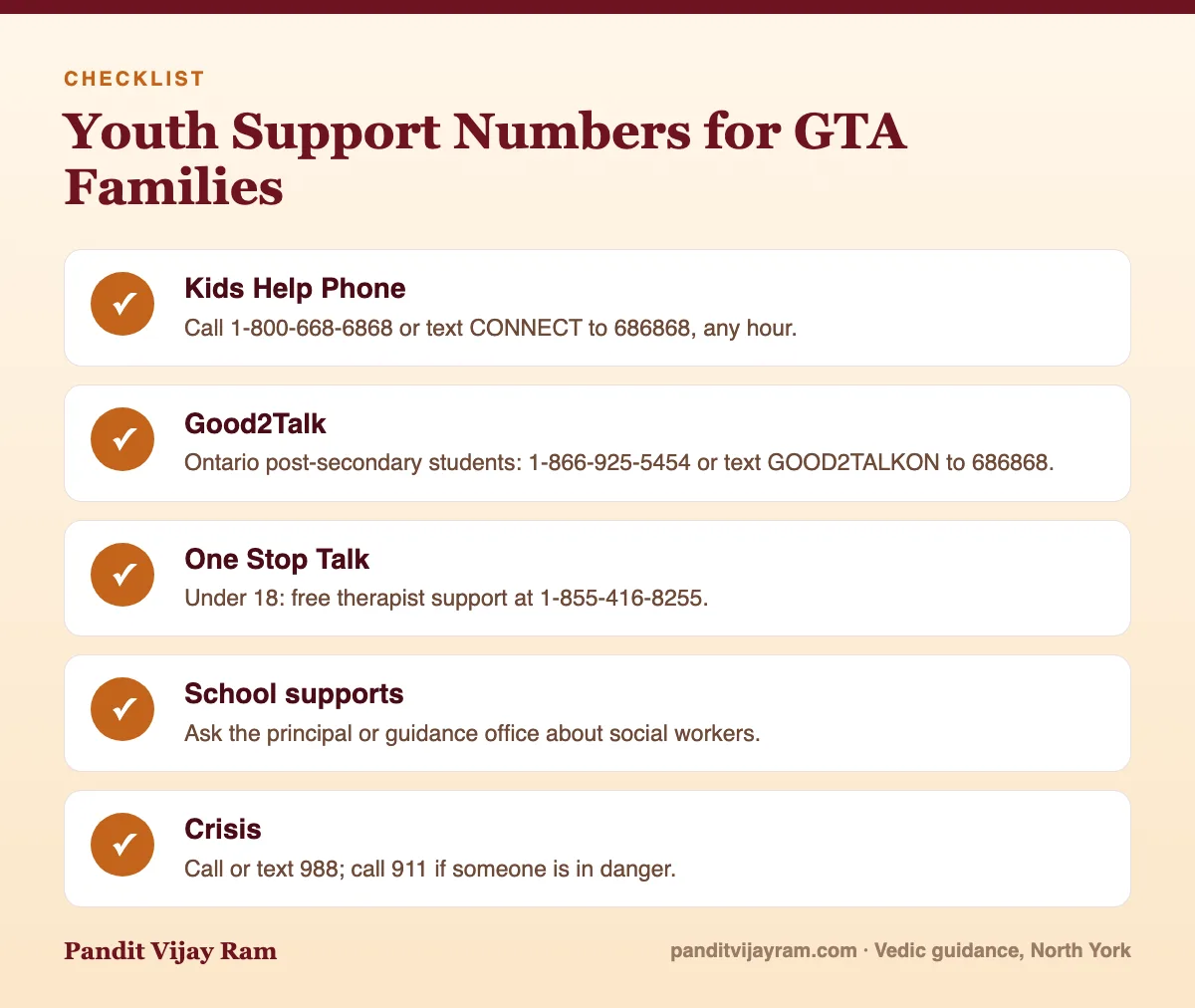
Kids Help Phone answers calls at 1-800-668-6868 and texts to 686868 (send CONNECT) at any hour, in many languages. Ontario post-secondary students can call Good2Talk at 1-866-925-5454 or text GOOD2TALKON to 686868. Anyone in suicidal crisis can call or text 988, and emergencies go to 911.
These are the core numbers for youth across the GTA, confirmed on each service's own website or on ontario.ca:
- Kids Help Phone: call 1-800-668-6868 to speak with a professional counsellor, or text CONNECT to 686868 to reach a trained volunteer crisis responder. Ontario describes it as free, multilingual and confidential.
- Good2Talk: for students at Ontario colleges and universities, 1-866-925-5454 or text GOOD2TALKON to 686868. The service says it offers free, confidential support at all hours.
- One Stop Talk: free, confidential, immediate mental health support with a registered therapist for children and youth under 18, at 1-855-416-8255.
- 9-8-8: the Suicide Crisis Helpline, call or text 988.
- 911: when someone is in immediate danger.
Save these in your child's phone with their permission, and in your own. A teenager is more likely to reach out at two in the morning if the number is already there and no one has to ask.
Older relatives sometimes worry that calling a helpline will bring police or social workers to the door. These are counselling services. Confidentiality has limits when life is at serious risk, which is exactly when outside help is needed. For a wider view of family mental health resources, see mental health support for South Asian families in the GTA.

What support do GTA schools offer students?
School boards across the GTA employ social workers, child and youth counsellors and guidance staff. In the Toronto District School Board, school social workers offer individual, group and family counselling, crisis response and attendance support, with parental consent sought when a student is referred. Ask the principal or guidance office how referrals work.
Every GTA school board organises support differently, so the right first contact is your child's teacher, guidance counsellor or principal. As one verified example, the Toronto District School Board describes its Social Work and Attendance Services this way:
- Individual counselling on self-esteem, anxiety, grief, anger and conflict.
- Group sessions on topics such as separation, social skills and grief.
- Family counselling when a student's concern calls for it.
- Crisis response after a tragic event at a school.
- Referrals to outside agencies.
The board notes that the school obtains consent from parents or guardians before an assessment begins. Peel, York, Durham and Halton boards and the Catholic boards have their own student services teams; their websites and school offices explain the process.
Parents from our communities sometimes hesitate because they fear a file will follow the child. Ask directly how records are kept and who sees them. Most staff will explain gladly.
If conflict at home is part of the stress, our guide on teenagers and parents in immigrant families offers ways to talk across generations. Younger children who seem to ignore every instruction may be helped by the ideas in children not listening: parenting stress and Vedic support.
What are Youth Wellness Hubs and who can use them?
Youth Wellness Hubs Ontario is a network of community hubs for people aged 12 to 25. Ontario says the hubs bring mental health and substance use support, primary health care and community and social services together in one place. Local hubs are run by community agencies, and several serve GTA neighbourhoods.
The idea behind a hub is simple: a young person should not have to tell their story five times in five offices. A hub combines counselling, health care, help with school or work, and peer support under one roof, often with drop-in access.
Ontario's mental health support page describes the hubs as serving ages 12 to 25. Local hubs in the GTA are run by community agencies, and their addresses and hours change, so check the Youth Wellness Hubs Ontario website or call 211 to find the nearest one.
Hubs can suit young people who:
- Feel uncomfortable going to a doctor with parents present.
- Want help with mood, substances or sleep alongside school or job concerns.
- Prefer a youth-focused space to a clinic waiting room.
- Are over 18 and have aged out of children's services.
For students living away from home at a GTA college or university, the campus health or counselling centre is usually the first stop, with Good2Talk available at any hour. Newcomer students can also ask their school's international student office about settlement help, and our guide to settlement services in the GTA lists community routes.
A parent who drives a teenager to a hub and waits in the car is showing trust. That gesture often matters more than any lecture.
How can parents tell normal teenage stress from a need for help?
Ordinary stress rises and falls with exams or friendships. Seek help when changes last more than two weeks or interfere with daily life: sleeping far more or less, withdrawing from everyone, falling grades, talk of hopelessness, self-harm, or substance use. Any mention of suicide calls for immediate support through 988 or 911.
Use this simple decision rule at home:
- Watch and talk if the change is short and linked to a clear event, such as a breakup or a hard exam week. Offer food, rest and a calm conversation.
- Book the family doctor if low mood, poor sleep, appetite change or withdrawal lasts beyond about two weeks. A doctor can check thyroid, iron, vitamin D and other physical causes that our long winters make worse.
- Use a helpline or hub when your child will not talk to you but might talk to someone else. Offer Kids Help Phone or Good2Talk without demanding to know what was said.
- Act at once if there is talk of suicide, self-harm or harm to others. Call or text 988, or call 911.
In my practice, parents sometimes bring a teenager's horoscope and ask for a remedy for laziness or bad company. I look at the chart, but I also ask about sleep, screens and whether the young person feels respected at home. Very often the real need is to be listened to.
Winter darkness affects young people too. Our article on winter darkness and low mood in Toronto covers light, routine and when to seek medical care.
Where does spiritual support fit for students and young people?
Faith can steady a young person through exams, homesickness and big decisions, when it is offered gently rather than imposed. Short prayers, a calm study space and a kundli reading focused on strengths can help. Spiritual guidance should never replace counselling, medical care or crisis services when a young person is struggling.
Many students from our communities pray before exams or carry a small murti or a kara for courage. That is healthy. Problems begin when spiritual explanations are used to avoid real help, or when fear is placed on a young mind.
Practices that support rather than frighten:
- A two-minute morning prayer to Saraswati or Ganesha before study, or a few breaths of silence for those of other faiths.
- A tidy study corner with good light; simple placement ideas appear in our guide to vastu for a home office.
- A strengths-based chart reading through our kundli and horoscope service, focused on aptitudes and timing rather than fixed verdicts.
- Service with peers, such as a youth seva group at a temple or gurdwara, which builds friendship and purpose.
I tell parents never to say a child is cursed or under nazar in front of them. Young people take such words to heart. If you believe nazar is at play, perform a quiet family custom privately and still pursue counselling if the struggle continues.
Young adults weighing career choices may find our article on what a chart can suggest about the right field useful as one input among many.
The bottom line
Youth support in the GTA is easier to reach than many parents think. Kids Help Phone, Good2Talk, One Stop Talk and 988 offer confidential help at any hour, while schools and Youth Wellness Hubs provide counselling in person. Watch for changes lasting more than two weeks and act at once on any talk of self-harm. Offer faith gently, alongside proper care, never instead of it.
Key takeaways
- Kids Help Phone: call 1-800-668-6868 or text CONNECT to 686868 at any hour.
- Ontario college and university students can reach Good2Talk at 1-866-925-5454.
- School social workers and Youth Wellness Hubs offer counselling close to home.
- Changes lasting beyond two weeks deserve a doctor's visit and a conversation.
- Spiritual support should calm a young person, never frighten or replace care.