
Hindu Funeral and Cremation Rites in the GTA: A Practical Guide
When someone dies, the family is asked to make many decisions within hours, often while still in shock. Planning a Hindu funeral GTA families can feel proud of means holding two threads at once: the legal steps Ontario requires and the antyesti rites your elders expect. Over more than forty years of practice I have stood with families in hospital corridors, funeral home chapels and crematorium viewing rooms, and I have seen how much it helps when someone explains the order of things calmly. Many of those families live in North York, Scarborough, Brampton and Markham, and their questions are almost always the same. This guide walks through the first calls to make, registering the death, choosing and talking with a funeral home, the traditional rites from washing the body to the last prayers at the crematorium, the days of mourning that follow, and where to find grief support. It is general guidance, and every family's regional customs deserve respect.
What are the first steps when a Hindu family member dies in Ontario?
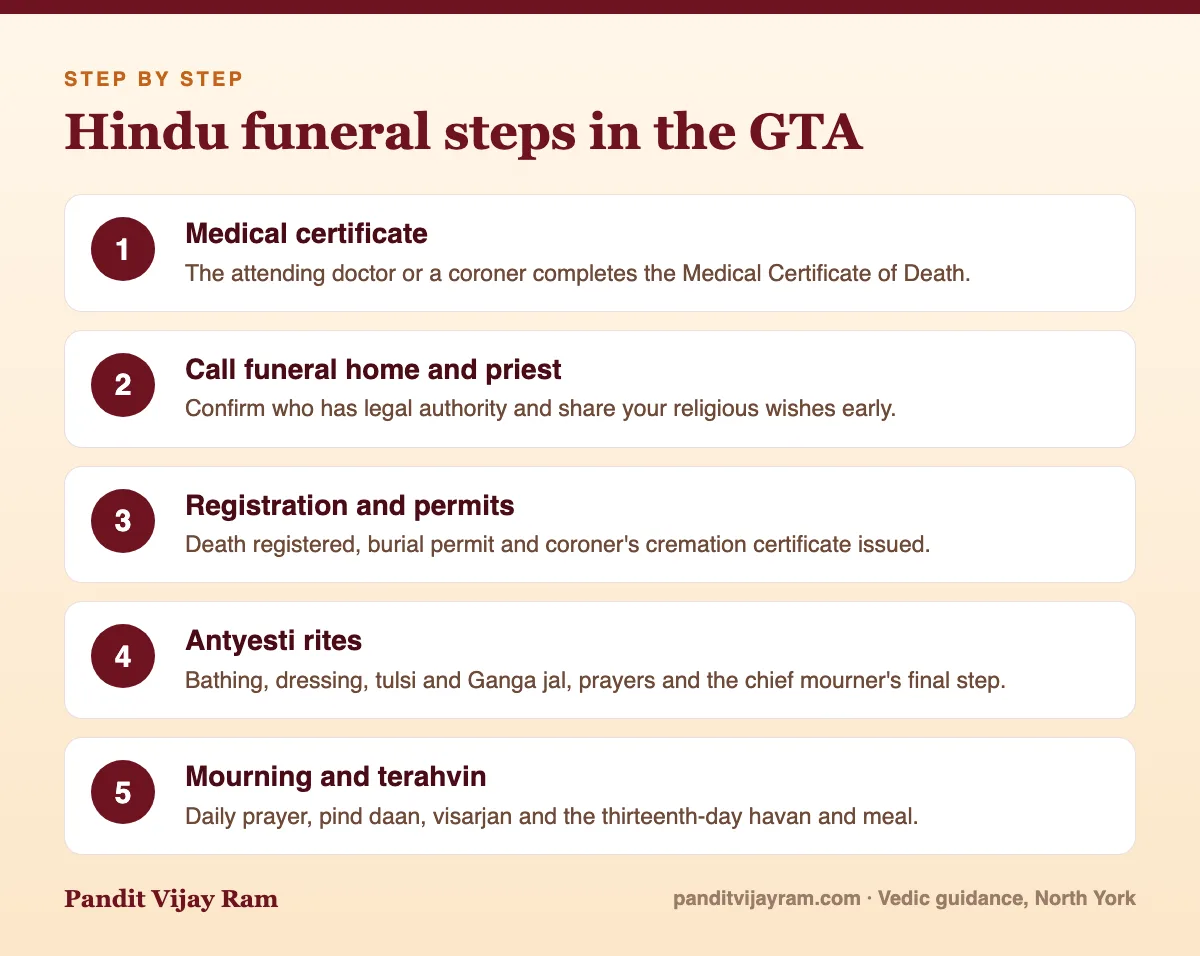
First, get a Medical Certificate of Death from the attending doctor, or call emergency services for an unexpected death; a coroner may be involved. Then contact a funeral home or transfer service, confirm who has legal authority to make arrangements, and call your family priest. Registration and a burial permit must come before cremation.
Ontario's guide, What to do when someone dies, sets out the order. In plain terms:
- Medical certificate. The doctor who was caring for the person, or a coroner, completes the Medical Certificate of Death. If a death is unexpected, call emergency services first.
- Who decides. Only certain people have legal authority over arrangements. Ontario lists them in order: the estate trustee, then a spouse, adult children and parents. Agree as a family early to avoid conflict later.
- Funeral home or transfer service. Most families call one to move the body. Ontario says you do not have to use a funeral establishment, and family members may provide funeral services themselves if they are not paid, except arterial embalming.
- Registration. A funeral director usually completes the Statement of Death with an informant, normally a family member, and registers the death with the municipality.
- Burial permit. The death must be registered before a burial permit is issued, and the permit is needed for cremation.
- Coroner's cremation certificate. Cremation also requires this certificate, which a funeral home usually arranges.
While these steps happen, call your family pandit. Timing matters to many Hindu households, who prefer cremation soon after death, and the priest will work around the crematorium's schedule.
How do you choose a funeral home for Hindu rites in the GTA?
Ask each funeral home whether it regularly serves Hindu families, whether relatives can wash and dress the body, whether a small lamp, incense or havan is allowed in the chapel, and whether family can witness the cremation. Compare written prices. All funeral establishments and crematoria in Ontario must be licensed by the Bereavement Authority of Ontario.
Many funeral homes across the GTA work with Hindu, Sikh and Jain families and are used to their customs, but practices differ. A short phone call with clear questions saves stress later. Ask:
- Washing and dressing. Can close family perform the ritual bath and dress the body in new or white clothes, or a red sari for a married woman in some traditions?
- Items in the casket. Are tulsi leaves, Ganga jal, a sacred thread, sandalwood paste and flowers permitted?
- Chapel rites. Is a lamp, incense or small havan allowed, and what fire rules apply?
- Crematorium viewing. Can the family be present when the casket enters the cremation chamber, and can the chief mourner take part in the final step?
- Timing. How quickly can paperwork and cremation be arranged?
- Ashes. When will the remains be ready, and in what container?
The Bereavement Authority of Ontario licenses funeral establishments, crematoria, cemeteries and transfer services, and families can contact it about concerns with a licensed operator. Its site also explains family-led death care for those who want to do more themselves.
Ask for an itemised written price list and do not feel pressured into extras. A simple, dignified service fully honours the person.
What happens during antyesti, the Hindu last rites?
Antyesti is the Hindu funeral sacrament. Typical steps include lighting a lamp near the body, a ritual bath, dressing in clean clothes, applying sandalwood or vibhuti, placing tulsi and Ganga jal at the lips, prayers and circling by the chief mourner, and then cremation, which the chief mourner symbolically begins.
Customs vary widely among North Indian, Gujarati, Bengali, Tamil, Telugu, Marathi and Indo-Caribbean families, so follow your priest and elders. A common outline is:
- At home or the funeral home. A lamp is lit near the head. Family chant the name of God, often Ram naam or Om Namah Shivaya.
- Bathing and dressing. Close relatives wash the body, sometimes with water mixed with Ganga jal, and dress it in clean clothes. Married women may be dressed as a bride in some traditions.
- Final offerings. A tulsi leaf and a few drops of Ganga jal are placed at the lips. Flowers, sandalwood and kumkum or vibhuti are applied.
- Parikrama. The chief mourner, traditionally the eldest son but often any child, circles the body with a pot of water or a lamp while prayers are recited.
- Mukhagni. In India this is lighting the pyre. At a GTA crematorium, the chief mourner may light camphor or press the start button where the facility permits.
Afterwards the family bathes, the home is cleaned and a lamp is kept burning. Our article on cleansing the home after a death describes gentle routines for the days that follow.
What are the 13 days of mourning and the terahvin ceremony?
Many Hindu families observe a mourning period of about ten to thirteen days after death. Daily prayers, scripture reading such as the Garuda Purana or Gita in some families, simple food and pind daan offerings mark this time. The thirteenth-day ceremony, often called terahvin, closes formal mourning with a havan, a meal and charity.
The length and form of mourning differ by community and caste tradition, and some families shorten it to fit work and travel in Canada. Common elements are:
- Sutak or ashaucha. A period when the household does not hold celebrations or visit temples for festivals. Simple vegetarian food is eaten.
- Daily prayer. A lamp and readings, such as the Bhagavad Gita, the Garuda Purana in some households, or bhajans.
- Pind daan. Rice balls offered to nourish the departed soul on set days, guided by the priest.
- Asthi visarjan. Immersing the ashes, either locally or later in India. Ontario's rules are explained in our guide to scattering ashes in Ontario.
- The thirteenth day. A havan or shanti path, a meal for relatives and priests, and gifts or charity in the person's name.
Many GTA families hold the terahvin at a temple hall or at home with a priest. Our guide to Hindu temples across the GTA can help you find a mandir, and Vijay Ram ji's puja and anushthan service can arrange a havan or shanti puja.
Remembrance continues through annual shraddh, explained in our article on shraddh and pitru remedies.
Where can grieving families find support in the GTA?
Grief support in the GTA includes peer groups such as Bereaved Families of Ontario, hospice and hospital bereavement programs, your family doctor, faith communities and counsellors who understand South Asian families. Grief can bring dreams, a felt presence or poor sleep; these are usually normal. Seek medical help if sleep, appetite or mood stay low.
After the relatives go home, the quiet can be hardest. Practical supports include:
- Bereaved Families of Ontario. BFO-Toronto describes itself as a charity offering peer support, one-to-one and in groups, to people grieving any kind of loss. Other affiliates serve other regions.
- Hospice and hospital programs. If your loved one was cared for by a hospice or palliative team, ask about their bereavement follow-up.
- Your family doctor. Especially for elders who live alone or a spouse who stops eating or sleeping.
- Faith community. Satsang, bhajan groups and temple volunteers often check on mourners.
- Culturally aware counselling. Our guide to South Asian mental health support in the GTA lists options. In crisis, call or text 9-8-8.
Families sometimes ask me whether a dream of the departed means the soul is restless. Most often it is love and grief working through the mind. Our articles on feeling the spirit of a deceased relative and living in a house where someone died explore this gently and without fear.
The bottom line
A Hindu funeral in the GTA runs on two tracks: Ontario's steps of medical certificate, registration and burial permit, and the antyesti rites your family holds dear. Ask funeral homes clear questions about washing, chapel rites and crematorium viewing, and get prices in writing. Then let the mourning period, the thirteenth-day ceremony and later shraddh carry remembrance forward, with grief support close at hand.
Key takeaways
- A medical certificate, death registration and a burial permit must come before cremation in Ontario.
- Funeral homes and crematoria in Ontario are licensed by the Bereavement Authority of Ontario.
- Ask early whether family can wash the body, hold chapel rites and witness the cremation.
- Mourning often lasts ten to thirteen days and closes with the terahvin ceremony.
- Grief support groups, your family doctor and your faith community can help afterwards.