
Navratri in the GTA: Garba, Fasting and a Practical Spiritual Plan
Families planning Navratri Toronto evenings face a real squeeze. Work and school do not pause for nine nights, the commute eats the evening, and garba often starts after dinner and runs late. Yet the goddess is calling, the temple calendar is filling up, and many of us want our children to feel what Navratri felt like at home. Clients in North York, Brampton and Mississauga ask me every year how to do it properly without burning out. In more than four decades of Vedic practice, I have seen that a small, steady observance kept for nine nights carries more devotion than an ambitious plan dropped by the fourth day. This article explains what Navratri celebrates, a simple home plan that fits a working week, the nine forms of Durga night by night, how to fast sensibly and who should not fast at all, and what to know before you head to garba.
What is Navratri and why is it celebrated?
Navratri, meaning nine nights, honours the Divine Mother as Durga, celebrating her victory over the buffalo demon Mahishasura. It is observed twice a year, in spring as Chaitra Navratri and in autumn as Sharad Navratri. The tenth day, Vijayadashami or Dussehra, marks the triumph of good over wrong.
Navratri is celebrated very differently across India and the diaspora, and the GTA sees nearly all of these styles side by side.
- Gujarati and Rajasthani families centre the nights on garba and dandiya raas around a lamp or image of the goddess.
- Bengali families celebrate Durga Puja in the final days with pandals, arti and dhunuchi dance.
- North Indian families often keep fasts, read the Durga Saptashati and perform kanya puja on Ashtami or Navami.
- South Indian families may set up a golu, a display of dolls on tiered steps, and invite friends to visit.
- Indo-Caribbean families often mark the nights with temple services, fasting and devotional songs.
Sharad Navratri, the autumn observance, is the larger festival for most GTA families. Chaitra Navratri in spring often ends with Rama Navami.
Exact start dates and the kalash sthapana muhurat change each year, so check a panchang set for Toronto. Our guide to reading the panchang for auspicious timing explains how. For families who want a deeper reading practice, our article on the Durga Saptashati path describes its structure.
How can busy families celebrate Navratri at home?
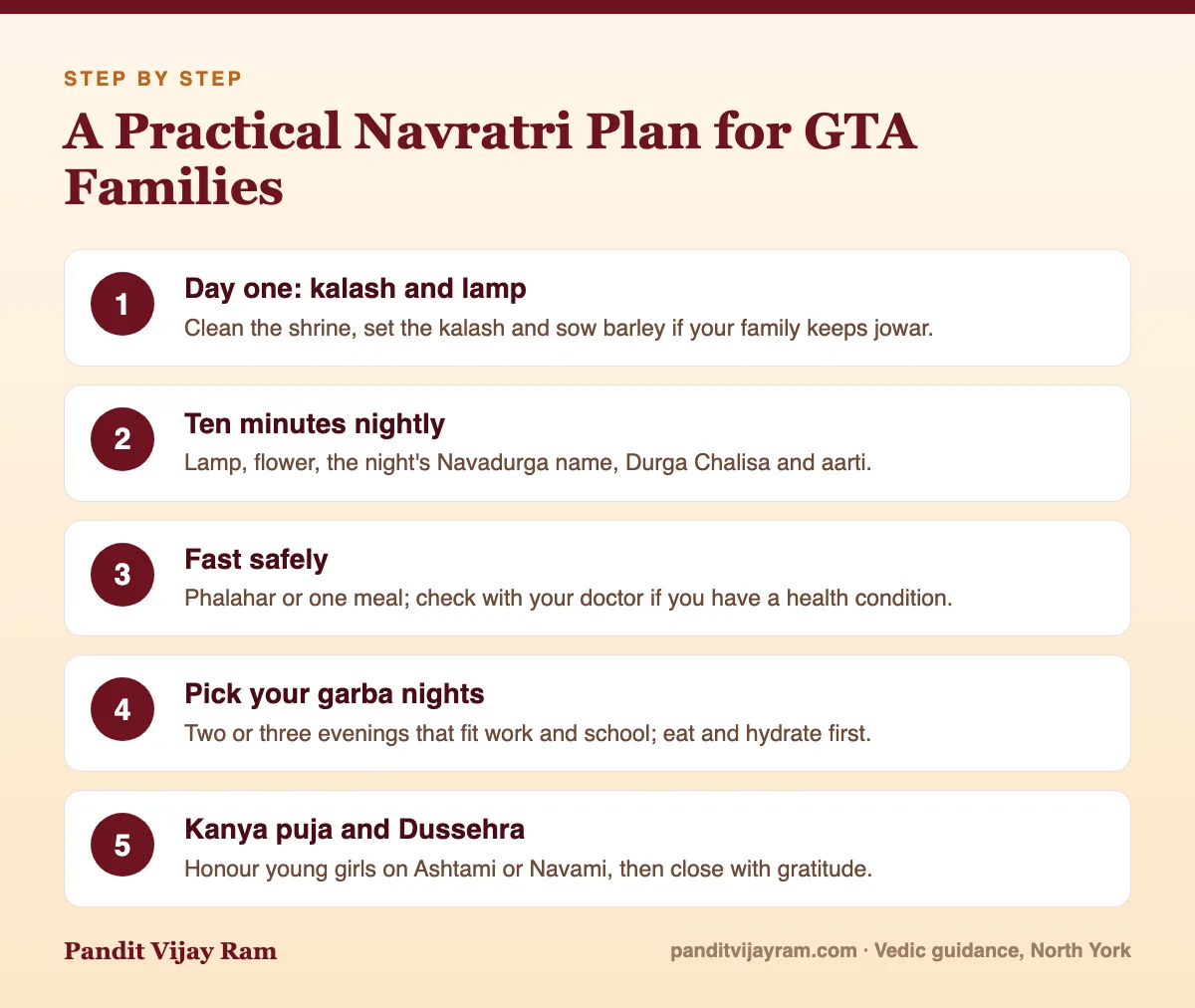
Set up a simple kalash and lamp on the first day, then give the goddess ten to fifteen focused minutes each evening: light the diya, offer a flower, chant a short mantra or Durga Chalisa, and do aarti together. Save longer rituals such as kanya puja for the weekend or the final days.
A realistic nine-night plan for a working household looks like this:
- Day one setup. Clean the shrine, place a kalash with water, mango leaves and a coconut, and sow barley or wheat in a small tray of soil if your family keeps jowar. This takes under an hour.
- Each evening. Light one ghee lamp, offer a fresh flower, chant the day's goddess name or the Durga Chalisa, and do aarti. Ten minutes is enough when done with attention.
- One reading. If you want to read the Saptashati, divide its chapters across the nine nights rather than attempting it all at once.
- One family moment. Let children ring the bell, choose the flower or tell the story of the day's form.
- Ashtami or Navami. Hold kanya puja, inviting young girls to be honoured and fed. Many GTA families move this to the nearest weekend.
- Dussehra. Close the observance with gratitude, share prasad and return sprouted grains to the soil.
If your family keeps an akhand jyoti burning all nine nights, plan carefully in a condo or rental. Read our fire-safe lamp guide first, and consider having the unbroken lamp kept at a temple. A full Durga anushthan with havan can also be performed on your behalf through Vijay Ram ji's Durga puja and havan service.
Which form of Durga is worshipped on each night of Navratri?
The nine forms, called Navadurga, are usually worshipped in this order: Shailaputri, Brahmacharini, Chandraghanta, Kushmanda, Skandamata, Katyayani, Kalaratri, Mahagauri and Siddhidatri. Each night focuses on one form and its qualities, from steadiness and discipline to courage, nurture and spiritual fulfilment.
Knowing the night's goddess turns a routine aarti into a short teaching for the whole family. A simple guide:
- Night 1, Shailaputri: daughter of the mountain, a prayer for stability and a firm start.
- Night 2, Brahmacharini: the ascetic, honouring discipline and steady effort.
- Night 3, Chandraghanta: crowned with the half-moon bell, invoked for courage and calm.
- Night 4, Kushmanda: associated with the creation of the cosmos, a prayer for vitality.
- Night 5, Skandamata: mother of Skanda, honouring nurture and parental love.
- Night 6, Katyayani: the warrior form, often prayed to by those hoping for a good marriage.
- Night 7, Kalaratri: the fierce dark form who removes fear. Our article on Kali puja for protection explains why fierce forms are protective, not frightening.
- Night 8, Mahagauri: radiant and pure, a prayer for forgiveness and peace.
- Night 9, Siddhidatri: giver of spiritual accomplishment, closing the cycle.
Some families also link a colour to each day for clothing. That custom varies by region and year, so follow your community's list if you enjoy it, without worrying if you miss one.
What are the rules for Navratri fasting, and who should not fast?
Navratri fasts range from one simple meal a day to fruit and milk only. Many families avoid grains, onion, garlic and regular salt, using sabudana, kuttu, singhara, potatoes and rock salt instead. People with diabetes, pregnancy, eating-disorder history or regular medication should speak to their doctor before fasting, or choose another offering.
Fasting is an offering of discipline, not a test of endurance. Choose a level you can keep safely:
- Phalahar: fruit, milk, yoghurt, nuts and fasting flours, the most common choice.
- One meal: a single sattvic meal in the evening after puja.
- Partial fast: fasting only on the first and last days, or on Ashtami.
- Strict fasts without water: these are traditional for some, but I do not recommend them for anyone working, dancing garba or living with a health condition.
Please talk to your family doctor before fasting if you have diabetes, heart or kidney conditions, low blood pressure, are pregnant or breastfeeding, take regular medication, have a history of disordered eating, or are a growing teenager or a frail elder. Fasting while on insulin or certain tablets can be dangerous.
Practical care for those who do fast:
- Drink water, coconut water or buttermilk through the day.
- Fried fasting foods every night add up. Balance sabudana and kuttu puris with fruit, yoghurt and roasted makhana.
- Eat before garba, not after midnight only.
Those who cannot fast can offer charity, extra japa or a habit given up instead. Our article on fasting as spiritual discipline explains the reasoning in more detail.
Where can you play garba in Toronto and what should you know?
Garba nights in the GTA are usually hosted by temples, Gujarati and other cultural associations, and community groups in halls and event spaces. Check their notices and social pages as the festival nears. Eat beforehand, drink water, wear comfortable footwear, plan for late nights on work days and keep the devotional centre in mind.
Garba takes its name from garbha, the womb, and traditionally circles a clay pot with a lamp inside, a symbol of the goddess as the source of life. Dandiya raas, danced with pairs of sticks, often follows. Even in a crowded hall, many dancers begin by bowing to the goddess at the centre.
Before you go:
- Find events early. Popular nights may need tickets or registration. Temple and association websites and community newsletters are the most reliable sources.
- Fuel and fluids. Hours of dancing after a day of fasting can make people faint. Eat a proper phalahar meal before you leave and keep water with you.
- Footwear and clothing. Many halls want dancers in clean flat shoes or barefoot. Heavy chaniya choli can be hot, so dress in layers for the cold walk back to the car.
- Work and school nights. Choose two or three evenings rather than all nine if mornings matter.
- Children. Agree a meeting point in large venues.
- Getting home. Plan a safe ride, especially after late events in winter weather.
Joy is part of the worship. If you cannot dance, sitting with the aarti and singing along is participation too.
The bottom line
A Navratri Toronto plan works when it fits real life: a simple kalash and lamp, ten focused minutes each evening, and the night's form of Durga named aloud. Fast only at a level that is safe for your health, and speak to your doctor first if you have a medical condition. Choose the garba nights that suit your week, eat before dancing and let joy sit at the centre of the festival.
Key takeaways
- Navratri honours Durga over nine nights and ends with Dussehra.
- Ten steady minutes of nightly prayer carry more devotion than an exhausting plan.
- Knowing each night's Navadurga form turns aarti into a family teaching.
- Speak to your doctor before fasting if you have a medical condition, are pregnant or take medication.
- Eat and hydrate before garba, and choose the nights that suit your week.