
Hindu Heritage Month in Ontario

Diwali lamps often glow in GTA windows around the start of November, and many people assume that is all the month holds. In fact, Hindu Heritage Month Ontario recognition gives the whole of November a wider purpose: remembering where our traditions came from, sharing them with neighbours and teaching them to the next generation. Families in North York, Scarborough and Brampton often ask me how to mark the month meaningfully beyond sweets and fireworks. In more than forty years as a Vedic practitioner, I have watched children grow proud of their roots when the adults around them explained the why behind each custom. This guide explains what Ontario's Hindu Heritage Month Act says, how it connects with Canada's national calendar, how families, temples and schools across the GTA can observe it, and how to share Hindu heritage with friends of other faiths in a spirit of respect rather than display.
What is Hindu Heritage Month in Ontario?
It is November, proclaimed by Ontario's Hindu Heritage Month Act. The Act's single proclamation reads that the month of November in each year is proclaimed as Hindu Heritage Month. Its preamble honours Hindu Canadians' contributions to Ontario and calls the month an opportunity to remember, celebrate and educate future generations.
The Hindu Heritage Month Act began as a private member's bill sponsored by MPP Joe Dickson and received Royal Assent, according to the Legislative Assembly of Ontario's bill record. Its key points:
- The proclamation: November in each year is Hindu Heritage Month in Ontario.
- Contributions: the preamble says Hindu Canadians have contributed across many fields and helped make Ontario the multicultural success story it is.
- Diwali: it describes Diwali as the biggest Hindu celebration, one that commemorates the victory of good over evil.
- Purpose: recognising these contributions and providing an opportunity to remember, celebrate and educate future generations.
Like other heritage months, it is a recognition rather than a public holiday. Schools and offices stay open, but many choose to mark it through assemblies, displays and events.
Hindu families in Ontario come from India, Nepal, Sri Lanka, Bangladesh, the Caribbean, Fiji, East Africa and beyond. The month belongs to all of them. Indo-Caribbean traditions, for example, have their own beloved forms of puja and music, described in our guide to Indo-Caribbean Hindu traditions in the GTA.

Is Hindu Heritage Month recognised across Canada too?
Yes. Canadian Heritage's list of important and commemorative days includes Hindu Heritage Month in November, alongside Tamil Heritage Month in January, Sikh Heritage Month in April and Asian Heritage Month in May. In Ontario, the provincial Act and the national listing point to the same month.
Recognition happens at two levels, and both use November:
- Provincial: Ontario's Hindu Heritage Month Act proclaims November in law.
- National: Canadian Heritage lists Hindu Heritage Month in November on its calendar of important and commemorative days.
Ontario also has separate heritage-month laws for several communities close to many Hindu families, including Tamil, Sikh, Bangladeshi and South Asian heritage. May is proclaimed as South Asian Heritage Month in Ontario; our guide to South Asian Heritage Month in the GTA explains it.
Why does a heritage month matter if no one gets a day off? In my experience it gives permission. A shy child finds it easier to bring a diya to show-and-tell when the school calendar names the month. A manager finds it easier to approve a team lunch with Indian sweets. Recognition opens small doors.
It also invites accuracy. Hindu practice is diverse, with Vaishnava, Shaiva, Shakta and Smarta streams, regional festivals and many languages. When presenting Hindu heritage publicly, show that variety rather than a single picture.
How can Hindu families observe Hindu Heritage Month at home?
Choose a few meaningful practices for the month: a daily lamp and short prayer, one scripture story each week, a family puja such as Lakshmi–Ganesh puja for Diwali, cooking festival foods together, and honouring ancestors. Explain the meaning behind each act to children so heritage becomes understanding, not routine.
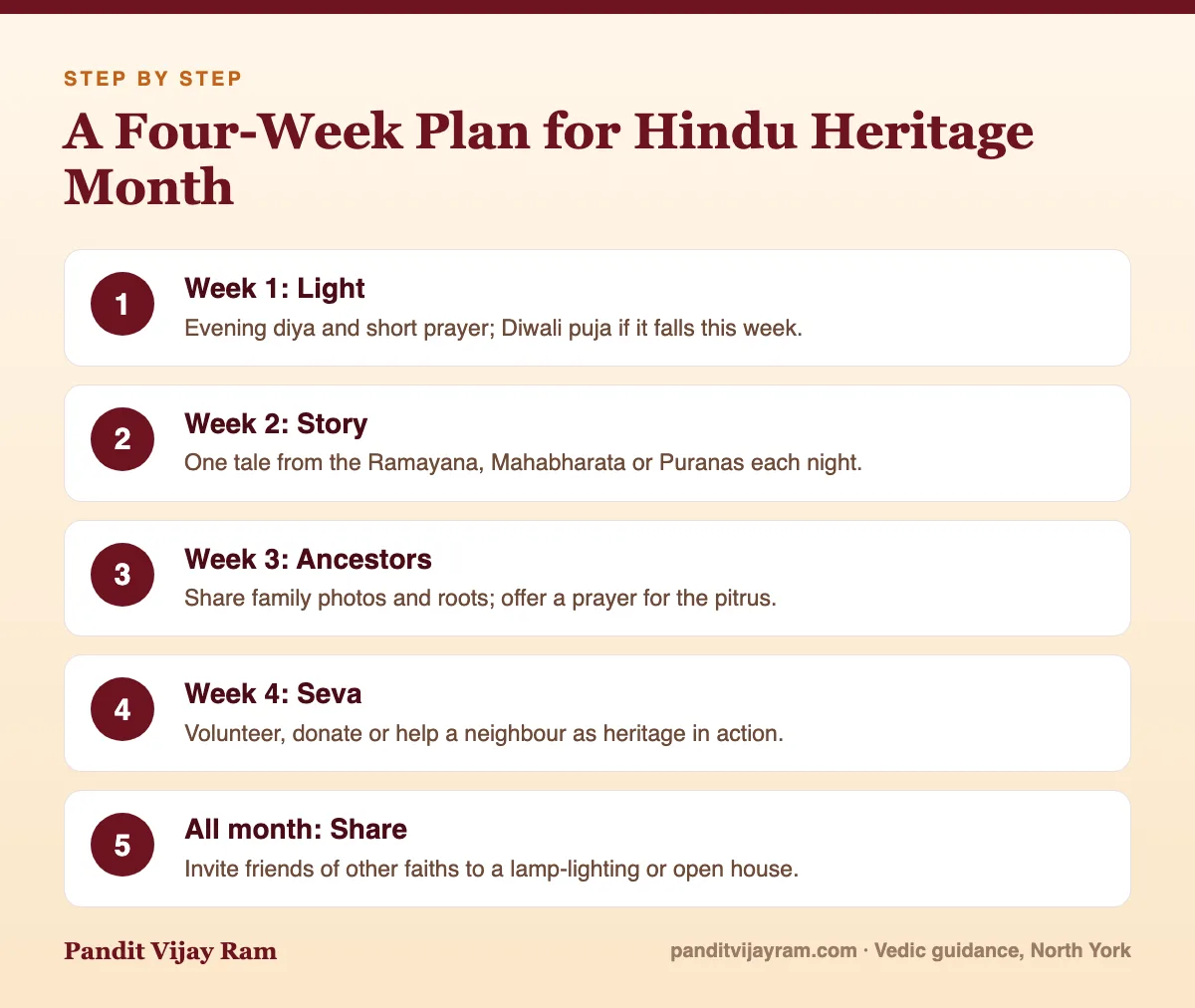
A month is long enough to build a habit. Here is a simple four-week plan many GTA families can adapt:
- Week one, light: light a diya each evening and recite a short prayer. If Diwali falls this week, perform Lakshmi–Ganesh puja at home, following condo and fire-safety rules.
- Week two, story: read or tell one story from the Ramayana, Mahabharata or Puranas each night. Ask children what the hero should have done differently.
- Week three, ancestors: look at old family photographs, share where grandparents came from, and offer a simple prayer for the pitrus.
- Week four, seva: volunteer at a temple kitchen, donate to a food bank, or help an elderly neighbour. Seva is heritage in action.
Families in the Gujarati, Marathi and North Indian traditions may also observe Tulsi Vivah around this season; see Tulsi Vivah: meaning, story and how families celebrate.
Do not worry about doing everything perfectly. I tell families that one sincere lamp is better than an elaborate puja done in a rush. If you would like help planning a havan or anushthan for the month, our puja and anushthan page explains what is involved.
How can temples, schools and workplaces in the GTA mark the month?
Temples can host open houses and talks for neighbours, schools can invite Hindu families to share festivals and stories, and workplaces can offer an inclusive lunch or talk. The best events are led by community members, show Hindu diversity, explain meanings, and avoid turning sacred symbols into decorations or costumes.
Across the GTA, heritage months are often marked locally rather than with one big event. Ideas that work:
- Temple open house: a guided tour explaining murtis, aarti and prasad, with time for questions. Our list of Hindu temples across the GTA includes visitor etiquette.
- School sharing: a parent reads a Diwali story, demonstrates rangoli, or explains the meaning of namaste.
- Library displays: many branches welcome book suggestions for heritage months.
- Workplace talk: a short session on Hindu festivals and why some colleagues fast or need time off.
Respect matters in each setting:
- Do not use images of deities on paper plates, napkins or anything that will be thrown away.
- Ask before photographing worship.
- Explain that not all Hindus celebrate the same festivals or eat the same foods.
- Keep fire safety in mind; battery diyas are wise in offices and classrooms.
If a Hindu employee or student needs time off for a festival during November, the Ontario Human Rights Code's protection of creed applies. Our guide to religious accommodation in Ontario explains how to ask.
How can Hindu heritage be shared respectfully with other faiths?
Share by invitation, not persuasion. Explain customs in plain language, welcome questions, listen to neighbours' traditions in return, and present Hinduism as a living family of practices rather than a set of exotic images. Interfaith sharing works best over food, stories and service, where friendship rather than debate leads the way.
The GTA is one of the most religiously mixed regions anywhere. Hindu families live beside Sikh, Muslim, Christian, Jewish, Buddhist and secular neighbours, and many households are themselves interfaith. Hindu Heritage Month is a natural chance to build understanding.
Gentle ways to share:
- Invite neighbours to a lamp-lighting or a simple aarti and explain each step.
- Bring sweets with a note explaining the festival or the meaning of prasad.
- Join interfaith events run by community groups or libraries.
- Listen as much as you speak. Ask friends about Advent, Hanukkah, Gurpurab or Eid, and notice the shared themes of light and gratitude.
Hindu tradition has long held that truth is one though the wise call it by many names, a phrase from the Rig Veda that many families quote. That spirit suits interfaith sharing well. It also means never belittling another faith to praise our own.
Couples navigating two traditions at home may find our guide to interfaith marriage and family disapproval helpful. Families of every background are welcome to the guidance on our about page, which explains how Vijay Ram ji works within the Vedic tradition.
The bottom line
Hindu Heritage Month in Ontario is November, proclaimed by provincial law and listed on Canada's commemorative calendar. Families can observe it with daily light, stories, ancestor prayers and seva, while temples, schools and workplaces mark it through respectful, community-led events. Sharing Hindu heritage works best by invitation and friendship, honouring other faiths as we explain our own.
Key takeaways
- Ontario's Hindu Heritage Month Act proclaims November as Hindu Heritage Month.
- Canadian Heritage also lists Hindu Heritage Month in November.
- The month is a recognition, not a public holiday, and belongs to every Hindu community.
- A simple weekly plan of light, story, ancestors and seva suits most families.
- Interfaith sharing should invite and explain, never persuade or belittle.