
Finding an Imam for Istikhara or Ruqyah Questions in the GTA

Muslim readers often write to me with a sincere question: should I pray istikhara myself, or ask someone to do it for me? Is the ruqyah a relative recommended genuine? Finding an imam for istikhara GTA families can trust is the safest answer to both. I work in the Vedic tradition from North York, and in more than forty years I have learned the limits of my own role. When a question concerns Islamic law, prayer or Quranic healing, the respectful thing is to send the person to a qualified imam of their own faith. This guide is written to make that easier. It explains why rulings on istikhara and ruqyah belong with scholars, how to find an imam or chaplain across Toronto, Peel and York, a few established Islamic centres where you can start, what to ask, and how to recognise someone who sells fear rather than faith. It is a map, not a fatwa.
Why should istikhara and ruqyah questions go to an imam?
Istikhara and ruqyah are acts of Islamic worship with rules drawn from the Quran, the Sunnah and the work of scholars. Questions about how to pray, whether someone else can pray on your behalf, which recitations are authentic and what is forbidden involve fiqh, Islamic jurisprudence. A qualified imam can answer within your school of thought.
Salat al-Istikharah is a prayer in which a Muslim asks Allah for guidance in a permissible choice, followed by a specific supplication taught in hadith. Ruqyah is healing through recitation of the Quran and authentic supplications. Both are simple at their core, yet questions around them quickly become technical:
- Can a parent or imam pray istikhara for someone else?
- Must a dream follow istikhara, or is ease in the matter the sign?
- Which verses and duas are used in ruqyah, and is blowing on water acceptable?
- Are amulets, written charms or particular oils permitted?
- How should a woman seek ruqyah while keeping modesty?
Sunni schools, Shia scholars and different teachers answer some of these differently. That is not confusion; it is a tradition of careful scholarship. A local imam knows your community, speaks your language and can explain the reasoning, not just a ruling.
Our earlier guides explain the practices themselves: istikhara dreams and their meaning, istikhara for marriage and ruqyah water and oil. For any ruling, your imam remains the authority.

How do you find a qualified imam or Islamic centre in the GTA?
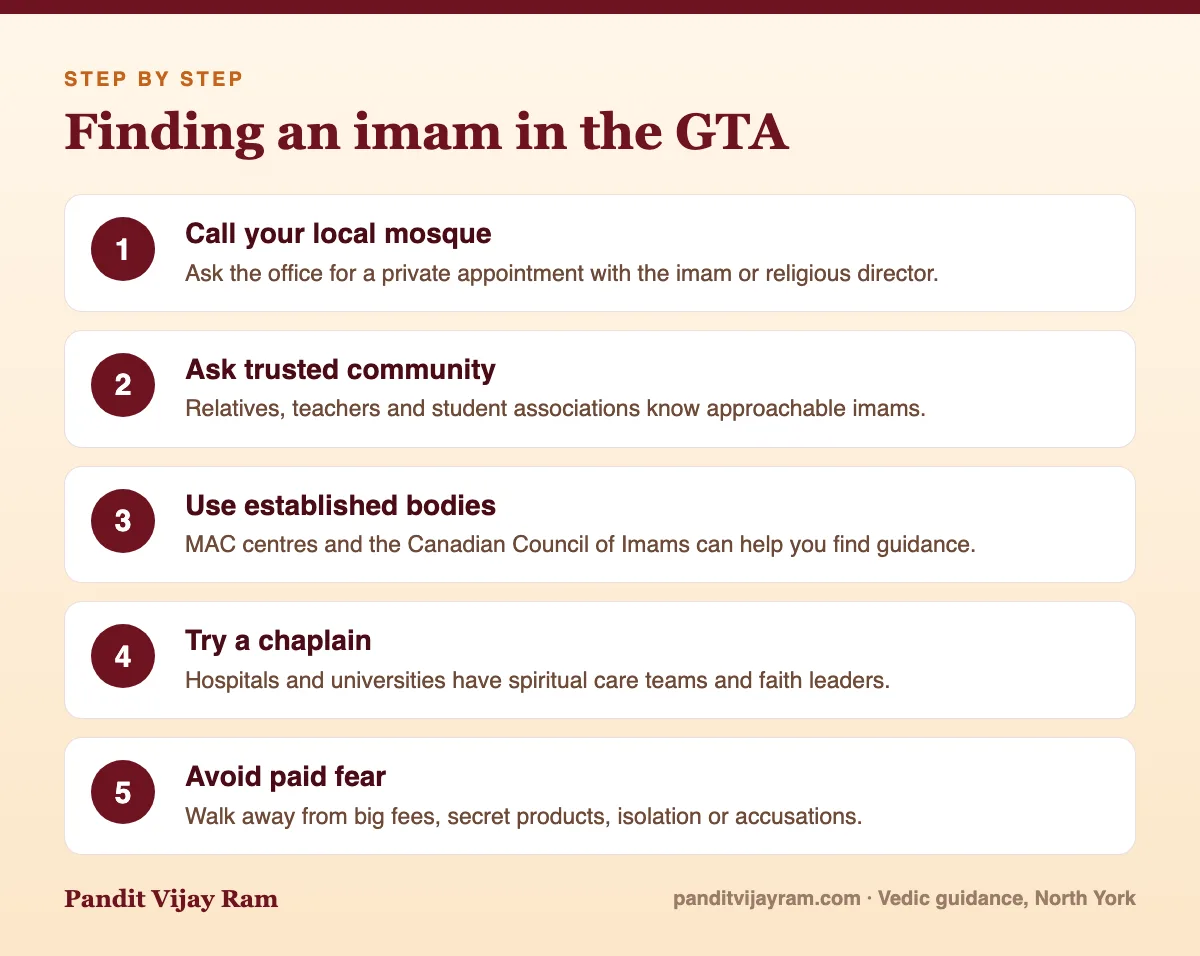
Start with your nearest mosque and ask to speak with the imam or religious director. If you have no mosque, ask trusted relatives, a Muslim student association or established organisations such as the Muslim Association of Canada, which runs centres in Toronto and Mississauga. The Canadian Council of Imams brings imams together nationally.
The GTA has many mosques and musallas, from large Islamic centres to small prayer rooms above shops. Good ways to find the right imam include:
- Your neighbourhood mosque. Call the office, explain that you have a personal religious question and ask for an appointment with the imam.
- Established organisations. The Muslim Association of Canada lists its centres and masajid, including Masjid Toronto, with two downtown locations on Adelaide and on Dundas, and the Islamic Community Centre of Ontario in Mississauga.
- The Canadian Council of Imams. It describes itself as a platform for imams and Muslim leaders across Canada, affiliated with many imams, and its contact form includes religious guidance as a category.
- Family and community. Relatives, a respected teacher at a weekend madrassah or a Muslim student association often know which imam is approachable on sensitive matters.
- Women's needs. Many women prefer to speak first with a female teacher or counsellor. Ask the mosque whether one is available.
Look for an imam with recognised study, a role in an established congregation and a willingness to say, "I will check and come back to you." That humility is a good sign.
For families also facing marital or community stress, our guide to family support services in Toronto lists non-religious help.
Which established Islamic centres in the GTA can you contact?
Examples include the Islamic Foundation of Toronto on Nugget Avenue in Scarborough, which provides imams who are licensed marriage officers, and Muslim Association of Canada centres such as Masjid Toronto downtown and the Islamic Community Centre of Ontario in Mississauga. Many other mosques across Peel, York and Durham also serve their communities.
This is a short, verified starting list, not a ranking. Each institution describes itself on its own website:
- Islamic Foundation of Toronto, Nugget Avenue, Scarborough. It runs religious schools, including hifz and Sunday school, holds weekly hadith study, and says it provides imams who are licensed marriage officers to perform the nikah.
- Masjid Toronto, with sites on Adelaide Street and Dundas Street, a Muslim Association of Canada community centre in the downtown core.
- Islamic Community Centre of Ontario, in Mississauga, also a Muslim Association of Canada centre.
- Canadian Council of Imams, a national body rather than a mosque, useful if you need help finding an imam suited to your question.
Brampton, Markham, Richmond Hill, Vaughan, Ajax and Oshawa each have their own mosques. Ask locally, and visit for a regular prayer first so you meet the community before bringing a personal matter.
Vijay Ram ji has no affiliation with any of these organisations. Readers who want to understand how Islamic and Vedic protection differ can read our respectful comparison, ruqyah and Vedic protection.
When should you speak with a Muslim chaplain instead?
Chaplains help when you are in a hospital, university, prison or the military and cannot easily reach your mosque. Many GTA hospitals have spiritual care teams that can connect patients with a Muslim chaplain or imam, and universities such as the University of Toronto have multi-faith centres with faith leaders who offer spiritual support.
A chaplain is trained to offer spiritual care inside an institution and to work alongside doctors, counsellors and staff. Muslim chaplains often have both religious study and training in pastoral care, which suits sensitive questions.
Situations where a chaplain may be the best first contact:
- In hospital. Ask the nurse for spiritual care. They can arrange a visit for prayer, ruqyah recitation or end-of-life support, respecting medical treatment.
- At university. The University of Toronto's Multi-Faith Centre has a faith leader team offering spiritual support and guidance to students. Other campuses have similar services.
- Mental health worries. If someone fears jinn or sihr but also shows signs of depression, anxiety or psychosis, a chaplain can bridge faith and medical care. Our article on possession or mental illness discusses this carefully.
See your family doctor for persistent symptoms, and call or text 9-8-8 in a crisis. Many imams themselves encourage ruqyah and medical care together.
Women facing abuse at home can contact the Canadian Council of Muslim Women, which lists gender-based violence and family law supports, and the helplines in our domestic violence help guide.
How do you spot a fraudulent ruqyah or istikhara service?
Be cautious of anyone who charges large fees to pray istikhara on your behalf, sells costly oils or amulets with unknown writing, insists a relative has done sihr against you, asks you to be alone with them, or demands secrecy from your family. A genuine imam teaches you to pray yourself and refers you to medical help when needed.
Fear makes people vulnerable, and some exploit it under a religious name. Warning signs include:
- Payment pressure. Escalating fees, "special" sessions or packages promising quick removal of sihr or jinn.
- Products. Expensive bottles of water or oil, or taweez with symbols you cannot read.
- Accusations. Naming a relative or neighbour as the cause, which breaks families apart.
- Isolation. Asking a woman or child to be alone, or telling you not to consult your imam or doctor.
- Online only. Social media accounts with no mosque, community or real name behind them.
Scholars widely teach that ruqyah should use the Quran and authentic supplications, in a language you can understand, without hidden ingredients. If someone claims otherwise, ask your imam.
If you have lost money, keep the messages and receipts and see our step-by-step guide to reporting spiritual fraud in the GTA. Vijay Ram ji's istikhara guidance page sets out his narrower role. He can help a person think a decision through quietly, but he asks Muslim clients to pray istikhara themselves and to bring every question of ruling to their imam.
The bottom line
Finding an imam for istikhara or ruqyah questions in the GTA starts with your local mosque and established institutions such as the Islamic Foundation of Toronto and Muslim Association of Canada centres. Chaplains in hospitals and universities help when you cannot reach a mosque. Keep rulings with qualified scholars, pray istikhara yourself where your imam advises it, and walk away from anyone who sells fear, secret products or accusations against family.
Key takeaways
- Istikhara and ruqyah questions involve fiqh, so a qualified imam is the right authority.
- Your neighbourhood mosque is the first stop; national bodies can help you find an imam.
- The Islamic Foundation of Toronto and MAC centres are established places to start in the GTA.
- Hospital and university chaplains bridge faith and medical or mental health care.
- High fees, secret products, isolation and accusations against relatives are warning signs.