
Istikhara Dreams: What Signs Mean and Why Many Scholars Say There Are None
Questions about istikhara dream meaning reach me from Muslim families across the GTA, often late at night. Someone has prayed istikhara about a proposal or a job, slept, and woken unsure. Was the green in the dream a yes? Does no dream mean no? Should they pray again, or pay someone to interpret it? Clients in North York, Scarborough and Mississauga have shown me pages of notes about colours and symbols, and the worry in those notes is real. I work in the Vedic tradition, not as an Islamic scholar, and in more than forty years of guiding people through big decisions I have learned to respect each faith on its own terms. This article sets out what mainstream Sunni teaching says about istikhara and dreams, where the popular colour meanings come from, how scholars describe the result, how the prayer is offered, and when worry about signs needs a different kind of help.
Do you have to see a dream after istikhara?
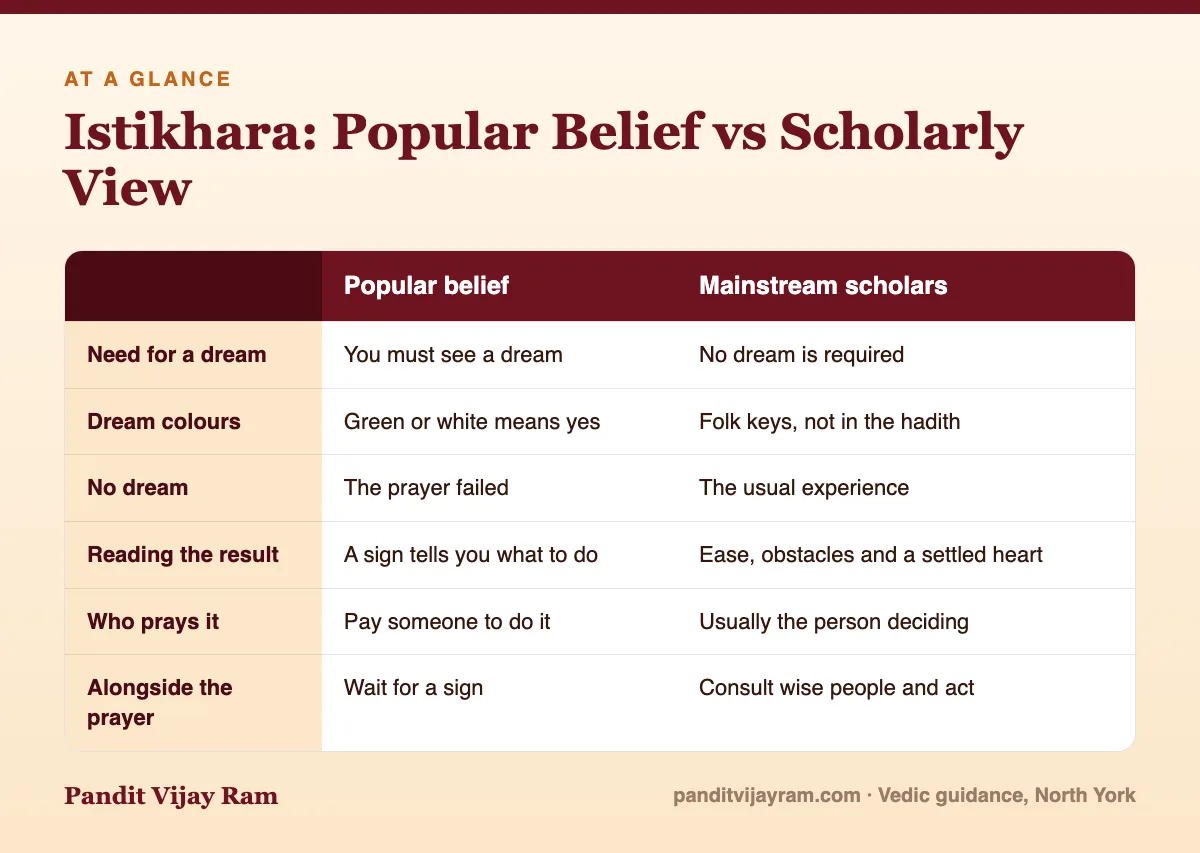
No. The hadith that teaches istikhara, narrated by Jabir ibn Abdullah in Sahih al-Bukhari, mentions two units of voluntary prayer and a supplication, but says nothing about sleeping or dreaming. Mainstream Sunni scholars therefore teach that a dream is not a condition of istikhara, and that its answer can arrive entirely without one.
The Prophet Muhammad, peace be upon him, taught his companions istikhara for all their affairs, as carefully as he taught them chapters of the Quran. The supplication asks God, by His knowledge and power, to decree a matter if it is good for the person's faith, livelihood and final outcome, to turn it away if it is not, and to make the person content with whatever is chosen.
Notice what the prayer asks for. It does not request a vision. It asks God to arrange the matter and to bring contentment. For that reason many scholars describe istikhara as handing over a decision you are already working on, not as consulting an oracle.
Dreams still have a respected place in Islamic thought. A true dream is described in hadith as one part of prophecy, and some people do report a clear dream after istikhara. Scholars generally say such a dream can be a comfort, but it is not required and it should not override sound judgement or clear facts.
So if you prayed and saw nothing, nothing has gone wrong. That is the ordinary experience for most people. For the wider place of protective prayer in Muslim life, see our respectful overview of nazar in Muslim tradition.
What does it mean if you see green or white in an istikhara dream?
Popular guides say green or white in a dream after istikhara means yes, while red or black means no. These colour keys do not appear in the hadith of istikhara. Many scholars regard them as later folk interpretation, so a colour should never be treated as a binding answer about a marriage, job or move.
The colour system circulates widely on social media and in pamphlets. It usually runs like this: green, white or light colours are favourable; red, black or dark scenes are unfavourable; yellow is uncertain. Some versions add rivers, mosques, snakes or particular people.
There are three reasons to hold these keys lightly.
- No source in the Sunnah. The prayer was taught in detail, and a colour code is not part of it.
- Dreams have many causes. Islamic tradition itself distinguishes true dreams from those arising from one's own thoughts and from disturbing whispers. Anxiety about a decision easily colours what we dream.
- The stakes are high. Accepting or refusing a spouse because of a dream colour, without looking at character and compatibility, can cause real harm.
If a dream after istikhara leaves you feeling calm or uneasy, take that feeling as one small input. Then look at the facts, talk to people you trust and keep acting. Our article on frightening dreams and their meaning gives similar cautions from the Vedic side about reading too much into night imagery.
How do you know the result of istikhara?
Scholars describe the result of istikhara as what unfolds after you pray and continue to act. If the matter becomes easy and your heart settles, many take that as a sign to proceed. If it keeps meeting real obstacles, that may be the turning away the prayer asked for. Consultation helps you read these signs honestly.
The classical scholar Imam al-Nawawi wrote that after istikhara a person should go ahead with what their heart feels open to. Other scholars added a caution: that openness should not simply be the wish you already had before praying. The aim is to set your preference aside as much as you can and see how events and your conscience respond.
Signs people commonly describe include:
- Ease: paperwork goes through, families agree, the right information arrives at the right time.
- Obstacles: repeated, genuine barriers, not just ordinary nerves or one difficult conversation.
- Contentment: a quieter mind about the choice, even if it is hard.
- New facts: learning something important, good or bad, that clarifies the decision.
Many scholars allow repeating istikhara if the matter is still unclear. Others encourage making the decision with the best information available and trusting God, which is the meaning of tawakkul.
Alongside the prayer, Islamic teaching strongly encourages istishara, consulting wise and knowledgeable people. Our companion guide to istikhara for marriage sets out the practical questions to ask.
How is the istikhara prayer offered?
Make the intention, pray two units of voluntary prayer at a time when prayer is permitted, then recite the istikhara supplication, naming the matter where indicated. Many scholars say the supplication may be recited after the salam, and some allow it before. No special time, place or sleeping position is required.
The steps are short and within reach of anyone who prays.
- Have a real decision in mind. Istikhara is for permissible choices, such as accepting a proposal, a job offer or a move. It is not prayed about obligations or things that are clearly forbidden.
- Purify yourself with wudu as for any prayer.
- Pray two rak'ahs of nafl, voluntary prayer, avoiding the times when voluntary prayer is disliked.
- Recite the supplication taught in the hadith, in Arabic if you know it or with its meaning in your heart, mentioning your matter at the place indicated.
- Carry on with life. Take the practical steps the decision needs and watch how things unfold.
Scholars generally teach that you should pray istikhara for yourself. Opinions differ on asking another person to pray it on your behalf, and many encourage a parent or friend to make ordinary supplication for you instead.
For questions of fiqh, such as timing, repetition or a particular school's view, your local imam is the right person to ask. Vijay Ram ji works in the Vedic tradition and does not issue religious rulings. His istikhara guidance is a confidential conversation that helps you lay out a decision calmly, with the prayer itself remaining yours.
When is worry about istikhara signs a reason to seek other help?
If you are praying istikhara again and again, losing sleep over dream symbols, or feeling unable to make any decision without a sign, the worry may need care in itself. Speak to a trusted imam and your family doctor. Be wary of anyone who charges to interpret your dreams or says only they can read your result.
Istikhara is meant to bring peace, so persistent distress is a signal worth listening to.
- Repetitive checking. Some people pray repeatedly, then doubt each result. Scholars describe excessive doubt as waswasa, and it can overlap with anxiety or obsessive-compulsive patterns that a doctor or counsellor can help with.
- Sleep problems. Vivid or frightening dreams night after night can follow stress, medication or sleep disorders. A family doctor can check.
- Low mood. If indecision sits inside a wider sadness or hopelessness, please talk to your doctor. In a crisis, call or text 988, Canada's Suicide Crisis Helpline.
- Pressure from others. If relatives use a claimed dream to push or block a marriage, that is a family conversation, not a religious verdict.
Watch for exploitation too. Paid services that promise to read your istikhara for a fee, then announce a curse that needs costly taweez or rituals, follow a familiar pattern. Report fraud to the Canadian Anti-Fraud Centre. For a respectful explanation of how Islamic healing is properly understood, see our comparison of ruqyah and Vedic protection, and the wider resources on our evil eye and curses hub.
The bottom line
The istikhara dream meaning most people search for is simpler than the colour charts suggest: mainstream Sunni scholarship teaches that a dream is not required. The result is usually read through ease, obstacles, new facts and a settled heart as you continue to act, together with consultation. Pray istikhara yourself, ask an imam about religious rulings, and treat persistent worry or paid dream-readers as reasons to seek trusted help.
Key takeaways
- The istikhara hadith teaches a prayer and supplication, with no mention of dreams.
- Colour meanings for istikhara dreams come from later folk interpretation.
- Many scholars read the result through ease, obstacles and a settled heart.
- Istikhara goes hand in hand with istishara, consulting wise people.
- Repeated anxiety about signs deserves care from an imam and a doctor.