
Ruqyah and Vedic Protection: How the Two Approaches Differ
Many households in the GTA are mixed in faith or live side by side with neighbours of other faiths, so the question of ruqyah vs Vedic protection comes up more often than people expect. A Muslim friend recommends ruqyah; a Hindu aunt suggests a Hanuman path; and someone frightened at night wonders which one is right for them. Families in North York, Scarborough and Mississauga ask me this question with real care, because they do not want to offend God or anyone's tradition. This guide sets the two approaches side by side honestly. You will learn what ruqyah is in Islamic teaching, what Vedic protection involves, where they share common ground, where they genuinely differ, and how to choose with a clear conscience. In more than forty years of practice I have learned that the most helpful answer usually begins with the person's own faith, not with whichever ritual sounds strongest. Ordinary causes such as poor sleep, stress, illness or a noisy building always come first, whichever tradition you follow.
What is ruqyah in Islam?
Ruqyah is the Islamic practice of seeking healing and protection by reciting verses of the Quran, the names of Allah and supplications taught by the Prophet Muhammad. Scholars describe lawful ruqyah as recitation in understandable words, free of any appeal to other than Allah, with the belief that healing comes only by His will.
In Islamic teaching, ruqyah is first of all something a believer can do for themselves or for family. The recitations most often used include Surah Al-Fatiha, Ayat al-Kursi (the Throne Verse in Surah Al-Baqarah), and the final three short chapters of the Quran: Al-Ikhlas, Al-Falaq and An-Nas. The last two are known together as the mu'awwidhatayn, the two chapters of seeking refuge.
Common features of ruqyah that Muslim scholars accept include:
- recitation over oneself, or by a trusted reciter (a raqi), sometimes blowing lightly over the person or over water or oil;
- regular salah, remembrance (dhikr) and morning and evening supplications as daily protection;
- avoiding amulets with unknown words, sacrifice to anyone other than Allah, or any reliance on the healer rather than on God.
Scholars also warn against reciters who charge fear-based fees, isolate women from their families, or claim to command jinn. Those cautions come from within the tradition itself.
Ruqyah is often associated with concerns about jinn, sihr (sorcery) and the evil eye. A separate guide covers how nazar is understood in Muslim tradition, and our ruqyah healing page explains how the practice is offered here with respect for that faith.

What does Vedic protection involve?
Vedic protection is a set of Hindu practices that ask a deity to shelter a person, family or home. It includes mantra jaap, recitations such as the Hanuman Chalisa, puja and havan, a protective thread or kavach, and lamp-lighting at dusk. Practices are often matched to a horoscope reading and a family's own tradition.
Where ruqyah centres on one scripture and one God, Vedic protection draws on many texts and on deities who each carry a particular quality. Hanuman is called on for courage and freedom from fear. Durga and Kali are invoked as the protective Mother. Narasimha is the fierce guardian of the devotee. Shiva is approached through the Mahamrityunjaya mantra for wellbeing.
The main tools are:
- Recitation. Mantras and hymns such as the Hanuman Chalisa or the Devi Kavach.
- Fire and offering. A puja at the home shrine, or a havan in which offerings are made into a consecrated fire.
- Wearable protection. A raksha sutra, a rudraksha, or a kavach prepared with mantra.
- Astrology. A kundli reading can show whether a difficult planetary period is part of the picture, which changes the remedy.
A priest or pandit usually leads the larger rituals, but daily practice belongs to the household. If you want a closer look at the stronger hymns, see the guide to protective mantras and the Bajrang Baan. For help with unsettled homes, the spirit and ghost removal service describes what a Vedic approach involves.
What is the difference between ruqyah and Vedic protection?
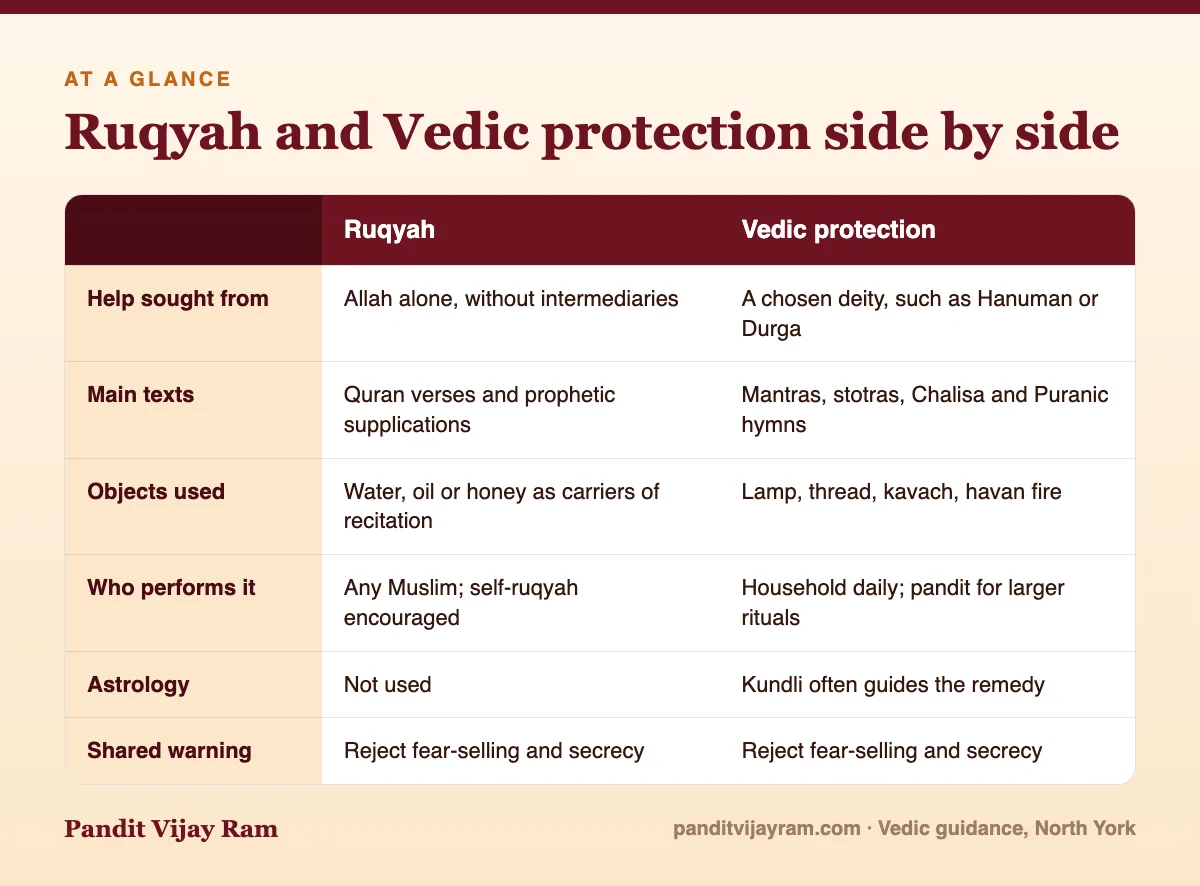
The core difference is theology. Ruqyah is strictly monotheistic recitation of the Quran and seeks help from Allah alone, without intermediaries. Vedic protection invokes particular forms of the divine through mantra, image, fire and offering. Their texts, languages, rules about objects and ideas about who may perform the practice also differ.
Seeing the differences clearly helps people choose with integrity rather than mixing practices in a way their own faith would not accept.
- Source of help. Ruqyah asks Allah directly. Vedic practice addresses a chosen deity, understood by many Hindus as one face of the single Supreme.
- Texts and language. Ruqyah uses Arabic Quranic verses and prophetic supplications. Vedic protection uses Sanskrit and Awadhi hymns, Puranic stotras and mantras.
- Objects. Ruqyah treats water, olive oil or honey only as carriers of recitation, and mainstream scholars reject talismans with unclear writing. Hindu practice openly uses images, lamps, threads and consecrated kavach.
- Fire and offering. Havan and arati are central in Vedic ritual. Ruqyah has no fire ritual.
- Who performs it. Any sincere Muslim may perform ruqyah, and self-ruqyah is encouraged. Larger Vedic rituals are usually led by a trained priest, though daily prayer is open to all.
- Diagnosis. Vedic practice often reads the horoscope. Ruqyah does not use astrology, and Islamic teaching discourages it.
Both traditions agree on one point: protection is sought from the divine, not owned by the practitioner. That shared humility matters more than any outward method.
Can a Hindu use ruqyah or a Muslim use Vedic mantras?
That depends on the person's own conscience and tradition. Many Muslim scholars hold that a Muslim should not take part in rituals addressed to other deities. Ruqyah is a prayer to Allah, so non-Muslims sometimes listen to it with respect. The kindest approach is to follow your own faith first and ask your own religious teachers.
I am asked this often, especially by couples in interfaith marriages and by families who have lived next to each other for decades. My answer is simple: I do not ask anyone to step outside their faith to feel safe.
Some helpful principles:
- For a practising Muslim, ruqyah from the Quran, regular salah and the daily adhkar are the natural first step. If you want guidance from within your community, speak to your imam or a reciter he trusts.
- For a practising Hindu, the Hanuman Chalisa, a lamp at dusk and a family puja are the natural first step, with a pandit's help for anything larger.
- For a mixed household, each person can keep their own prayer. A shared practice can be as simple as keeping the home clean, quiet and kind, and agreeing not to mock each other's rituals.
- For someone with no fixed tradition, choose the practice whose meaning you understand and respect, not the one that sounds the most dramatic.
The magic and entities hub gathers related guides, including the respectful overview of jadu, Obeah and Brujeria traditions across communities.
Are jinn and bhoot the same thing?
No. In Islam, jinn are a distinct created order made from smokeless fire, with free will and accountability, mentioned in the Quran. In Hindu tradition, a bhoot or preta is usually understood as the restless spirit of a deceased person. The two concepts come from different worldviews, even when people describe similar experiences.
People often use these words interchangeably, but the traditions themselves do not. In Islamic belief, jinn are not ghosts of the dead. They are a separate creation, some believing and some not, and Islamic teaching says the souls of the dead do not wander among the living. That is why ruqyah addresses jinn and sihr, not departed relatives.
In Hindu tradition, a preta is a soul in transition after death, and the funeral rites, the thirteen days of observance and shraddh are meant to help it move on peacefully. Bhoot is the broader folk word for a ghost. There is also a wider Hindu vocabulary of beings such as yakshas, rakshasas and pishachas, which come from Puranic stories rather than from the idea of a dead person.
This matters for practice. A Muslim family worried about jinn will usually find comfort in ruqyah. A Hindu family grieving a relative may be helped more by shraddh and prayer for the departed than by any protective ritual. Before either, it helps to rule out what is ordinary: sleep paralysis, grief, medication changes and stress. The guide to sleep paralysis or jinn walks through that carefully.
How do I choose between ruqyah and Vedic protection?
Start with your own faith and with ordinary checks: sleep, health, stress and the state of your home. Then choose the practice your own tradition teaches and that you can keep up calmly. Avoid anyone who mixes traditions to frighten you, demands secrecy, or claims special power over spirits.
Here is the decision rule I share with families who ask.
- Check the ordinary first. See your family doctor for poor sleep, panic, unexplained pain or changes in mood. Fix noise, damp and wiring problems at home.
- Ask which faith you live by. If you pray salah, ruqyah fits your life. If you keep a mandir at home, Vedic practice fits yours.
- Begin with daily, low-key practice. In ruqyah that means Al-Fatiha, Ayat al-Kursi and the three refuge chapters. In Vedic practice, a lamp and the Hanuman Chalisa.
- Seek a trustworthy guide if the trouble continues. Ask them what they will do, how long it may take and what they expect from you. A good guide answers plainly.
- Walk away from red flags. Threats, escalating fees, demands to cut off family or stop medicine are never part of genuine practice in either tradition.
For Hindu households wanting a structured remedy, the puja and anushthan page describes how a guided ritual is planned. No practice in either tradition can promise a specific outcome. What both offer is a disciplined way to turn toward God and to steady the mind.
The bottom line
Understanding ruqyah vs Vedic protection begins with respect: ruqyah is Quranic recitation that seeks help from Allah alone, while Vedic protection invokes the divine through mantra, puja and kavach. Ordinary causes such as sleep, health and the home deserve checking first in either tradition. The wisest choice is usually the practice of your own faith, kept steadily and guided by someone honest.
Key takeaways
- Ruqyah is Islamic recitation of the Quran and prophetic supplications, seeking healing from Allah alone.
- Vedic protection uses mantra, puja, havan and kavach addressed to protective deities.
- Jinn in Islam and bhoot or preta in Hindu belief are different concepts.
- Follow your own faith first and ask your own religious teachers about mixing practices.
- Genuine practice in both traditions rejects threats, secrecy and fear-based fees.