
Istikhara for Marriage: Practical Questions to Ask Alongside the Prayer
Istikhara for marriage is one of the most common reasons Muslim families in the GTA ask me about the prayer. A rishta arrives through relatives or an app, the first meetings go well, and then comes the weight of the decision. People want to know whether the prayer alone will tell them, or what else they should be doing. Families in North York, Mississauga and Scarborough often describe the same tension: parents keen, the young person unsure, and everyone hoping istikhara will settle it. I work in the Vedic tradition rather than as an Islamic scholar, and over forty years of helping families with marriage decisions I have seen how much depends on asking the right questions early. This guide explains where istikhara fits in the rishta process, what istishara means, the practical questions to ask about a proposal, how families can check a match responsibly in Canada, and why consent is never optional.
When should you pray istikhara for a marriage proposal?
Many scholars advise praying istikhara once you know enough about the proposal to consider it seriously, usually after initial family enquiries and meetings, and before giving a firm answer. Istikhara is not meant to replace getting to know the person. It is the prayer you offer while you gather facts and consult.
A rishta decision usually moves through stages, and istikhara fits naturally into the middle of them.
- First information. Names, families, education, work, where they live. At this point most people simply make general supplication for guidance.
- Meetings. Family meetings and, where your family allows, chaperoned conversations or video calls between the two people. Islamic teaching encourages the couple to see each other before deciding.
- Istikhara and consultation. Once you are genuinely considering a yes, pray istikhara and begin consulting the people whose judgement you trust.
- Decision and nikah. Proceed with what has become easy and clear, or step back if real obstacles keep appearing.
The supplication itself names the matter, so be specific in your heart: this marriage, to this person. Some people pray it more than once as new information arrives.
You do not need a dream to know the answer. Our companion article on istikhara dreams and their meaning explains why mainstream scholars say the result usually shows through ease and a settled heart, not visions. For broader preparation, see our guide to the first family meeting for an arranged marriage.

What is istishara and why does it matter for marriage?
Istishara means seeking counsel. The Quran praises believers whose affairs are settled by mutual consultation and tells the Prophet to consult others before deciding and then trust God. For marriage, this means asking parents, a guardian, an imam and people who truly know the proposed spouse, alongside your own istikhara.
An often-quoted saying captures the balance: istikhara is asking the Creator, istishara is asking His creation. Neither replaces the other.
Islamic history offers a vivid example. When Fatimah bint Qays received proposals from two men, she went to the Prophet, peace be upon him, for advice. He spoke frankly about each suitor's temperament and circumstances and recommended someone else, Usama ibn Zayd, whom she married and later spoke of happily.
Good people to consult include:
- Parents and the wali. In most schools the guardian has a formal role in the nikah, and parents often know family histories.
- An imam or scholar, for questions of religious compatibility and fiqh.
- People who know the proposed spouse, such as colleagues, classmates or community members, who can speak honestly about character.
- A trusted friend who knows you well and will tell you the truth.
- A marriage counsellor, particularly when past relationships, divorce or children are involved.
Good advisers are frank, keep confidences and do not push their own interests. Those who will not give an honest opinion are not really being consulted. Vijay Ram ji's istikhara guidance offers a confidential space to set these voices side by side.
What questions should you ask before accepting a rishta?
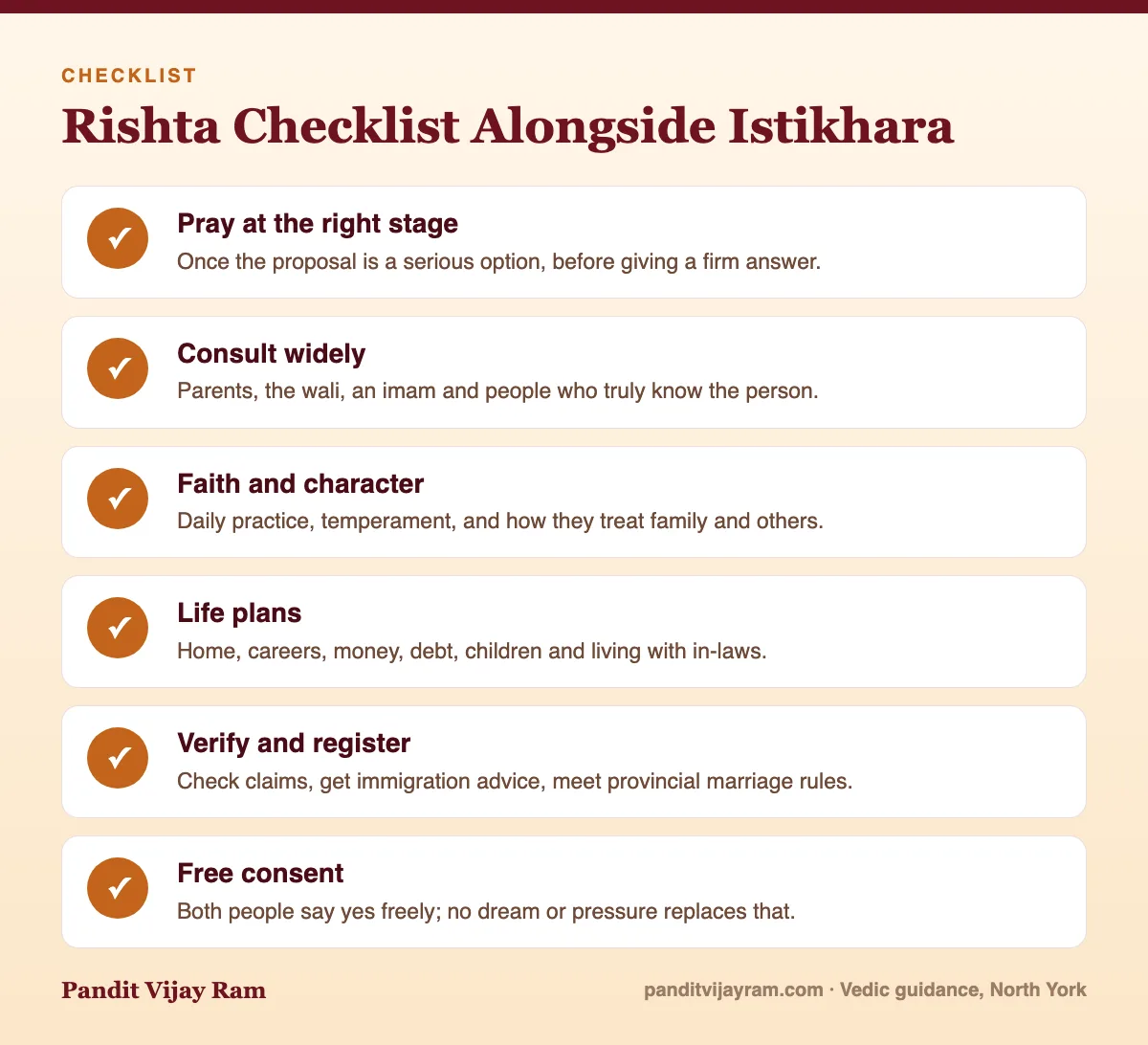
Ask about faith and practice, character and temperament, where the couple will live, careers, money and debt, children, roles at home, relationships with in-laws, past marriages, health matters both families should know, and immigration plans. Discuss the mahr and any nikah conditions openly, before commitment, rather than discovering differences later.
A hadith often cited for marriage advises accepting a proposal from someone whose religion and character please you. These questions help you see both.
- Faith: How do you practise day to day? What role will religion play in raising children?
- Character: How do you handle anger, disagreement and stress? How do you treat parents, siblings and people who serve you?
- Home and location: Where do you want to live, and will we live with family?
- Work and study: What are both people's career plans, including the wife's?
- Money: Are there debts, loans or obligations to support relatives? How will finances be shared?
- Children: Do you want them, when, and how many?
- History: Any previous marriage, engagement or children?
- Health: Any condition the other family should know, and, for cousin marriages, whether carrier screening should be discussed with a doctor.
- The nikah: The mahr, any conditions written into the contract, and the wedding's scale and cost.
Asking these is not a lack of trust. Couples who answer them honestly before the nikah start with fewer surprises. For couples from different faith backgrounds, our article on interfaith marriage and family disapproval covers further questions.
How can families check a marriage proposal responsibly in Canada?
Meet in family or chaperoned settings, verify identity, education and work claims, speak with people who know the person, and take time rather than rushing. For proposals from abroad, get immigration advice from IRCC or a licensed professional, never send money to someone you have not met, and make sure the marriage is legally registered in your province.
Due diligence protects both families, and it is fully consistent with istikhara.
- Verify the basics. Confirm names, education, employment and marital status through documents or people who know them, politely and on both sides.
- Meet more than once. Different settings, such as a family dinner, a walk and a video call with siblings present, show more than a single formal visit.
- Ask the community. An imam, a mosque committee or long-standing family friends can often confirm reputation.
- Overseas proposals. Spousal sponsorship has strict rules. Speak to IRCC or a licensed immigration consultant or lawyer, and be alert to proposals where immigration seems to be the main goal.
- Online introductions. Be cautious of profiles that quickly ask for money, gifts or secrecy. Report suspected romance fraud to the Canadian Anti-Fraud Centre.
- Legal registration. A religious nikah should also meet your province's marriage licence and registration requirements. A family lawyer can explain how the mahr and any marriage contract are treated.
None of these steps question God's decree. They are the effort Islam expects of a person before placing trust in God. For broader resources, our evil eye and curses hub gathers related guidance for Muslim and South-Asian families.
What if your istikhara, your heart and your family disagree?
Slow down and talk openly. Explain your concerns or reasons to your parents, consult an imam, and keep gathering facts. In Islam a valid marriage requires the free consent of both the bride and the groom, so no prayer, dream or family pressure can stand in for a person's own yes. Forced marriage is a crime in Canada.
Disagreement is common and often healthy. It usually means someone has noticed something others have not.
- When parents are keen and you are unsure, name the specific worry, such as values, distance or temperament. Specific concerns can be explored; vague discomfort is harder to discuss.
- When you are keen and parents are not, ask what they know or fear. Parents sometimes see patterns in a family that a young couple misses.
- When someone cites a dream to block or push the match, gently return the conversation to character, faith and practical compatibility, which scholars treat as the real substance of kafa'ah.
Consent is not a formality. Classical scholarship requires the bride's agreement, and a marriage contracted under duress is gravely wrong. In Canada, forcing someone into marriage is a criminal offence. If you or someone you know is being pressured, threatened or taken abroad to marry, contact the police, a lawyer or a trusted community service. In an emergency, call 911.
Where everyone remains uncertain after honest consultation, it is fair to decline gracefully. A declined rishta, handled kindly, rarely harms anyone. For calm, confidential help thinking a decision through, Vijay Ram ji offers istikhara guidance consultations, while encouraging Muslim clients to pray istikhara themselves and seek fiqh answers from their imam.
The bottom line
Istikhara for marriage is a prayer that asks God to ease a good match and turn away a harmful one, and Islamic teaching pairs it with istishara, honest consultation. Ask clear questions about faith, character, home, money, children and family before you commit, and check a proposal responsibly, especially one from overseas. Remember that free consent from both people is essential, and that no dream or pressure can replace it.
Key takeaways
- Pray istikhara once a rishta is a serious option, while you keep gathering facts.
- Istishara means consulting parents, the wali, an imam and people who know the person.
- Discuss faith, character, money, home, children and the mahr before commitment.
- Verify proposals and seek proper immigration advice for matches from abroad.
- Free consent from both people is required, and forced marriage is a crime in Canada.