
Domestic Violence Help in the GTA: Shelters, Helplines and Safety Planning

Many people who read our love and marriage articles are, quietly, not asking about love at all. They are asking how to stop being afraid in their own home. If that is you, I want to say clearly: abuse is not caused by a planet, a curse or your own failings, and no ritual is the answer to it. Domestic violence help GTA services offer is real, free in many cases, confidential and available in many languages. In more than forty years of counselling families in North York and across the region, I have learned to put safety first and spiritual work a long way second. This page lists verified helplines and services, explains what a safety plan is, describes shelters and victim services in Toronto and Peel, and shows how legal help works. It also explains why controlling behaviour dressed up as love, or as spiritual power, is still abuse. If you are in danger right now, stop reading and call 911.
Who can I call for domestic violence help in the GTA?
Call 911 if you or your children are in immediate danger. For support any time, call the Assaulted Women's Helpline at 1-866-863-0511 or 416-863-0511 in the GTA, or dial #SAFE (#7233) on Bell, Rogers, Fido or Telus mobiles. Ontario also lists Fem'aide, Talk4Healing and the Victim Support Line for specific needs.
The Government of Ontario's page on getting help if you are experiencing violence lists these free, confidential helplines:
- Assaulted Women's Helpline: toll-free 1-866-863-0511, GTA 416-863-0511, TTY 1-866-863-7868, or #SAFE (#7233) on Bell, Rogers, Fido and Telus mobiles. The helpline says it offers service in more than 200 languages and is available 24 hours a day.
- Fem'aide, for Francophone and French-speaking women: 1-877-336-2433.
- Talk4Healing, for Indigenous women and their families: 1-855-554-4325.
- Victim Support Line: toll-free 1-888-579-2888, or 416-314-2447 in the GTA, for information and referrals for victims of crime.
- Support for male survivors of sexual abuse: 1-866-887-0015.
- 211 Ontario: dial 2-1-1 for referrals to local programs.
You do not need to be sure that what you are experiencing "counts" as abuse. Helpline workers listen, help you name what is happening and talk through options without pressure. You can call more than once.
Men, LGBTQ+ people and seniors also experience abuse. Ask 211 or the Victim Support Line for services that fit you, and see our guide to South Asian mental health support in the GTA for counselling in community languages.

What is a safety plan and how do I make one?
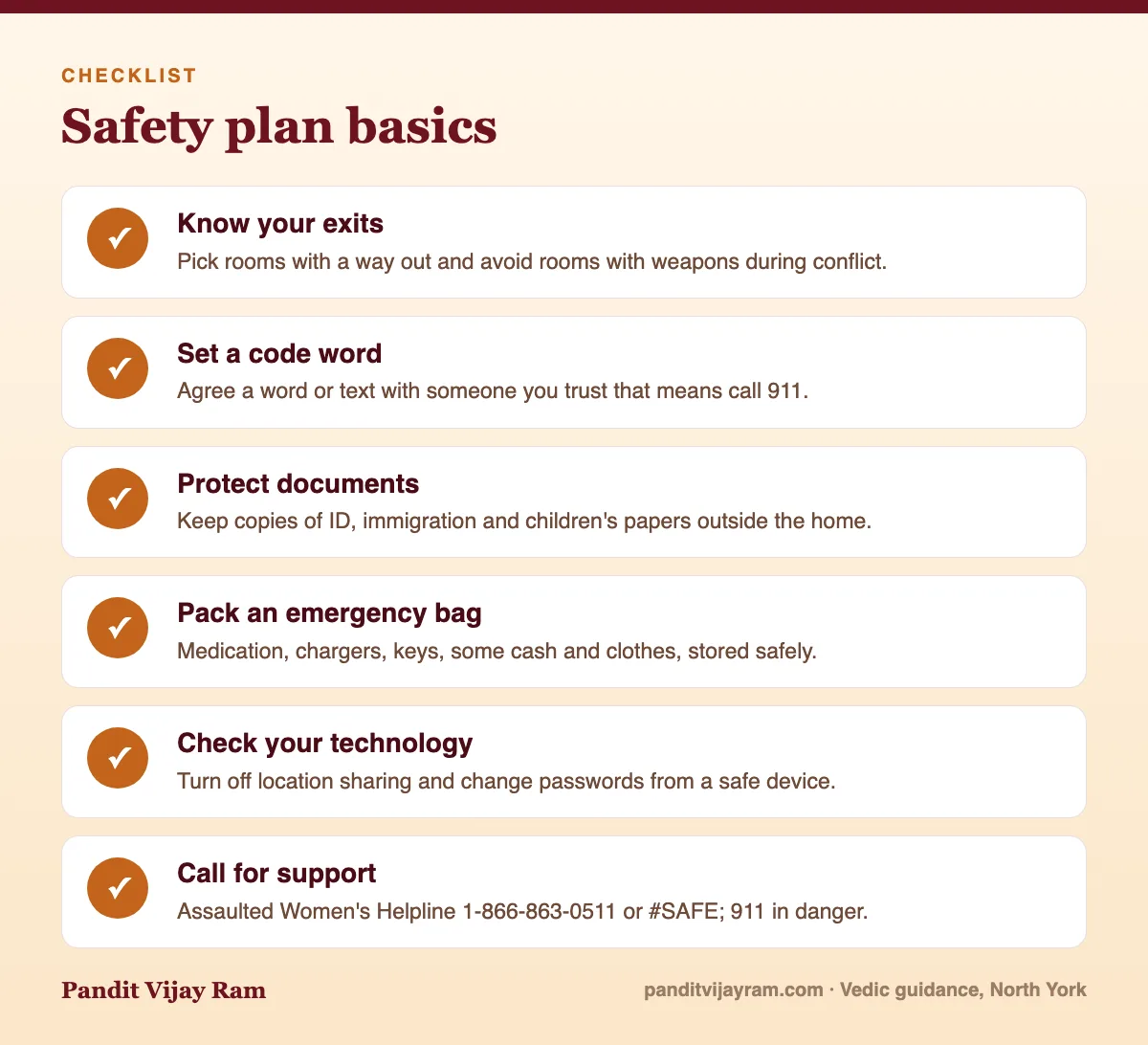
A safety plan is a personal set of steps to reduce risk while you stay, prepare to leave, or after you leave an abusive partner. It covers safe places, trusted people, a code word, important documents, money, children, pets and technology. Helpline workers and victim services can build one with you confidentially.
Every plan is different, because only you know your situation. Common elements include:
- Safe spots and exits. Know which rooms have a way out and avoid the kitchen or rooms with weapons during an argument.
- A code word. Agree on a word or text with a trusted friend or relative that means call 911 for me.
- Documents. Keep copies of ID, immigration papers, health cards, children's documents and bank details somewhere safe outside the home or in a secure online account.
- An emergency bag. Medication, chargers, keys, some cash and a change of clothes, stored with someone you trust.
- Children. Teach them how to call 911 and where to go. Tell the school who may and may not pick them up.
- Technology. Check phones for location sharing and change passwords from a safe device. Ontario and the Assaulted Women's Helpline both warn that browsing can be monitored and suggest steps to hide your tracks.
Steps to Justice, a legal information site led by Community Legal Education Ontario, includes a safety planning tool. Victim Crisis Assistance Ontario provides safety planning for eligible victims of crime.
Leaving is often the most dangerous time, so plan it with a professional where you can.
Where can I find a women's shelter in Toronto or the wider GTA?
Women's emergency shelters support women and their children who are fleeing violence, offering a safe bed, counselling, advocacy and help finding housing. To find one, call the Assaulted Women's Helpline or 211, or use ShelterSafe, a project of Women's Shelters Canada that helps people locate shelters near them. Shelter addresses are kept confidential.
A shelter is more than a place to sleep. Staff help with safety planning, court support, children's needs, income support applications and longer-term housing. Many also run outreach programs for people who are not ready to leave.
How to get there:
- Call first. The Assaulted Women's Helpline or 211 can check which GTA shelters have space and connect you.
- ShelterSafe. The site, run by Women's Shelters Canada, helps you find support near you and has information on abuse and safety planning.
- Bring what you can, but go even if you have nothing. Shelters can help replace essentials.
- Pets. Ask about pet safekeeping programs if fear for a pet is stopping you from leaving.
Newcomers sometimes fear that leaving will affect their status. Immigration and sponsorship questions need a lawyer or legal clinic, and shelter staff can help you find one. Our guide to legal aid for family matters in the GTA explains Legal Aid Ontario, which lists help with restraining orders and may assist above usual income limits in urgent abuse cases.
Families in Toronto can also look at family support services in Toronto for counselling and community programs.
What do victim services in Toronto and Peel offer?
Victim Services Toronto offers free, confidential crisis support around the clock, whether or not a crime is reported to police, through its line at 416-808-7066. Victim Services of Peel in Brampton runs a 24-hour crisis line at 905-568-1068 and programs including transitional housing and a South Asian Family Enrichment program. Durham and York have their own services.
Victim services agencies work alongside, but separately from, police. Counsellors may meet people soon after an incident, sometimes alongside police, stay with them through statements and court dates, and connect them with shelters, counselling and practical help.
- Victim Services Toronto describes crisis response, intervention and prevention for people affected by crime or sudden tragedy, with 24-hour support available whether or not the incident is reported to police.
- Victim Services of Peel lists victim crisis response, a sexual assault centre and anti-human trafficking program, a bail court program, transitional housing and a South Asian Family Enrichment program.
- Victim Services of Durham Region offers support to people in Durham Region.
- York Region residents can ask York Regional Police or 211 for local victim services.
Community agencies serve specific groups too. The South Asian Legal Clinic of Ontario works on gender-based violence, the Canadian Council of Muslim Women lists gender-based violence support, and the Centre for Spanish Speaking Peoples supports women who have experienced abuse.
Vijay Ram ji is not affiliated with any of these services. He simply wants readers to know they exist.
Can astrology or a love spell fix an abusive relationship?
No. Abuse is a pattern of power and control, not a planetary dosha or a curse, and no puja, vashikaran or kundli remedy makes an abusive relationship safe. Spiritual practice can support your strength while you get real help, but safety, legal protection and professional counselling must come first. Anyone promising otherwise is misleading you.
I have sat with women who were told by an elder that their husband's violence was due to Mangal dosha, or by an online spell-caster that a binding ritual would make him gentle. Both claims are false and dangerous. They keep people in harm's way and often cost them money.
Signs a relationship is abusive, not simply troubled, include:
- fear of your partner's reactions, and changing your behaviour to avoid them,
- control over money, phone, friends, clothing or immigration papers,
- threats to harm you, the children, pets or themselves,
- forced sex or pressure after you say no,
- physical violence of any kind, including pushing or blocking doors.
Ordinary arguments, which our article on husband and wife arguments covers, are different from fear and control. Couples counselling and marriage remedies, such as those on the marriage problem guidance page, are not suitable while abuse is happening.
If someone is pressuring you through a so-called love spell, or will not accept a breakup, read our guides on love binding spells and unwanted obsession. Stalking and threats belong with the police.
The bottom line
Domestic violence help in the GTA is available around the clock, and you do not have to face it alone. Call 911 in danger, the Assaulted Women's Helpline or #SAFE for support, and local victim services, shelters and Legal Aid Ontario for practical and legal help. Build a safety plan with a professional, protect your documents and technology, and remember that no astrology remedy or spell can make an abusive relationship safe.
Key takeaways
- Call 911 if you or your children are in immediate danger.
- The Assaulted Women's Helpline answers at 1-866-863-0511 and #SAFE on major mobile networks.
- Victim services in Toronto, Peel and Durham offer crisis support even without a police report.
- A safety plan covers exits, a code word, documents, children, pets and technology.
- Abuse is power and control; no puja, spell or kundli remedy makes it safe.