
Home Cleansing for Vaughan Homes: A Practical Guide for Local Housing
A new house should feel like a fresh start. Yet families often come to me after moving into a brand-new build in Maple or a high-floor suite near the subway and say it feels unsettled, as if the home has not yet accepted them. Questions about home cleansing in Vaughan usually arrive with photos of empty rooms, half-unpacked boxes and a worry about setting off the smoke detector. I meet families in person in North York and by video across Canada, and in more than forty years of practice I have learned that a new building needs a different approach from an old one. There is rarely a history to clear; there is a new household to settle. This guide adapts traditional Vedic cleansing and simple vastu to the housing Vaughan families actually live in: newly built homes in Woodbridge, Maple and Kleinburg, and the towers rising around Vaughan Metropolitan Centre. It covers the checks to do first, flame and alarm safety, and a full routine.
Why do new Vaughan homes sometimes feel unsettled?
New homes often feel unsettled for ordinary reasons first: construction dust, fresh paint and adhesive smells, unfamiliar furnace and ventilation noise, bare echoing rooms, and a family exhausted by moving. Spiritually, a new home has no rhythm of prayer yet. A blessing and steady routine give the household time to settle in.
A newly built house in Woodbridge or Kleinburg has rarely held anyone before you. The heaviness people describe is usually not a presence; it is the absence of one. No lamp has been lit there, no meals shared, no prayers spoken. Before any ritual, check the practical side:
- Air quality. New paint, flooring and cabinets can release odours for weeks. Run the ventilation system and open windows when the weather allows.
- Dust. Builders' dust settles in vents and corners. A deep clean is itself a cleansing.
- Noise. New furnaces, heat recovery ventilators and settling floors make unfamiliar sounds at night. They are normal.
- Carbon monoxide. Homes with gas appliances, fireplaces or attached garages need carbon monoxide alarms under Ontario rules. Make sure they are installed and working.
- Fatigue. Moving is one of the most stressful events in family life. Sleep and patience solve a lot.
Then begin the spiritual side gently. Our guide to cleansing a new house before moving in covers the griha pravesh steps, and the general method appears in how to cleanse negative energy from your home.

How do you cleanse a detached or semi-detached home in Woodbridge, Maple or Kleinburg?
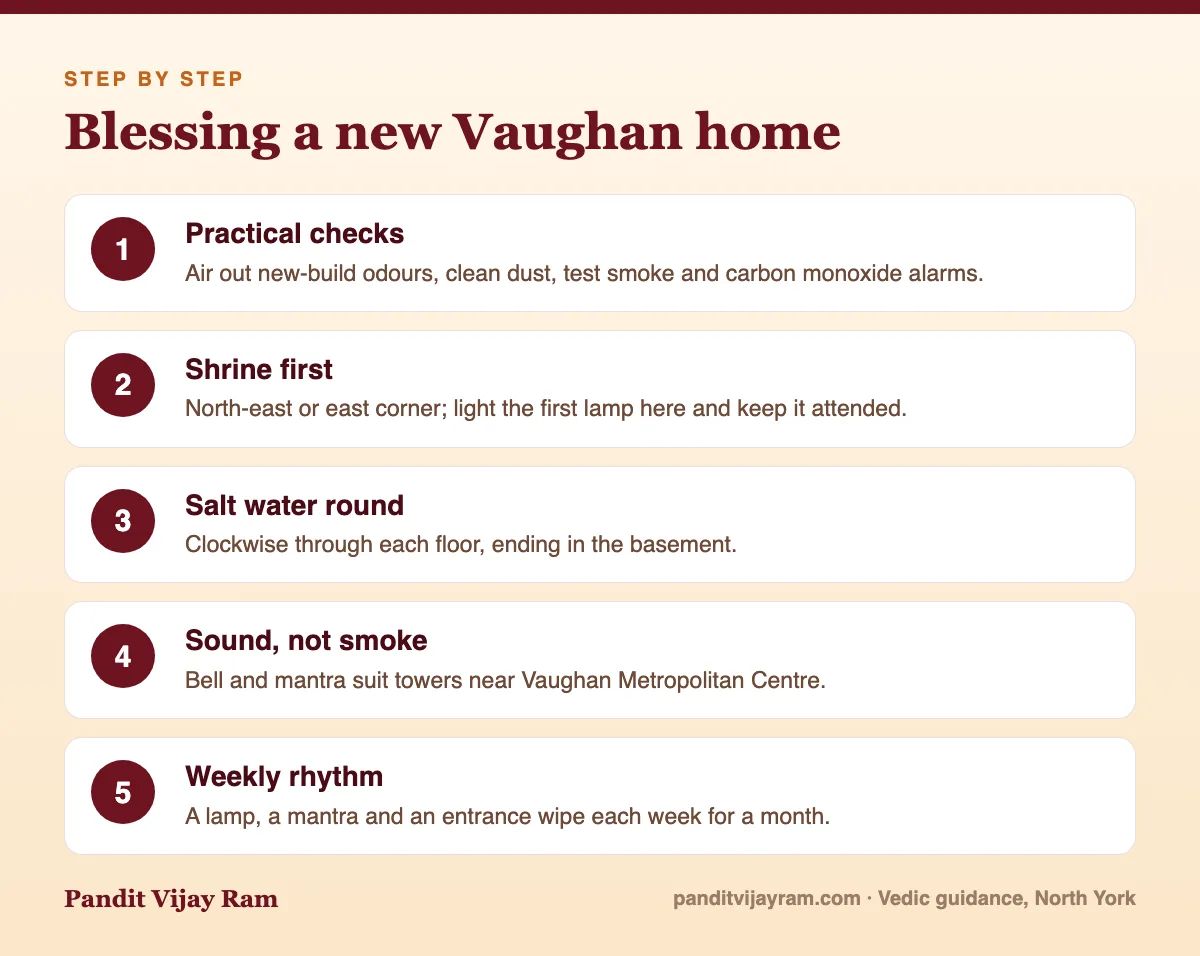
Start in the north-east, near the shrine if possible, and move clockwise through each floor. Clean thoroughly, wipe floors with rock salt water, ring a bell or chant in every room, light one attended lamp at the shrine, and finish at the main door with a prayer for the household. Repeat lightly each week for a month.
Many newer Vaughan homes have open-plan main floors, a double garage, three or four bedrooms upstairs and an unfinished or newly finished basement. Each part benefits from a little attention.
- Shrine first. Set up the home mandir before anything else, ideally in the north-east of the main floor. Light the first lamp here.
- Main floor, clockwise. Kitchen, dining and living areas. Wipe floors with water and a pinch of rock salt, and chant a short mantra as you go.
- Upstairs. Bedrooms are for rest; keep the cleansing gentle there. Our guide to cleansing a bedroom for peace suggests a calming approach.
- Basement. Unfinished basements collect boxes. Clear a path, sweep, and sit for a few minutes with a recording of mantra.
- Garage entrance. Many families enter through the garage every day. Keep that door clean and uncluttered, and place a small image or symbol of protection there if you wish.
- Main door. Close with a prayer at the formal entrance.
If you can manage a little smoke, a short guggul dhoop round on the main floor, with windows open and detectors in mind, is described in our guggul dhoop cleansing guide.
How do you cleanse a condo near Vaughan Metropolitan Centre?
Treat the tower as a shared building. Read the condo rules on open flame and smoke, keep any diya small, attended and far from the detector, or use an electric lamp. Cleanse with salt water, sound, mantra and fresh air from the balcony door instead of dhoop. Keep corridor doors closed so nothing drifts into shared spaces.
The towers around Vaughan Metropolitan Centre, near Highway 7 and Jane Street, are modern buildings with sealed ventilation, sensitive detectors and alarm systems linked to the whole tower. A small mistake can bring the fire service to everyone's door.
- Rules first. Read the condo declaration and rules, and ask management if flames are allowed in suites.
- Water and salt. Wipe the entrance, kitchen floor and door frames.
- Sound. A bell, a conch, or ten minutes of recorded mantra fill a suite without any smoke at all.
- Light. A ghee diya on a metal tray in the shrine area, attended, or an electric diya if the rules say no flame.
- Air. Open the balcony door briefly afterwards to let stale air out, weather permitting.
- Neighbours. Avoid strong incense that travels through hallways.
Compact layouts benefit from simple vastu, covered in our guide to vastu for apartments and condos. Renters should ask the landlord before any flame, since the landlord is responsible for alarms in a rental under Ontario rules.
What alarm and fire rules should guide a Vaughan home ritual?
Ontario requires a working smoke alarm on every storey and outside sleeping areas, and carbon monoxide alarms in homes with fuel-burning appliances, fireplaces or attached garages. Vaughan Fire and Rescue Service advises testing smoke alarms monthly and replacing them every ten years. Never disable an alarm for puja, and check for local fire bans before any outdoor flame.
Fire safety is part of the ritual, not an obstacle to it. A blessing that puts the family at risk contradicts its own purpose. A short decision rule for any flame in a Vaughan home:
- Is there a working smoke alarm on this storey? If not, fix that first.
- Is the flame on a metal tray, away from curtains and garlands? If not, move it.
- Will an adult stay beside it the whole time? If not, use an electric lamp.
- Is the room ventilated? Open a window before lighting camphor or dhoop.
- Is this an outdoor fire? Check Vaughan Fire and Rescue Service news for any temporary ban on fire pits, chimineas or bonfires first. Old puja materials should never be burned in the yard; our guide on disposing of puja items offers respectful alternatives.
The fire service also suggests flameless candles for decoration. Many families keep one real lamp at the shrine and battery lights everywhere else, which works well for households with young children or elderly parents. Owners are responsible for alarms in their own homes; in a rental, the landlord is.
Which simple vastu adjustments suit Vaughan's newer homes?
Focus on what you can change without renovation. Place the shrine in the north-east or east, keep the centre of the main floor open, make the formal entrance bright and clean even if you use the garage door daily, sleep with your head toward the south or east, and keep heavy storage toward the south-west.
Builders in Vaughan design for light, traffic flow and the market, not for vastu. Most homes can still be adjusted gently.
- Orientation. Use a phone compass to find north-east. Even a corner of the living room can hold the shrine.
- Open centre. Open-plan main floors already suit the vastu idea of an uncluttered centre. Keep it that way.
- Heavy items. Bookcases, wardrobes and storage boxes sit best toward the south-west.
- Kitchen. Keep the stove clean and the sink clear at night.
- Facing. Families worried about a south-facing lot can read our guide to south-facing house vastu, which explains why the fear is overstated.
If you are still choosing a home, read vastu when buying a house in Ontario before you sign. For a review of a specific floor plan, the vastu consultation page explains what to send. Families across the boundary to the east can compare approaches in our Richmond Hill home cleansing guide.
When should a Vaughan family seek further help after cleansing?
Seek further help when a sincere weekly routine has run for about a month, the practical checks are complete, and the home still feels heavy or the family keeps struggling. A kundli and floor-plan review can then look for patterns. Medical symptoms, fear for safety or thoughts of self-harm always go to a doctor, 9-1-1 or 9-8-8 first.
Most families feel a difference within a few weeks once the house has been cleaned, blessed and lived in with a steady lamp and prayer. When that does not happen, I suggest a pause and a careful look before doing more rituals.
- Recheck the home. Has the air improved? Are alarms working? Is a gas appliance serviced?
- Recheck the family. Is someone grieving, unwell, overworked or under money pressure? Those weigh on a whole home.
- Then consider a consultation. A kundli reading can show whether the household is going through a difficult period, and a vastu review can suggest small changes.
Persistent arguments after a move are common and are explored in our article on constant fights at home. If anyone in the house feels hopeless or unsafe, contact your family doctor, and in a crisis call or text 9-8-8. You can read how I work with families on the Vaughan astrologer page.
The bottom line
Home cleansing in Vaughan begins with the building in front of you. Fix ordinary issues such as new-build odours, dust and carbon monoxide alarms first, then follow a full routine in a Woodbridge, Maple or Kleinburg house or a smoke-free method in a tower near Vaughan Metropolitan Centre. Keep alarms working, flames attended and vastu changes small, and give the new household a steady rhythm of prayer.
Key takeaways
- New Vaughan homes often need welcoming more than clearing.
- Ventilate new-build odours and check carbon monoxide alarms first.
- Towers near Vaughan Metropolitan Centre need smoke-free cleansing methods.
- Vaughan Fire and Rescue Service advises monthly smoke alarm tests.
- Small vastu changes work well in open-plan newer homes.