
South-Facing House Vastu: Myths and Remedies

Few vastu beliefs cause as much worry as the idea that a south-facing home is unlucky. Buyers walk away from good houses because of it, and families who already own one sometimes feel uneasy for years. South facing house vastu deserves a calmer explanation. I hear this question from homeowners in North York, Vaughan and Etobicoke more than almost any other, usually with a listing open on their phone. The fear comes from the south's association with Yama, the guardian of dharma and of the departed, but that is only part of the picture. Traditional vastu looks at the exact position of the door along the wall, divided into segments called padas, and several of those positions on a south wall are considered favourable. This guide explains how to tell which way a house faces, which entrance positions are praised or cautioned, what simple remedies are used, and why south-facing homes in Canada have practical advantages of their own. In more than forty years of practice I have seen many contented families in south-facing homes, and very few problems that a direction alone could explain.
Is a south-facing house bad according to vastu?
No, not automatically. The south is Yama's direction, and Yama is the guardian of dharma and of the departed, which is why the myth grew. Vastu itself judges the door's exact position, the plot's shape and the layout inside. A well-placed south entrance in a balanced house is considered perfectly acceptable, and some positions are thought to support prosperity.
In the scheme of the eight guardians, or dikpalas, each direction has a ruler. Indra holds the east, Kubera the north, Varuna the west and Yama the south. Popular retellings treat Yama only as the god of death, so the south became a direction to fear. In older thought Yama is also Dharmaraja, the keeper of order and justice, and the south is linked with Mars, the planet of energy and courage.
Classical vastu texts do not say "never face south". They divide each side of the plot into segments and describe the results of a door in each one. That detail tends to disappear in short social media posts, which reduce a nuanced system to a simple rule.
Other features matter just as much:
- Whether the southwest corner is heavy and closed, as vastu prefers.
- Whether the northeast is light and open.
- Where the kitchen, bedrooms and bathrooms sit.
- How much daylight the home receives.
A south-facing house with a well-placed door and a sound layout often scores better than a north-facing one with a poorly placed door and a cluttered northeast. For a side-by-side look at the other directions, see north-facing and west-facing homes.

How do you know if your house is south-facing?
Stand at the main door, step outside and look straight out. The direction you face is the direction the house faces. If that is south, or within roughly twenty degrees of south, the home is treated as south-facing. Use a phone compass away from cars and metal railings, and check the result on a satellite map.
Buyers sometimes confuse the direction of the road with the direction of the house, especially on corner lots and crescents common in GTA subdivisions. The method below avoids that mistake:
- Use the main door. The door the family uses daily is usually the one that counts, but most practitioners read the formal front entrance first. A garage door is not the main entrance.
- Stand inside the threshold. Face outward, as if leaving the house.
- Read the compass. Hold it flat and away from the metal door frame.
- Confirm with a map. Satellite views show the house footprint against true north.
- Note any tilt. A house facing south-southeast or south-southwest is read differently, since its door falls closer to one corner.
Remember that Toronto's main streets do not run exactly north-south. Yonge Street and its parallel roads lean noticeably west of true north, so a house on an east-west street may sit several degrees off. That is normal; read the nearest of the eight directions.
Corner houses often have two road frontages. Vastu teachers differ on which matters more, but most look first at where the main door actually sits.
Which entrance positions are good for a south-facing house?
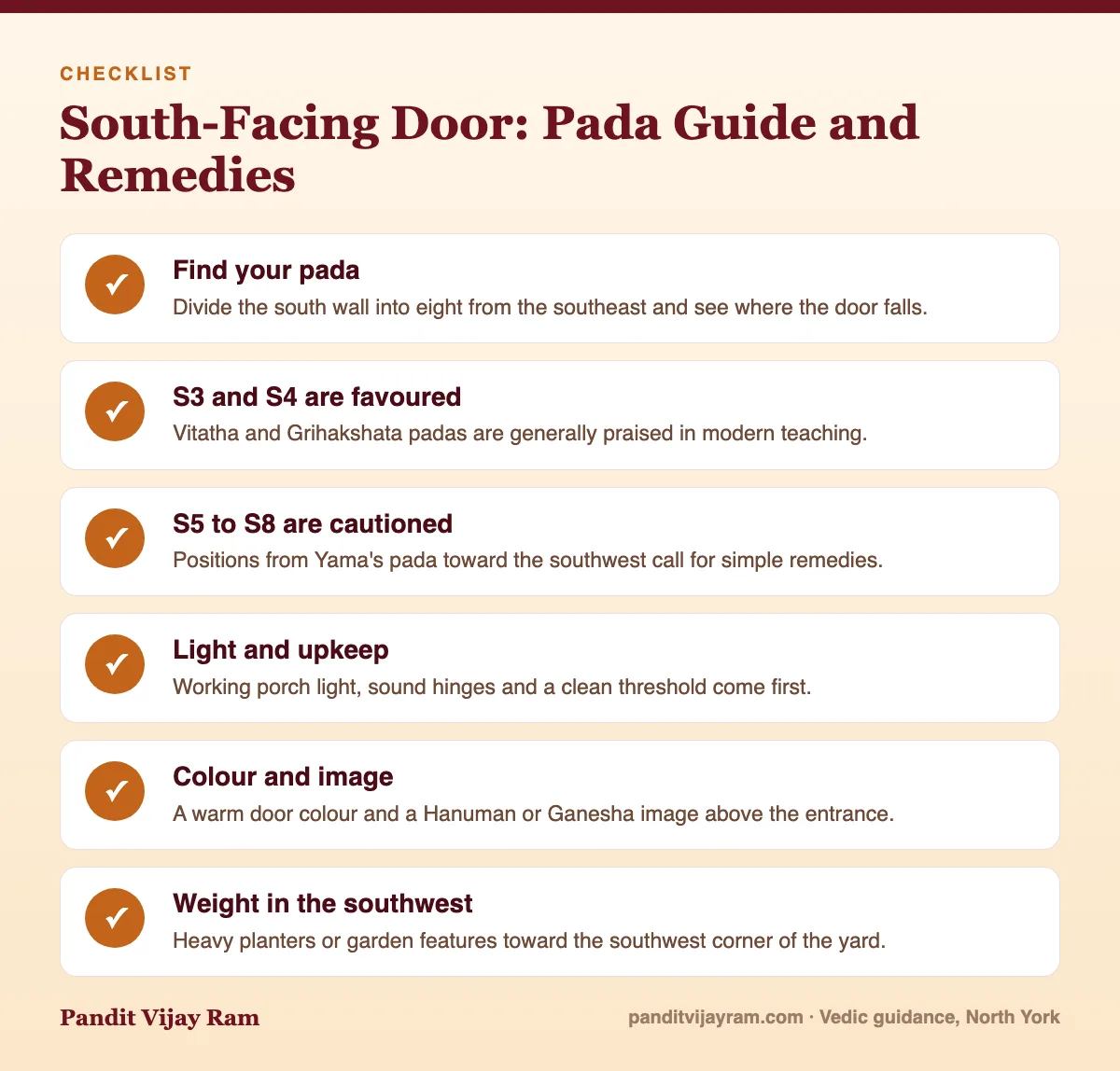
In the widely taught system of thirty-two entrances, the south wall is divided into eight padas counted from the southeast corner. The third and fourth, ruled by Vitatha and Grihakshata, are favoured. The fifth, Yama's own pada, and the positions toward the southwest corner are usually cautioned. Teachers differ on the first two.
The pada system comes from the vastu purusha mandala, a grid of squares each ruled by a deity. Popular modern teaching uses the outer ring and gives each wall eight entrance positions. On the south wall, counted from southeast to southwest, the usual list runs:
- S1 Anila – mixed opinions; some link it with restlessness.
- S2 Pusha – mixed; some teachers accept it, others link it with dependence on others.
- S3 Vitatha – generally favoured, linked with growth and activity.
- S4 Grihakshata – generally favoured, linked with prosperity and steady income.
- S5 Yama – usually cautioned.
- S6 Gandharva – usually cautioned.
- S7 Bhringaraja – usually cautioned.
- S8 Mriga – usually cautioned, as it sits closest to the southwest.
To find your pada, measure the south wall from the southeast corner to the southwest corner, divide by eight and see which segment the door falls in. If the door spans two, read the segment holding most of its width.
Classical texts such as the Mayamata and Manasara use their own grids, and modern schools do not agree on every pada, so treat this list as a guide rather than a verdict. A vastu consultation can read your actual measurements.
What are the remedies for a south-facing main door?
Common remedies for a south door are simple: keep the entrance bright, clean and in good repair, use a solid door in a warm colour such as red, maroon or brown, place an image of Hanuman or Ganesha above it, and keep the threshold well defined. None of these needs construction.
Traditional and modern practitioners suggest a range of steps. Here they are roughly in order of cost and effort:
- Upkeep first. Fix sticking hinges, broken bells and burnt-out porch bulbs. A neglected entrance is the most common real problem I see.
- Light. Keep an exterior light working through the evening, and an interior light near the door.
- Colour. Red, maroon, terracotta or wood tones are linked with Mars, the south's planet. A painted door or a coloured doormat both work.
- A protective image. Many families place Panchmukhi Hanuman or Ganesha above or beside the door. Hanuman is especially linked with courage and protection.
- A threshold strip. Some homes add a brass or wooden threshold so the boundary of the house is clearly marked.
- Weight on the southwest. Planters or heavy garden features toward the southwest of the yard strengthen the earth zone.
- A regular prayer. Reciting the Hanuman Chalisa on Tuesdays or Saturdays at the doorway is a common household practice.
Pyramids, special strips and expensive "dosh nivaran" kits are also sold for south doors. I am cautious about them; the visible steps above are cheaper and easier to maintain. The guide to vastu remedies without demolition discusses gadgets in more detail, the threshold customs are covered in the main door cleansing guide, and a Hanuman puja is available for families who want a formal blessing.
Are there practical advantages to a south-facing home in Canada?
Yes. In the northern hemisphere a south-facing front receives the most winter sun, so the driveway and front steps often clear of snow and ice faster. Front rooms get bright, warm light in cold months. These are real everyday benefits that vastu's critics of south-facing homes rarely mention, and they matter in a GTA winter.
Vastu grew up in a hot climate where strong southern sun could overheat a house, which may be part of why classical writers preferred openings on the north and east. Canada's climate flips some of that logic.
- Snow and ice. A south-facing driveway and walkway get direct sun through the short winter days, so melting starts sooner. That can mean less shovelling and safer steps for elders.
- Light in the living areas. Front rooms with south windows stay brighter when daylight is scarce, which many people find good for mood.
- Heating. South-facing glass gains warmth from low winter sun, which is a basic principle of passive solar design.
- Front gardens. Sun-loving plants such as marigolds do well, and a tulsi pot can live on a sunny front step through the summer.
There are trade-offs. The backyard of a south-facing house faces north and gets less sun, which matters to keen gardeners.
In my view these practical factors deserve as much weight as tradition. A home's light and warmth affect daily life directly, and vastu at its best was always about living well in a particular climate.
Should you avoid buying a south-facing house?
Not on direction alone. Check the door's pada, the layout and the condition of the home, and weigh price, location, schools and the inspection report first. If the door falls in a favoured position and the house is sound, a south facing is no reason to walk away. If it falls in a cautioned pada, remedies exist.
A simple decision rule for buyers:
- Practical checks first. Price, commute, schools, the home inspection and a real estate lawyer's review come before any vastu point.
- Find the pada. Measure the south wall and locate the door segment.
- Favoured pada and sound layout: proceed on vastu grounds without worry.
- Cautioned pada but a strong house otherwise: plan remedies such as door colour, lighting, a Hanuman image and southwest weight. These rarely change your decision.
- Several serious concerns together, such as a cautioned door, an open southwest and a cut northeast corner: discuss with a vastu adviser before deciding, and compare with other options.
I also suggest noticing how you feel in the house during a showing. If it feels bright and welcoming, that impression counts. If fear of the direction is your only concern, remember that Dakshinamurthy, Shiva as the teacher, is by name the south-facing form.
For the wider set of things to check during a purchase, including slope, plot shape and kitchen placement, read the guide to vastu points when buying a house in Ontario.
The bottom line
South facing house vastu depends on where the door sits along the wall, not on the direction alone. The third and fourth padas from the southeast are generally favoured, while positions near the southwest are cautioned and balanced with simple remedies. In a Canadian climate, a south-facing front also brings winter sun and faster snow melt. Judge the whole house calmly, start with practical checks, and do not let a myth make the decision for you.
Key takeaways
- A south-facing house is not unlucky by direction alone.
- The house faces the direction you look when stepping out of the main door.
- On the south wall, the third and fourth padas from the southeast are generally favoured.
- Remedies include light, a warm door colour, a Hanuman image and weight in the southwest.
- South-facing fronts gain winter sun and clear snow sooner in the GTA.