
Home Cleansing for Richmond Hill Homes: A Practical Guide for Local Housing

People usually ask me about home cleansing in Richmond Hill after something shifts: a move into a new townhouse, a run of arguments, a basement that never feels right, or a condo that seems heavy despite the view. Families sit with me in North York with photos of floor plans and the same worry: will a cleansing set off the alarms, upset the landlord, or simply not suit a modern building? In more than forty years of Vedic practice I have learned that the home itself tells you what it needs. A large detached house with a finished basement asks for a different routine from a compact unit on Yonge Street. This guide adapts traditional cleansing and a few simple vastu ideas to the housing Richmond Hill families actually live in. You will find ordinary checks to do first, smoke-light methods, what Ontario's alarm rules mean for your ritual, and a step-by-step routine that works across house types.
What should you check before cleansing a Richmond Hill home?
Rule out ordinary causes first. Check for damp or mould in basements, poor ventilation, faulty wiring, flickering fixtures, noisy furnaces, and carbon monoxide risks from fuel-burning appliances or attached garages. Notice sleep, stress and relationships too. Heaviness that remains after those are addressed is what a spiritual cleansing is meant for.
Many Richmond Hill homes have finished basements, attached garages and gas furnaces. Each brings ordinary explanations for an uneasy feeling that no ritual should cover up.
- Basements. A musty smell, a cold patch on a wall, or condensation near windows points to moisture. Damp air affects mood and sleep. Deal with it before anything else.
- Air. Townhouses and condos with sealed windows can feel stale. Run the bathroom and kitchen fans and open a window for a few minutes each day.
- Gas and garages. Ontario requires carbon monoxide alarms in homes with fuel-burning appliances, fireplaces or attached garages. Headaches that ease when you leave the house are a reason to call a technician, not a priest.
- Electrical. Buzzing outlets or flickering lights need an electrician.
- People. Constant tension may come from overwork, grief or a relationship under strain.
Once those are addressed, a cleansing can do its real work. Our article on whether a house can be cursed explains the difference between ordinary and spiritual heaviness, and the negative energy removal service describes when a fuller assessment is worthwhile.

How do you cleanse a large detached house in Richmond Hill?
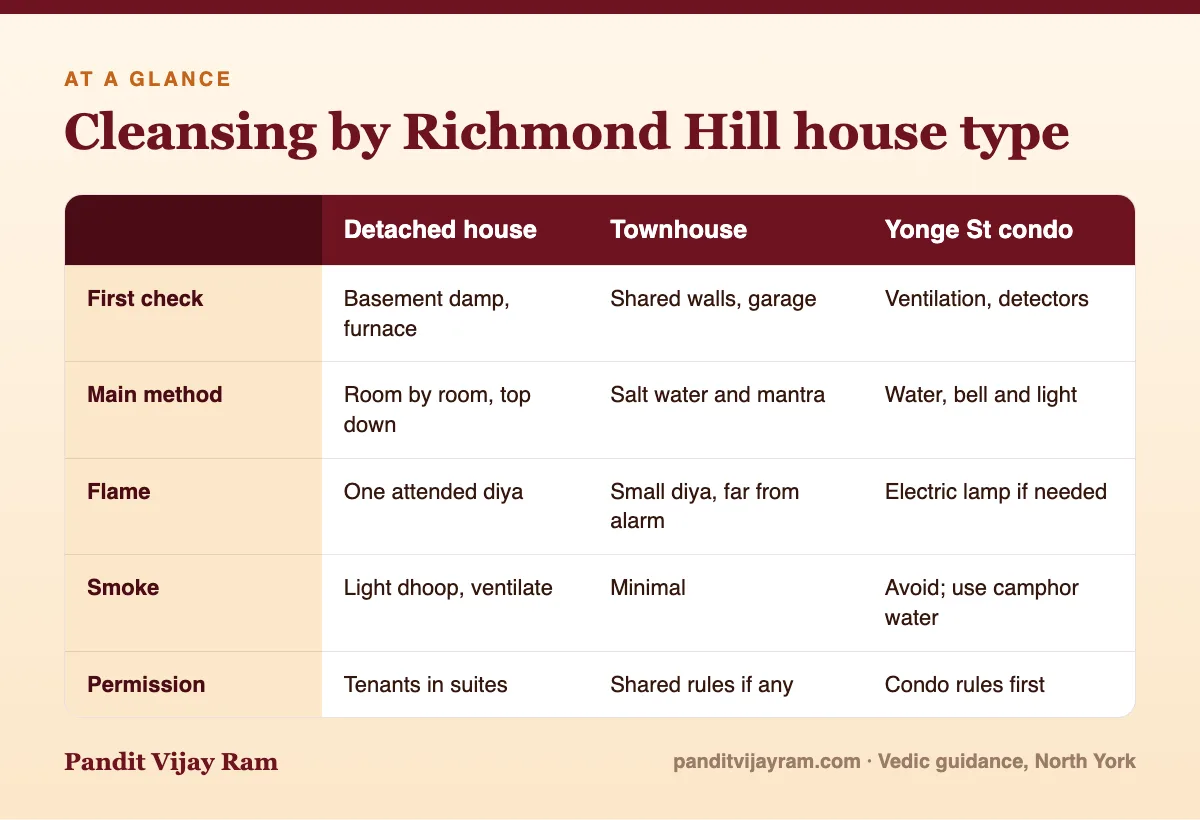
Work floor by floor, from the top of the house down to the basement and out through the main door. Clean and declutter first, then wipe floors with salt water, light a lamp in the puja area, chant a protective mantra in each room, and close with a short prayer at the entrance. Keep one person responsible for every flame.
Detached homes in Richmond Hill often have three levels, several bedrooms and a basement used as a gym, office or rental suite. Size makes a cleansing slower, not harder. A practical order:
- Top floor first. Bedrooms and bathrooms. Open curtains, clear clutter under beds, and wipe the floor with water and a little rock salt. Our guide to salt water mopping explains the mix.
- Main floor. Kitchen, living room and puja area. Light the lamp here. Chant a mantra such as the Gayatri or a Hanuman prayer while walking clockwise through each room.
- Basement last. It is often the most neglected space. Clear boxes, air it, and sit for a few minutes with the lamp or a recording of mantra.
- Main door. Wipe the threshold, place a small diya or a clean mat, and offer a prayer for the household.
If the basement is rented to tenants, cleanse only your own areas and respect their privacy. For more on the entrance, read our piece on main door threshold rituals.
How do you cleanse a townhouse or Yonge Street condo without smoke?
Use water, sound, light and intention instead of heavy smoke. Salt-water wiping, ringing a bell, chanting or playing mantra, a single ghee diya on a metal tray or a sealed electric lamp, and a few drops of camphor dissolved in water all work well. Avoid dense dhoop or loose samagri near smoke detectors and shared ventilation.
Townhouses share walls and sometimes ventilation. Condos along Yonge Street have sensitive smoke detectors, corridor alarms and condo rules about open flames. A cleansing that triggers an evacuation is not a cleansing anyone enjoys, and it rarely leaves the home feeling peaceful.
- Water. A bowl of water with rock salt, or Ganga jal if you have it, wiped on floors and door frames.
- Sound. A small bell or conch in each room, or ten minutes of recorded mantra.
- Light. One attended ghee diya on a metal tray far from the detector, or an electric lamp if the building forbids flames.
- Scent. Camphor or a few drops of sandalwood in water, rather than burning sticks.
- Air. Open a window or balcony door briefly afterwards to let stale air out.
Our full guide to cleansing a condo or rental without smoke goes into more detail, and vastu for apartments and condos covers layout ideas suited to compact units.
What do Ontario's alarm rules mean for a home ritual?
Never disable an alarm for a ritual. Ontario requires a working smoke alarm on every storey and outside sleeping areas, and carbon monoxide alarms in homes with fuel-burning appliances, fireplaces or attached garages. Homeowners are responsible in owner-occupied homes and landlords in rentals. Plan the cleansing around the alarms, not the other way round.
I sometimes hear that a family pulled the battery out of a smoke alarm so that camphor would not trigger it. Please do not. The alarm is protecting the very household the cleansing is meant to bless.
What the province says, in plain terms:
- Smoke alarms are required on every storey and outside all sleeping areas in Ontario homes.
- Carbon monoxide alarms are required in homes with a fuel-burning appliance, a fireplace or an attached garage, placed near sleeping areas and, under the current Fire Code, on every storey.
- Responsibility sits with the homeowner in an owner-occupied home and with the landlord in a rental.
- Enforcement is by the local fire department, which in this city is Richmond Hill Fire and Emergency Services.
Practical adjustments: keep the flame small and far from detectors, use camphor in water, ventilate, and never leave a lamp burning while you sleep or step out. Tenants should read their lease and ask the landlord before any flame. For outdoor fire, remember the City's open-air burning rules require a permit, so old puja materials should never be burned in the yard; our guide to disposing of puja items offers respectful alternatives.
Which simple vastu adjustments suit Richmond Hill homes?
Keep vastu modest and reversible. Keep the north-east corner light and uncluttered, place the puja area there if possible, let morning light into the main living space, keep the entrance clean and well lit, and avoid heavy storage directly at the centre of the home. No demolition or renovation is needed for these steps.
Newer Richmond Hill homes were built to local codes and market tastes, not to vastu shastra. That is fine. Most of the benefit comes from small, reversible changes.
- North-east. Clear it. A shelf for the deity, a plant, or simply open floor.
- Entrance. Many townhouses enter through the garage. Treat the front door as the ceremonial entrance anyway: keep it clean, lit and free of shoes piled outside.
- Centre of the home. Avoid storing heavy boxes or broken items in the middle of the main floor.
- Kitchen. Keep the stove clean, and avoid leaving dirty dishes overnight where possible.
- Bedrooms. Head toward the south or east when you sleep, if the room allows it.
Where a layout seems to fight you, read vastu remedies without demolition. For a room-by-room assessment of a specific floor plan, the vastu consultation page explains what to send. Families in the city to the east can compare housing advice in our Markham home cleansing guide.
When should a Richmond Hill family ask for further help?
Ask for help when heaviness stays after ordinary causes are fixed and a sincere home routine has been kept for a few weeks. Persistent fear, disturbed sleep with no medical cause, or repeated conflict after a move may justify a kundli reading or a vastu review. Health or safety concerns always go to a doctor or the authorities first.
A home cleansing is not a single event. I usually suggest a light weekly routine for three or four weeks before judging the result. Then the decision is simpler, because you are judging a pattern rather than one evening.
- If the home feels lighter, keep a small weekly habit: Thursday or Saturday lamp, salt-water wipe of the entrance, and a mantra.
- If nothing has changed, recheck the ordinary causes. Has the damp been fixed? Is someone unwell or grieving?
- If heaviness persists and the ordinary causes are clear, a consultation can look at the household's charts and the floor plan together.
Families who have just bought a home can start with our guide to cleansing a new house before moving in. If anyone in the household feels hopeless or unsafe, please contact your family doctor; in a crisis, call or text 9-8-8. You can read how I work with local families on the Richmond Hill astrologer page.
The bottom line
Home cleansing in Richmond Hill works best when it fits the building. Check ordinary causes such as damp, air quality and carbon monoxide first, then choose a full room-by-room routine for a detached house or a smoke-light method for a townhouse or condo. Never disable an alarm, respect landlord and condo rules, and keep vastu changes small and reversible, so the home feels lighter without new risks.
Key takeaways
- Fix damp, ventilation and carbon monoxide concerns before any ritual.
- Detached houses suit a top-floor-down routine ending at the main door.
- Townhouses and condos need water, sound and light more than smoke.
- Ontario requires smoke alarms on every storey; never disable one for puja.
- Small, reversible vastu changes are enough for most Richmond Hill homes.