
How to Cleanse a Bedroom for Better Sleep and Peace

The bedroom is the one room where you are at your most unguarded, so it is no surprise that people notice when it stops feeling restful. Couples tell me they argue more in there than anywhere else. Students say they cannot settle. Parents find a child refusing to sleep in their own room. Bedroom cleansing is a gentle response to that, and it begins with practical changes rather than elaborate rituals. Clients from North York, Downsview and Vaughan often send me a photo of their bedroom, and the answer is usually visible straight away: a mirror facing the bed, a phone charging by the pillow, or boxes crammed underneath. This guide explains why each of those matters in vastu and Vedic tradition, what to change first, and a short weekly ritual that takes about ten minutes. It also covers when poor sleep is a medical issue rather than a spiritual one. In more than forty years of practice, I have found that the bedroom responds faster than any other room, because people spend so many hours there.
Why does my bedroom feel heavy or unsettled?
Most often the reasons are ordinary: stale air, too much light or noise, screens, clutter or tension between the people who share the room. Vastu adds layout factors such as mirrors facing the bed or the head pointing north. Check the physical and emotional causes first, then make spiritual changes.
Before any ritual, run through a quick bedroom audit. These are the issues I find most often when families describe a restless room:
- Air. Windows kept shut all winter, a dusty furnace vent or a damp closet. Try opening a window for ten minutes each morning.
- Light. Streetlights through thin curtains, a glowing router or standby lights on a television.
- Noise. A neighbour's TV, a humming fridge on the other side of the wall or traffic outside.
- Temperature. Many Toronto homes run hot in winter; a cooler room usually helps sleep.
- Relationship strain. If arguments happen in bed, the room starts to hold that memory.
- Health. Snoring, reflux, pain or low mood all disturb sleep.
If the problem is mostly sleep itself, see a doctor first. Ongoing insomnia, loud snoring with gasping, or waking unrefreshed for weeks can point to conditions such as sleep apnoea, thyroid problems or depression. In a crisis, call or text 9-8-8.
Once those are addressed, vastu and Vedic practice offer the next layer, covered below. For a short nightly mantra routine, see clearing energy before sleep. The full set of household methods sits on the cleansing and protection hub.

Is it bad to have a mirror facing the bed?
Vastu advises against a mirror that reflects the bed, believing it bounces restless energy back at sleepers and can strain a couple's relationship. Practically, mirrors also reflect light and movement that can wake you. Move the mirror, angle it away, or cover it with a cloth at night.
This is the most common bedroom question I get, and the answer is reassuringly easy to act on. The traditional concern is that a reflective surface doubles the energy of the bed and keeps the mind active. Some families also believe it invites a third presence into a marriage, which is why newlyweds are often told to avoid it.
The practical concern is simpler. A mirror reflects headlights, streetlights and the glow of a phone. If you wake briefly in the night, catching your own movement in a mirror can startle you.
Ways to fix it, from easiest to most involved:
- Cover it at night with a light cotton cloth or a curtain.
- Angle it so it no longer shows the bed from where you lie.
- Move it to the inside of a wardrobe door or onto a north or east wall that does not face the bed.
- Replace mirrored wardrobe doors with frosted film, which many renters can apply and remove.
Other reflective surfaces count too. A large television screen opposite the bed acts like a dark mirror. A glass-fronted cabinet can do the same. Cover or turn these when you sleep.
Vastu also suggests avoiding mirrors directly behind the headboard. If your room has one, a fabric panel or a headboard placed in front of it solves the issue.
Which direction should you sleep in according to vastu?
Vastu recommends sleeping with your head toward the south for deep rest, or the east for students and anyone wanting clarity. West is acceptable for guests. Sleeping with the head toward the north is traditionally avoided. If you cannot move the bed, focus on the other changes instead.
The traditional reasoning ties sleep direction to the earth's magnetic field and to the direction of Yama, the lord of death, in the south. Sleeping with your head south is said to place your feet away from Yama and give stable, heavy sleep. The north-facing head position is linked with the way bodies are laid after death in some customs, so it is avoided by the living.
A simple guide many families follow:
- Head to the south: best for adults and the head of the household.
- Head to the east: good for children and students, linked to sunrise and learning.
- Head to the west: acceptable, often used in guest rooms.
- Head to the north: traditionally avoided.
For bed placement, vastu prefers the master bedroom in the southwest of the home, with the bed against a solid wall rather than under a window. Avoid placing the bed directly beneath a heavy beam or a ceiling fan if you can. The headboard should be solid, not slatted or open.
Many condo bedrooms only allow one bed position. In that case, do not lose sleep over it. Clearing clutter, covering mirrors and removing screens often matter more than direction. For a broader view of how the bedroom fits into the house's directions, see the guide to vastu cleansing by room and direction, or book a vastu consultation for your layout.
What should not be kept under the bed?
Avoid storing shoes, broken items, old paperwork, unused gifts, iron tools and anything linked to past relationships under the bed. Vastu teaches that clutter beneath you disturbs rest. If you need storage, use closed boxes of clean linens or seasonal clothes, and vacuum underneath regularly.
In small GTA bedrooms, the space under the bed often becomes the overflow cupboard. Traditional advice is that what sits under you while you sleep affects the quality of that sleep. Common sense agrees: a dusty, crowded underbed is a dust-mite hotspot and hard to clean.
A quick under-bed clear-out:
- Empty it completely on a weekend morning.
- Sort into keep, donate and discard. Old letters from an ex, broken electronics and items you have not touched in a year usually go.
- Vacuum thoroughly, then wipe the floor with a damp cloth.
- Sprinkle a little Ganga jal or water with a pinch of rock salt on tile or vinyl, and leave it to dry.
- Return only soft, clean items in closed containers: spare bedding, towels, off-season clothes.
Things traditionally kept away from beneath the bed include shoes, sharp tools, brooms, medicine stockpiles, and gold or cash. Some families also avoid storing religious books or murtis there, which is a matter of respect rather than danger.
Under-bed clutter often links to a deeper wish to hold on. If old items from a past relationship are stored there, the guide to clearing ties to a past relationship offers a gentle way to let go.
How do you spiritually cleanse a bedroom each week?
Choose one morning a week, open the window, change the sheets, and wipe surfaces. Then light a ghee lamp in the doorway, sprinkle Ganga jal in each corner moving toward the door, and chant a calming mantra. Move phones and laptops out for the night, and keep the room tidy until next week.
This weekly routine is built to be short enough that people actually keep it.
Physical reset (five minutes):
- Open the window and draw back the curtains.
- Change pillowcases and sheets, and shake out the duvet.
- Clear the bedside table of cups, wrappers and stray chargers.
Spiritual reset (five minutes):
- Light a small ghee lamp on a metal plate just inside the doorway, never on the bed or near curtains.
- Sprinkle a little Ganga jal with a tulsi leaf in each corner, moving clockwise and ending at the door.
- Chant the Mahamrityunjaya mantra or a simple Om eleven times.
- Many couples sit together for this part; it becomes a small weekly moment of connection.
Screens: Vastu and sleep science agree on this point. Phones and laptops near the pillow keep the mind alert. Charge them outside the bedroom, or at least across the room. Switch off Wi-Fi routers in the room overnight if you can.
If the room still feels unsettled after a month of this, and health and relationship issues have been looked at, a fuller assessment may help. The negative energy removal service explains how I review the room, the household and the chart together before suggesting anything stronger.
The bottom line
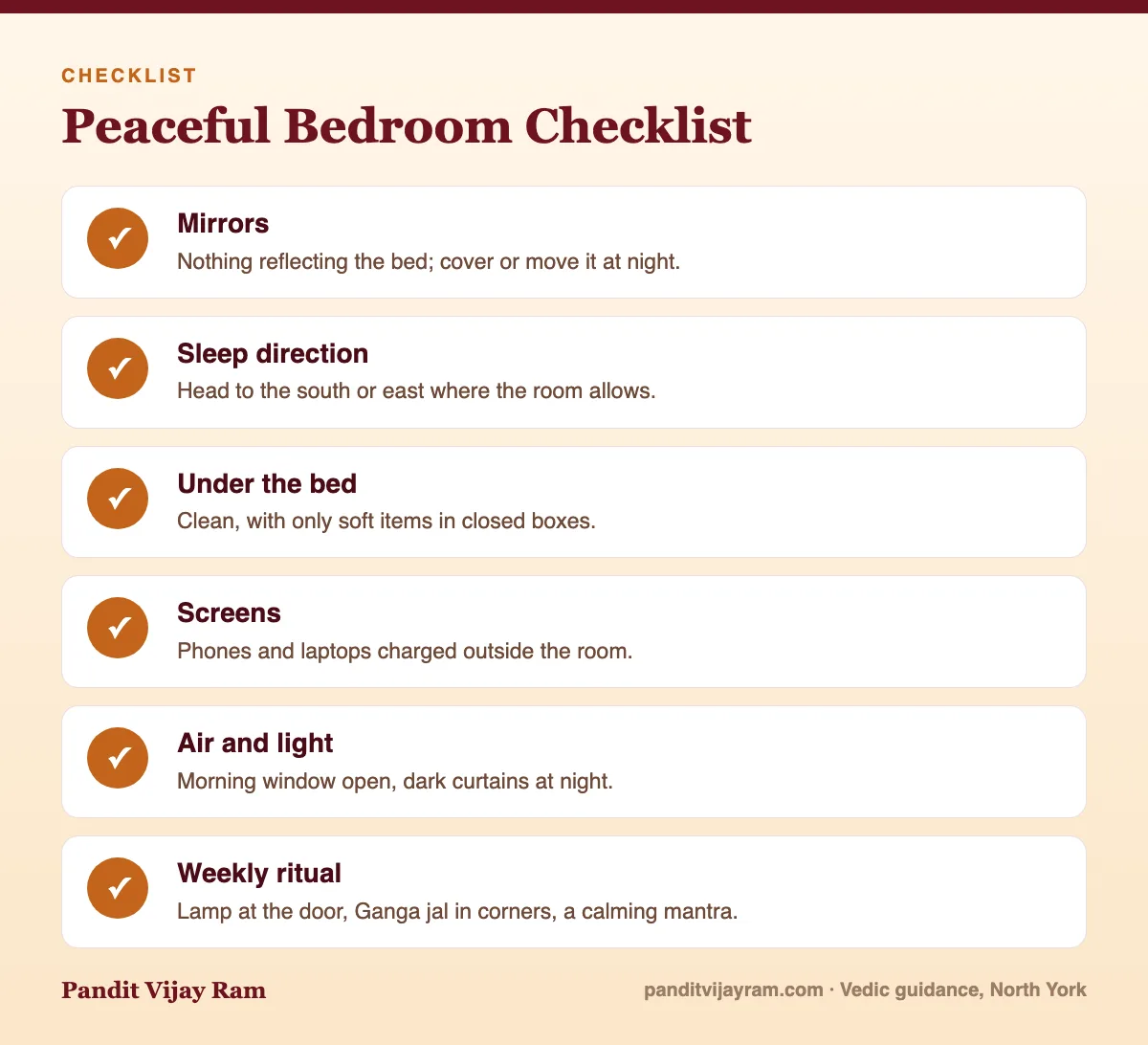
Bedroom cleansing starts with practical changes: fresh air, darkness, quiet and a clear space under the bed. Vastu then adds three key points: cover or move mirrors that face the bed, sleep with your head to the south or east where possible, and keep screens away from the pillow. A short weekly ritual with a lamp, Ganga jal and a calming mantra helps the room stay peaceful. Persistent insomnia or low mood deserve a doctor's visit before any further spiritual work.
Key takeaways
- Check air, light, noise and health before blaming the room's energy.
- Cover or move any mirror that reflects the bed.
- Sleeping with the head south or east is the traditional vastu advice.
- Keep under the bed clean, with only soft, closed storage.
- A ten-minute weekly lamp and water ritual keeps the bedroom settled.