
Constant Fights at Home: Negative Energy, Vastu or the Planets?

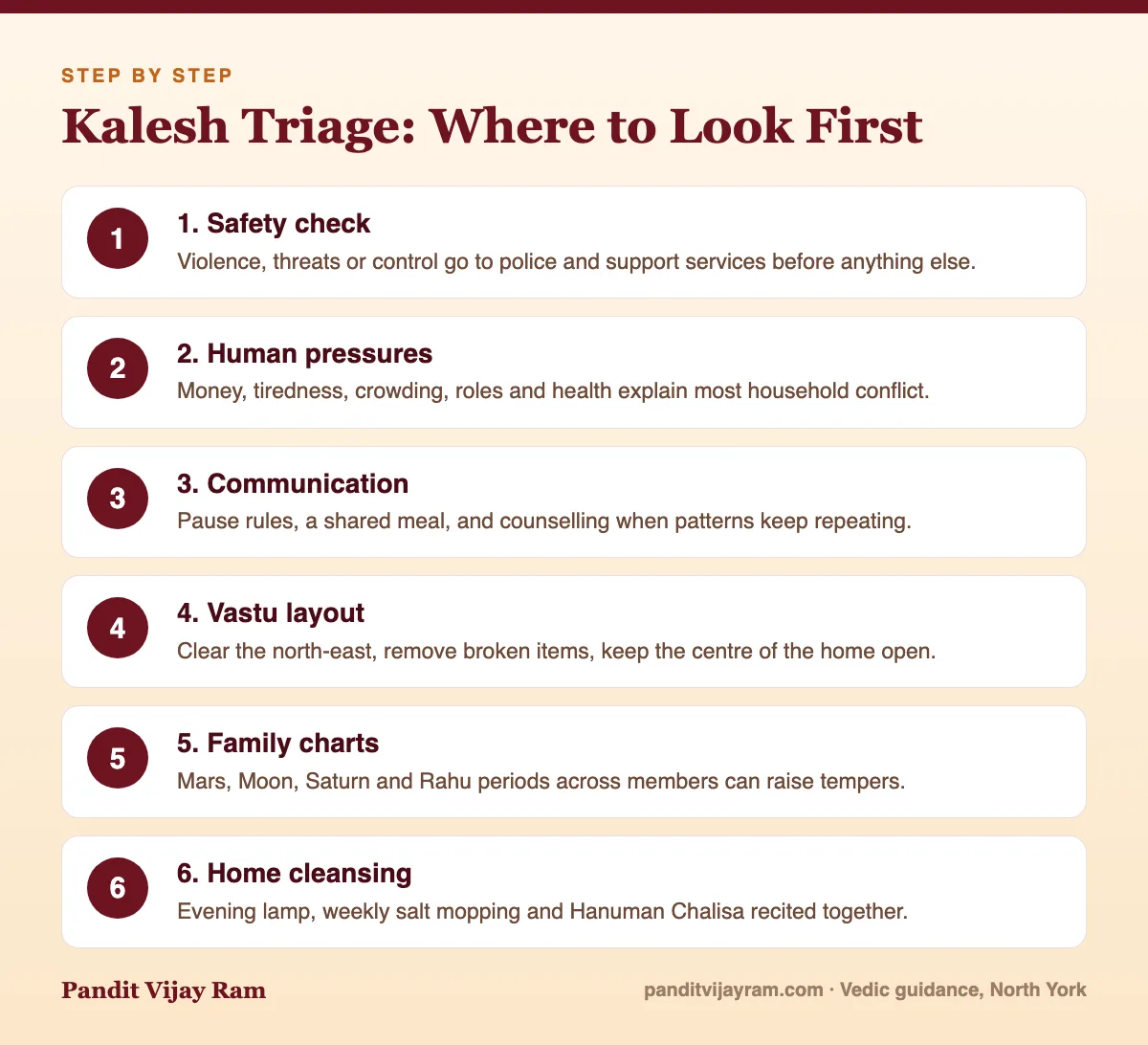
Every family argues. But some homes reach a point where every dinner ends in raised voices, children hide in their rooms and nobody remembers how the last fight started. Families who search for constant fights at home are usually exhausted, and many tell me someone has suggested the house itself is the problem. I meet such families in North York, Scarborough, Markham and across the GTA, and I always start with the same question: what changed in the household before the fighting began? This guide walks through the order I use to sort out kalesh. First come the ordinary pressures that cause most conflict. Then the vastu factors tradition associates with tension, the planetary periods that can make tempers shorter, and the simple cleansing and prayer that help a home settle. After four decades of sitting with families in their living rooms, I can say that most homes calm down once the real stress is named. Spiritual remedies then help keep that calm. There is also a section on when arguments become unsafe, because that changes everything.
Why does my family fight all the time?
Most persistent household conflict grows from pressure rather than anything unseen: money stress, long work hours, caring for elderly parents, crowded living, a new baby, in-law expectations or one person's untreated anxiety or drinking. These factors stack up. Before blaming energy or planets, list what changed in the home around the time the fighting started.
When I sit with a family, I ask each person, separately if possible, three questions: when did the arguments become frequent, what are they usually about, and what time of day do they happen. The answers are often revealing.
- Arguments about money often track a job change, a mortgage renewal or remittances sent home.
- Arguments at night often follow long shifts, hunger and screens. Tired people fight.
- Arguments about children or in-laws usually mean roles have not been agreed. A joint family under one roof needs clearer boundaries than one in separate homes.
- Arguments that seem to come from nowhere sometimes trace back to one family member struggling with depression, alcohol or health issues.
None of this is spiritual, and naming it is already a remedy. Some families benefit greatly from a counsellor or family therapist, and many workplaces offer free confidential counselling through an employee assistance program.
I mention these first because a havan cannot pay a bill, and a vastu change will not stop one exhausted spouse snapping at another at midnight. Once the household has an honest picture of its pressures, the traditional remedies below have something steady to build on. The family problem guidance page explains how I help families hold that conversation.

Can vastu cause fights in the house?
Vastu Shastra links certain layouts with tension: a kitchen in the north-east, a cluttered or dirty north-east corner, the master bedroom away from the south-west, broken objects kept on display, and heavy furniture blocking the centre of the home. Vastu is one contributing factor among many, and most corrections are simple and inexpensive.
Vastu treats the home as a map of forces. The north-east, ishaan kona, is the corner of clarity and prayer. The south-east belongs to fire and the kitchen. The south-west is earth and stability, where the head of the household traditionally sleeps. When these zones are confused, tradition says the people in them become restless.
Common kalesh-related observations and simple corrections:
- Clutter in the north-east: clear it and keep a small water vessel or shrine there.
- Broken items: cracked mirrors, stopped clocks and chipped idols are traditionally removed or repaired.
- Mirror facing the bed: cover it at night or move it; this is also a common bedroom sleep complaint.
- Fire and water side by side: a stove right next to the sink is associated with friction; a small divider or a plant between them is the usual remedy.
- Brahmasthan, the centre, blocked: keep the centre of the home open and uncluttered.
Rented apartments in the GTA rarely follow vastu, and families should not feel they need to move. Corrections are about arrangement, not renovation. Room-by-room details are in our guide to vastu home cleansing by direction. For a full layout check, see the vastu consultation.
Which planets cause arguments and family conflict in astrology?
Jyotish associates quarrels mostly with Mars, the planet of heat and assertion, especially when it affects the 2nd house of speech, the 4th house of home or the 7th house of partnership. Rahu periods bring restlessness, and Saturn's Sade Sati can add pressure. Several family members running hard periods together often coincides with kalesh.
When I read charts for a household in conflict, I look at more than one person. A husband in Mars mahadasha, a wife in Sade Sati and a teenager starting a Rahu antardasha can make the same home feel very different from a year earlier. That is a description of weather, not a sentence.
The placements I check most often:
- Mars in the 2nd, 4th, 7th, 8th or 12th house. This is the basis of mangal dosha, and it is linked with sharp words and impatience at home.
- Afflicted Moon. The Moon rules the mind and mother; a troubled Moon is associated with mood swings and emotional reactivity.
- Saturn on the 4th house. Often coincides with heavy responsibilities for parents or the house.
- Rahu-Ketu across the 1st and 7th houses. Linked with misunderstanding between partners.
Remedies are modest and devotional. For Mars, Hanuman worship on Tuesdays and red lentil donation. For the Moon, Monday Shiva abhishek with milk or water. For Saturn, a mustard-oil lamp on Saturday, lit after sunset near a peepal tree or at the home shrine. A kundli reading that covers the key family members helps everyone see the pressure as shared rather than one person's fault.
What are the traditional remedies for ghar mein kalesh?
Common household remedies for kalesh include reciting the Hanuman Chalisa or Sundarkand together on Tuesdays or Saturdays, an evening lamp at the shrine, keeping a tulsi plant, salt in the mop water once a week, and sharing one meal a day without phones. A family havan can mark a fresh start once tensions have eased.
I prefer remedies that bring people into the same room. Shared prayer interrupts the habit of retreating to separate corners, and that alone softens a household. Here is a simple weekly rhythm I suggest:
- Daily, at sunset: one person lights a ghee lamp and a stick of incense at the shrine. Others join for even two minutes.
- Tuesday or Saturday: the family recites the Hanuman Chalisa together. Some households read Sundarkand monthly; see our guide to Hanuman Chalisa and Sundarkand for home protection.
- Once a week: mop the floors with a handful of rock salt in the water, starting from the far corners and finishing at the main door.
- Every evening: one meal eaten together at the table, without phones or television.
- After a serious quarrel: open windows, let fresh air through, and avoid going to sleep angry if it can be helped.
Some families also keep a pair of fresh flowers in the living room, avoid thorny plants indoors, and offer water to the Sun each morning. These are gentle customs, and I suggest them as support. If the home still feels heavy after these steps and honest conversations, the guide to clearing energy after an argument goes into deeper cleansing.
When do arguments at home need help beyond remedies?
If arguments involve hitting, pushing, threats, breaking things, controlling money or isolating someone from friends, this is abuse and not kalesh. Safety comes first: call 9-1-1 in danger, and contact a local women's shelter or victim services. Persistent conflict without violence still benefits from couples or family counselling.
I have sat with families where the word kalesh was being used to soften something far more serious. Spiritual language must never become a reason to stay in danger. Please treat the following as safety concerns:
- Any physical violence, including pushing or grabbing.
- Threats of harm, of taking the children away, or of immigration consequences.
- One person controlling all the money, phones or passports.
- Fear about what will happen when a particular person comes home.
In those situations, contact police, a shelter or your local victim services. Children who see violence at home are affected too, and schools and doctors can help connect families with support.
For conflict that is painful but not dangerous, couples counselling, family therapy and community elders all have a role. Many families I work with use counselling for the communication and prayer for the atmosphere, and the two sit comfortably together.
If you are unsure whether what you feel is just heaviness or something more, the overview on how negative energy is assessed describes how I separate the layers. Further guides are on the cleansing and protection hub.
The bottom line
Constant fights at home almost always start with real pressures such as money, tiredness, crowding or unclear family roles, and naming those comes first. Vastu corrections, a family kundli reading and simple shared prayer then help a home settle. Any violence, threats or control are safety matters for police and support services, not kalesh to be fixed with remedies.
Key takeaways
- List what changed before the fighting began.
- Vastu fixes are about arrangement, not renovation.
- Mars, Moon, Saturn and Rahu periods can raise tension.
- Shared prayer and one phone-free meal soften a home.
- Violence, threats or control mean call for safety help.