
Home Cleansing With Guggul Dhoop: A Step-by-Step Guide
There is a particular smell many South Asian families remember from childhood: thick, sweet, slightly bitter smoke drifting from a clay pot as a grandparent walked the house at dusk. That was often guggul dhoop, one of the oldest resins used in Hindu homes for cleansing and protection. Readers in North York, Etobicoke and Brampton ask me how to recreate the custom properly: which resin to buy, how to light it without setting off every alarm, and how it differs from the loban or sambrani they see in stores. This guide answers those questions step by step. You will learn what guggul is, which resin suits which purpose, the room order traditionally followed, and the safety rules that matter when you burn charcoal or cow-dung cakes inside a modern, airtight Canadian home. Carbon monoxide is the hidden risk here, and I will not skip it. In more than forty years of evening dhoop, I have come to see the practice as a slow, attentive walk through the house rather than a quick fumigation. Done that way, it is calming, fragrant and safe.
What is guggul dhoop and why is it used?
Guggul is a gum resin from the Commiphora wightii shrub, native to dry regions of India and Pakistan and related to myrrh. When warmed on embers it releases dense, aromatic smoke. Hindu households burn it to purify the air, honour Shiva and Hanuman, and clear heaviness, especially in the evening.
Guggul appears in Ayurvedic texts and in temple worship across North India. Its smoke is offered to Shiva in many temples and to Hanuman on Tuesdays and Saturdays. Many families also burn it during Navratri, on Amavasya, and after a quarrel or a run of bad days.
Why it is valued in tradition:
- Density. Guggul produces thick, lasting smoke that reaches corners, unlike a thin incense stick.
- Fragrance. Sweet, woody and slightly medicinal, it is said to lift a heavy mood.
- Insects. Like many resins, its smoke was used in older homes to keep mosquitoes away.
- Protection. Folk belief holds that troublesome influences cannot stay where guggul smoke has been.
Two honest notes. First, wild guggul has been heavily over-harvested in India, so buy from sellers who source it responsibly, and use small amounts. Second, guggul supplements sold in health stores are a separate matter; never eat dhoop resin, and talk to your doctor before taking any supplement.
Guggul is one item in the traditional kit. The Vedic cleansing toolkit explains how it sits beside camphor, salt and Ganga jal. Other home methods are gathered on the cleansing and protection hub.
What is the difference between guggul, loban and sambrani?
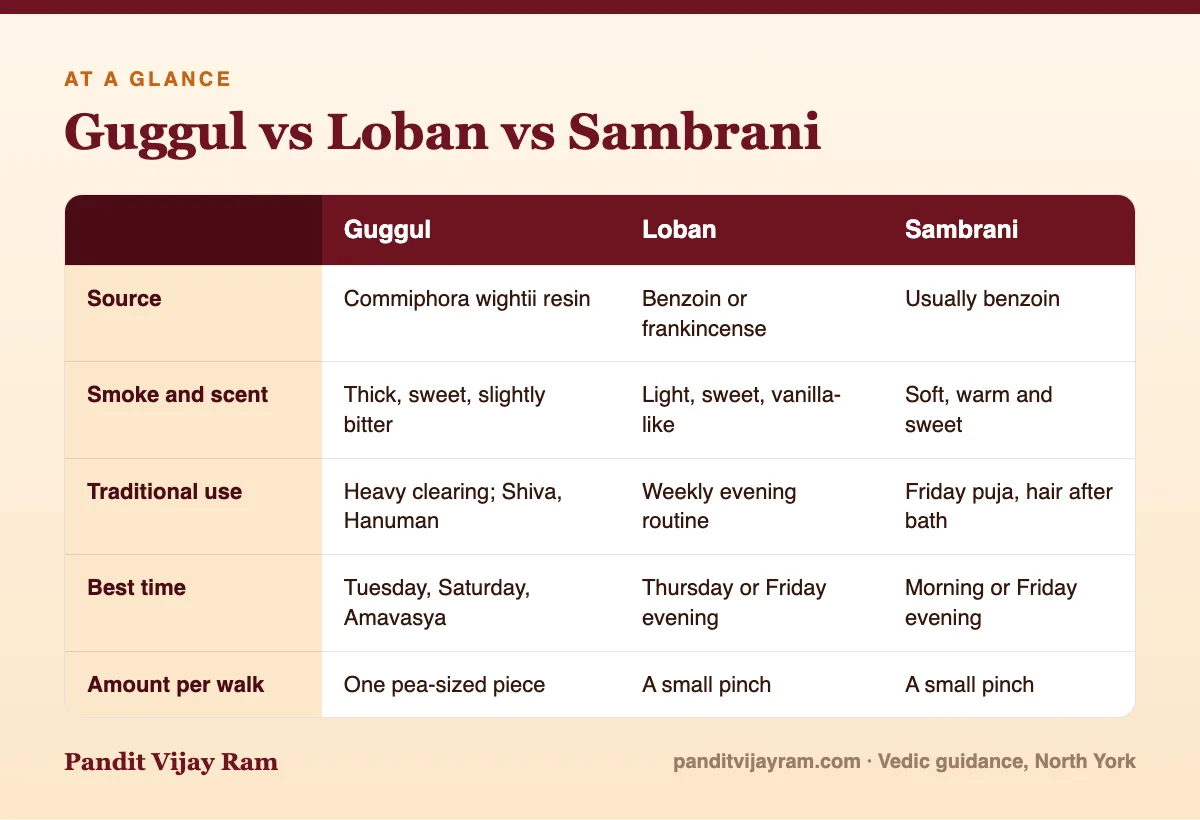
Guggul comes from Commiphora wightii and gives a heavy, sweet, slightly bitter smoke linked with Shiva and protection. Loban usually means benzoin or frankincense resin, with a lighter, vanilla-like scent used by Hindu, Muslim and Sufi households. Sambrani, the South Indian name, is usually benzoin. Ral, from the sal tree, is sharper.
Names overlap in stores, and the same word can mean different resins in different regions. Here is a practical guide to what each is generally used for:
- Guggul (gugal) – Heaviest smoke. Chosen for clearing after conflict, illness or a sense of oppression in the house, and for Shiva, Hanuman and Bhairav worship.
- Loban – Usually benzoin (Styrax) or frankincense (Boswellia). Lighter and sweeter. Widely burned on Thursday or Friday evenings in many Hindu, Muslim and Sufi homes, and used at dargahs.
- Sambrani – The Tamil and Telugu name, often benzoin. Used after a bath to dry and scent the hair in some families, and offered during Friday puja.
- Ral (sal resin) – From Shorea robusta. Flares brightly with a sharp smell. Often sprinkled into havan or onto glowing coals for a burst of smoke.
- Dhuna – A general term in some regions for resin incense, sometimes a mixed blend.
A simple decision rule:
- For a heavy, tense house after a hard event, choose guggul.
- For a gentle weekly evening routine, choose loban or sambrani.
- For a short burst during havan, add a pinch of ral.
Many families mix a little guggul with loban for a balanced scent. Dhoop cones and sticks labelled guggul usually contain only a small share of resin, which is fine for daily use. If you want to understand the fire offering itself, read the guide to havan for spiritual cleansing.
How do you burn guggul dhoop on a cow-dung cake or charcoal?
Place a small piece of cow-dung cake (uple) or a quick-light charcoal disc in a clay or brass dhoop holder on sand. Light it and wait until it glows with a thin layer of ash. Then add a pea-sized piece of guggul. Carry the holder by its handle, keeping it level and away from fabric.
Getting the base right makes the difference between gentle fragrance and a smoke-filled kitchen.
Equipment:
- A dhoopdani, a clay or brass holder with a long handle or chain
- A layer of sand or ash in the bottom, so heat does not crack the holder or scorch the floor
- One small piece of uple (dried cow-dung cake) or one quick-light charcoal tablet
- Tongs and long matches
- A small bowl of water nearby
Lighting: Light the uple or charcoal edge with a match. Cow-dung cake catches slowly; a drop of ghee helps. Quick-light charcoal sparks and fizzes for a few seconds, so hold it with tongs at arm's length. Let it sit until the surface is grey and glowing. That usually takes five to ten minutes.
Adding resin: Place a piece the size of a pea or a chickpea on the coal. Add more only when the smoke thins. A heap of guggul at once will choke the room and may flare.
Some families add a spoonful of ghee, a few cloves, dried neem leaves or a pinch of havan samagri to the coal. Keep these additions small. If you prefer no embers at all, an electric resin warmer heats guggul gently and produces far less smoke, which suits many apartments.
Which order should you take dhoop through the house?
Begin at the home altar, offering dhoop to the deity with a mantra. Then move through the house clockwise, from the innermost rooms toward the front, pausing in corners and doorways. Finish at the main door, holding the dhoop there briefly, then return the holder to a safe spot to burn out.
The traditional idea is that smoke gathers what is heavy and carries it outward, so you move from the inside of the house to the entrance. A typical route:
- Altar or mandir. Offer smoke with three clockwise circles. Chant Om Namah Shivaya, the Hanuman Chalisa, or a mantra your family uses.
- Upper floor or innermost rooms. Bedrooms and study rooms first. Keep the holder well away from bedding and curtains.
- Bathrooms. A brief pass through the doorway is enough.
- Kitchen. Move around the stove area but not over it.
- Living and dining rooms. Pause in each corner, then in the centre.
- Basement, if it is used and well ventilated. Skip unfinished basements with a furnace or gas appliances nearby.
- Main door. Stand at the threshold for a moment, then open the door briefly.
Dusk is the traditional time, especially on Tuesday, Saturday and Amavasya evenings. One walk-through a week is plenty for most homes. Daily dhoop at the altar only, without walking the house, is a gentler everyday habit.
For entrance rituals that pair well with evening dhoop, see the guide to main door and threshold rituals. If smoke is not possible where you live, the guide to cleansing a condo without smoke lists alternatives.
Is burning dhoop indoors safe for lungs, pets and smoke alarms?
It can be, with care. Charcoal and cow-dung cakes give off carbon monoxide, and resin smoke irritates sensitive lungs. Open a window, keep a working CO alarm, burn small amounts for a short time, keep children and pets away, never cover a smoke detector, and skip it entirely if anyone has asthma or breathing problems.
The risk with dhoop is different from a candle. Glowing charcoal produces carbon monoxide, a gas you cannot see or smell. Canadian homes are well sealed against winter, so it can build up faster than people expect. Every Ontario home with a fuel-burning appliance is required to have CO alarms, and they matter here too.
Safety rules I give every family:
- Ventilate. Open at least one window and run the range hood or bathroom fan throughout and for twenty minutes after.
- Keep it short. One walk-through of about ten minutes, then let the coal burn out in a ventilated spot.
- Never in a closed room. Do not leave a dhoop holder smouldering in a bedroom with the door shut, and never overnight.
- Alarms stay on. Never cover or unplug smoke or CO alarms. If yours trigger easily, use less resin or an electric warmer.
- Breathing. Skip dhoop if anyone has asthma, COPD, a recent chest infection, or is pregnant and sensitive to smoke. Birds should not be in the house during dhoop.
- Burns. Use a long handle, keep the holder level, and keep children and pets well back.
- Disposal. Douse spent coal in water, let it cool fully, and only then put it in the garbage, never straight into a plastic bin.
If anyone feels a headache, dizziness or nausea during dhoop, get everyone outside and call 9-1-1. For more on cleansing risks overall, read the guide to spiritual cleansing side effects. If a heavy feeling persists despite careful routines, the negative energy removal service explains how I assess a home before suggesting anything stronger.
The bottom line
Guggul dhoop is a traditional resin smoke that Hindu households have long used to purify and protect the home, especially at dusk. Choose guggul for heavier clearing and loban or sambrani for a lighter weekly routine. Burn a small piece on a glowing cow-dung cake or charcoal in a proper holder, and walk from the altar through the inner rooms to the main door. Ventilation, a working CO alarm, tiny amounts and constant attention are what keep the practice safe.
Key takeaways
- Guggul is a gum resin from Commiphora wightii, burned for purification and protection.
- Loban and sambrani are lighter resins suited to gentle weekly use.
- Use a pea-sized piece on a fully glowing coal in a sand-lined holder.
- Walk from the altar through the inner rooms and finish at the main door.
- Charcoal releases carbon monoxide, so ventilate and keep CO alarms working.