
Vastu for Apartments and Condos: What You Can Actually Change
Most vastu books picture a square house on an open plot with a garden and a gate. You live on the fourteenth floor of a tower, the door faces a corridor, and the kitchen is wherever the developer put it. It is easy to conclude that vastu for apartment living is either impossible or a list of expensive fixes. Neither is true. Many of the families I see in North York, Thornhill and Markham rent or own condos, and the questions they bring are practical: where should the bed go, does the balcony direction matter, what about a bathroom in the northeast? This guide shows you how to map the directions of a unit, what you can change with furniture and textiles alone, and which features are fixed, so you can stop worrying about them. In more than forty years of vastu work I have learned that most of the improvement in a flat comes from arrangement and upkeep, not from structure. You can rearrange a room in an afternoon; you cannot move a load-bearing wall, and you do not need to.
Does vastu work for apartments and condos?
Yes, in an adapted form. Traditional texts describe houses on land, but most practitioners now treat each unit as its own small plot, read from the unit's centre. The building's orientation and the lobby matter far less than how your own rooms, door and furniture sit within the eight directions of your space.
Vastu shastra grew up around village houses, temples and town planning, where a family chose the plot, the slope and the position of every room. A Toronto condo offers none of that choice, so teachers differ on how much of the system applies.
The common modern approach has three layers:
- Your unit – the most important layer. Its centre, door and room positions are read like a house.
- The building – its main entrance and overall shape are noted, but you share them with hundreds of people and cannot alter them.
- The floor level – some practitioners have opinions about very high or very low floors, but there is no classical rule written for towers, and I do not ask anyone to choose a floor for vastu alone.
This adapted view keeps the useful parts: the northeast kept light and calm, the southwest heavy and stable, the centre open, the southeast for fire and the northwest for movement. It drops anxieties that make no sense in a high-rise, such as the slope of land under a building you share. If you want help reading a specific floor plan, the vastu consultation service works from a drawing and photos.

How do you find the directions in a condo unit?
Stand near the middle of the unit with a phone compass, away from the fridge, stove and steel columns, and note north. Take two or three readings in different spots to confirm. Then lay a three-by-three grid over your floor plan so each outer square becomes one of the eight directions and the middle becomes the centre.
Accuracy matters more than people expect, because a reading that is twenty degrees off can move your kitchen from the southeast to the south. A simple method:
- Get the floor plan. Your listing, purchase documents or building management may have one. A hand sketch with rough measurements also works.
- Calibrate the compass. Phone compasses drift near metal and electronics. Remove your phone case if it has a magnet and recalibrate.
- Take readings. Stand in the centre and at two other points. If they disagree widely, the building's steel frame is interfering, so use a map app showing the building's footprint and street grid instead.
- Draw the grid. Divide the plan into nine equal parts. Label the corners northeast, southeast, southwest and northwest, the edges north, east, south and west, and the middle square brahmasthan.
- Mark the door. The facing of your unit's own entry door is what matters, not the building's lobby.
Toronto's street grid is tilted from true north, so do not assume that a street called "north" points due north. Many GTA units turn out to sit at an angle, and that is fine; read the nearest direction rather than forcing a perfect fit.
What vastu changes can renters make without touching the walls?
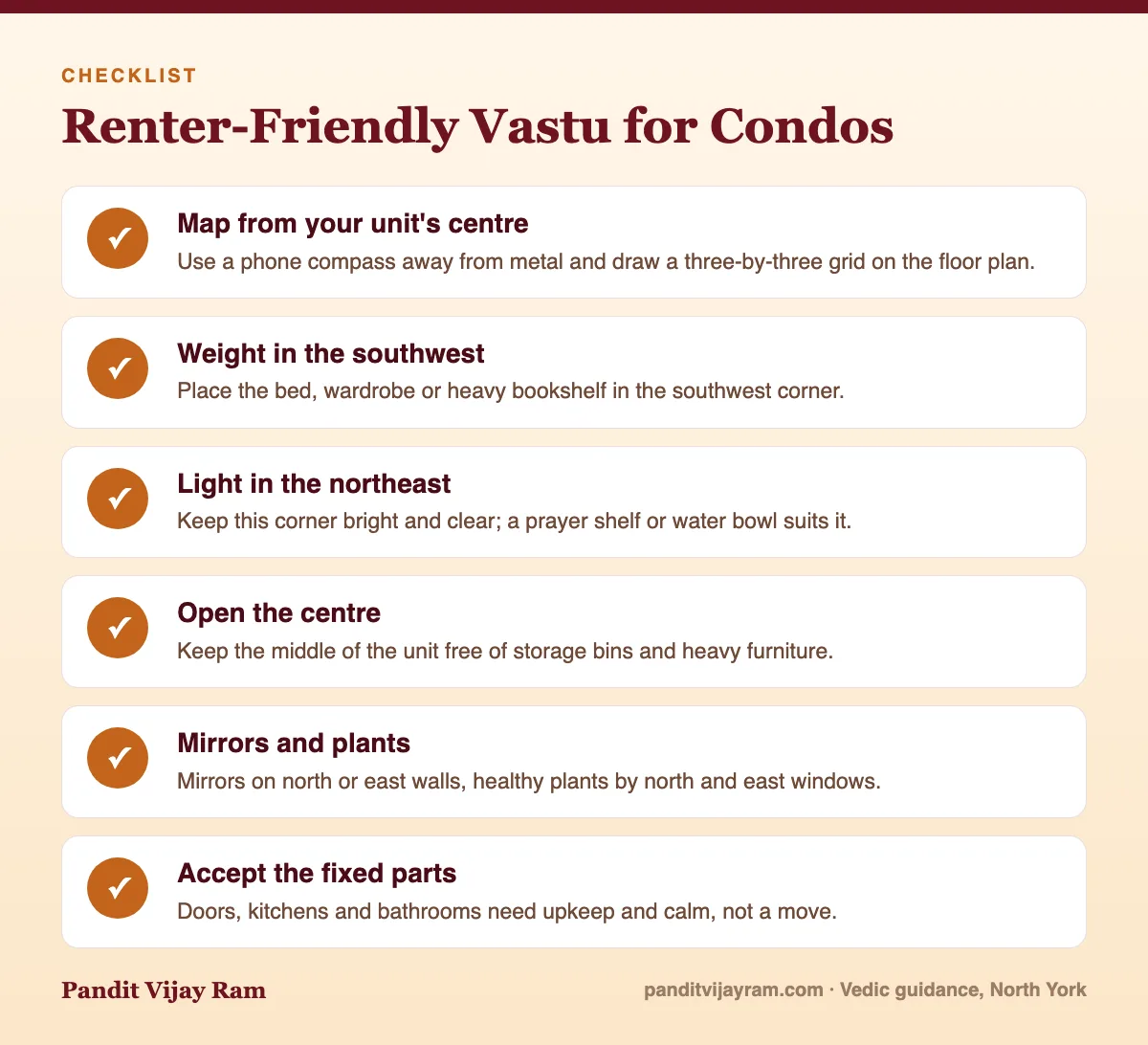
Renters can place the bed, sofa and heavy storage in the southwest, keep the northeast light and uncluttered, hang mirrors on north or east walls, add healthy plants in the north and east, use cushions and throws in direction colours, and clear the centre. None of these needs a landlord's permission.
Think of the movable layer of your home as the part vastu can reach. A practical checklist by zone:
- Southwest – the master bed, wardrobe or a heavy bookshelf. Sleep with your head toward the south or east if the room allows.
- Northeast – a small prayer shelf, a water bowl or a reading chair. Move shoe racks, bins and boxes elsewhere.
- Centre – keep floor space open. A coffee table is fine; a pile of storage bins is not.
- Mirrors – north or east walls suit them. Avoid a mirror facing the bed directly; a cloth over it at night is an easy fix.
- Plants – tulsi, money plant or a snake plant near north and east windows. Bring tender plants away from cold glass in a GTA winter.
- Colours – change cushions, rugs and curtains instead of paint. Warm tones suit the south, soft blues and greens the north and east.
- Lighting – a dark corner, especially in the northeast, benefits from a warm lamp.
Use removable hooks and adhesive strips rather than nails, so your deposit stays safe. The guide to vastu colours for each room gives fuller colour options, and the bedroom guide covers bed placement in more detail.
What parts of an apartment's vastu can you not change?
You cannot change the direction of your entry door, the position of the kitchen and bathrooms, the unit's shape, the balcony's facing or what sits in the units beside you. These are fixed features. Note them once, apply the simple balancing steps available, and then stop worrying about them, because worry does more harm than layout.
Many condo layouts have quirks that a vastu book would flag. Common ones in GTA towers include:
- Missing corners – L-shaped units where a corner zone is cut away, often by a corridor or neighbouring suite.
- A bathroom in the northeast – common in compact one-bedroom plans.
- An open kitchen in the centre – where the island sits in the brahmasthan.
- A south- or west-facing door – simply because of where the corridor runs.
Here is the honest perspective. Plenty of ordinary, happy families live in such units. A south door is not automatically harmful; its effect in vastu depends on its exact position along the wall, which the guide on south-facing homes explains. A missing corner can be balanced with light, a plant or an image in the remaining part of that zone.
What I discourage is moving house, breaking a lease or buying gadgets because of a fixed feature. Rent, commute, schools and safety matter far more to daily life. If a layout bothers you, the non-structural options in the guide to vastu remedies without demolition are the right next step, and the cost of most of them is close to nothing.
How do you balance a bathroom or open kitchen in the wrong zone of a flat?
Keep a misplaced bathroom spotless, ventilated and closed, with the lid down and the fan working. For an open kitchen in the centre, keep the island clear of clutter, cook in its southeast part where possible and add a little open floor space around it. Upkeep and calm use do most of the balancing.
Bathrooms and kitchens carry the two strongest elements in a home, water and fire, so their placement attracts most worry. A few steady habits help without any renovation.
For a bathroom in the northeast or centre:
- Keep the door closed and the toilet lid down when not in use.
- Run the exhaust fan after showers to prevent damp, which is a real health issue in condos.
- Fix dripping taps quickly; in vastu, steady leaks are seen as draining, and in practice they waste water and invite mould.
- Use light, clean colours and a small plant if there is a window.
For an open kitchen or island in the centre:
- Treat the island as a workspace, not a storage shelf. Clear it each night.
- If you have a choice of burners, favour those on the southeast side of the cooktop.
- Keep a rug-free path around the island so the centre still feels open.
These steps also make the unit easier to live in, which is no coincidence. For gentle cleansing methods that respect condo smoke rules, see the guide to cleansing a condo or rental without smoke.
When is a vastu consultation worth it for a rented flat?
A consultation is most useful before you sign a lease or purchase agreement, when you can still compare two or three units. After moving in, it helps if you want a clear plan for furniture and colours. It is not worth paying for structural advice you cannot legally or practically carry out in a rental.
A simple decision rule I share with tenants:
- Choosing between units? Compare door position, the northeast and southwest corners, and where the bedrooms fall. If everything else is equal, vastu can be a tie-breaker. It should never outweigh price, safety or commute.
- Already living there? Start with the free steps: clear clutter, move the bed, open the centre and improve light. Give it a few weeks.
- Still unsettled? A layout review can suggest one or two targeted changes for your floor plan. Bring the plan, photos and compass readings.
- Feeling low, anxious or unwell? See your family doctor first. A flat's layout is never a substitute for medical care.
Also look at the ordinary causes of an uneasy home: noise through shared walls, poor sleep, a heating system that runs too dry, or tension with a roommate. Fixing those often changes how a unit feels more than any direction. If you work from the unit, the guide to vastu for a home office covers desk placement in a small space.
The bottom line
Vastu for apartment and condo living works best when you treat your own unit as the plot and read it from its centre. Furniture, beds, mirrors, plants, textiles and an open centre are all within a renter's reach. Doors, kitchens, bathrooms and the unit's shape are fixed, and the right response is calm upkeep rather than moving or buying gadgets. Arrange what you can, look after the rest, and let comfort and safety lead.
Key takeaways
- Read vastu from your own unit's centre, not from the building's lobby.
- Take several compass readings away from metal and appliances.
- Heavy furniture in the southwest and a light northeast suit almost any flat.
- Fixed features such as door and bathroom positions need upkeep, not alarm.
- Use vastu as a tie-breaker between units, never ahead of safety or cost.