
Disposing of Old Puja Items and Murtis Respectfully in Toronto
Every home shrine slowly fills up over the years. Dried garlands, a chipped murti from a relative, calendar pictures, coconut shells and boxes of incense ash pile up, and many families end up searching 'dispose puja items Toronto' because they fear offending God or the city. Families in North York, Brampton and Scarborough ask me this most often after Diwali, a house move or the death of an elder. Back home, the custom was a river. Here, that habit harms the water and wildlife, and it is not what the scriptures actually require. In more than forty years of guiding families, I have found that a clear sorting method removes nearly all of the guilt. This guide explains what nirmalya means, why waterways are off the table, how to handle murtis and pictures, what can go into a garden or green bin, and how to say a respectful goodbye to each item.
What is nirmalya and why does it need respectful disposal?
Nirmalya is the name for offerings that have already been given to a deity, such as flowers, leaves, rice, kumkum and threads. Tradition treats them as blessed, so they are not thrown out with ordinary garbage. They are returned to the earth or to fire under care, with a brief prayer of thanks.
Once a flower has been placed at the feet of a murti, many Hindu households stop seeing it as just a flower. It has served the deity, and it should leave the home with the same care it arrived with. That instinct only becomes a burden when people believe a river is the one correct place.
The older texts speak more about attitude than location. They ask that blessed things are not trampled, mixed with unclean waste or treated carelessly. Soil, a clean compost pile, a temple's collection point and a controlled sacred fire have all been used for centuries.
It also helps to separate true nirmalya from what simply sat near the shrine. A plastic flower wrapper, an incense box or an empty ghee jar was never offered. Those can go into normal recycling once clean.
Daily care of the shrine itself is covered in our guide to cleaning a puja room and home mandir. This article picks up where that one stops: what to do with the things you are ready to let go.

Can you put puja flowers or idols in Lake Ontario or a river?
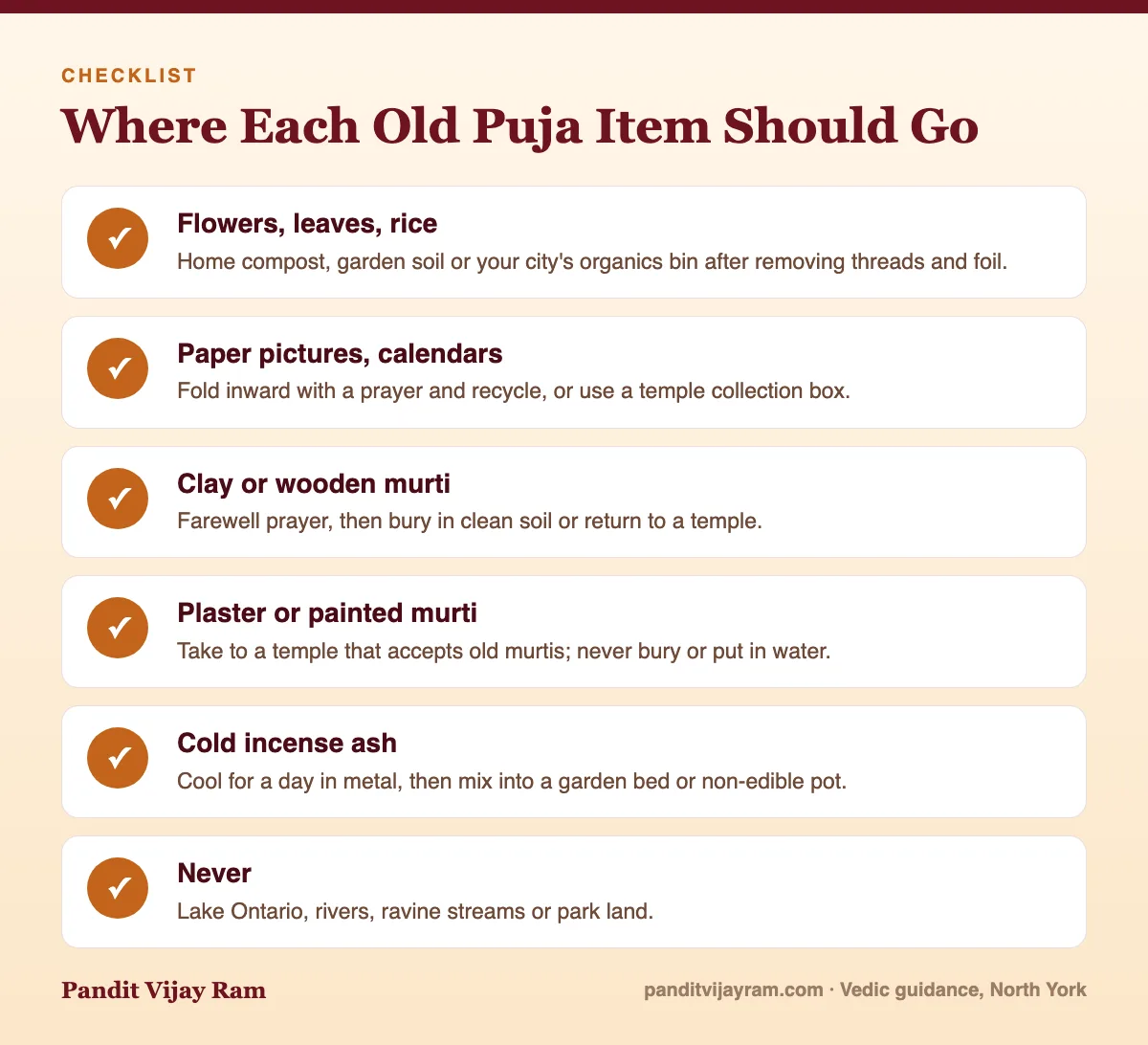
No. Placing murtis, flowers, paint, plastics or ash in Lake Ontario, the Don, the Humber, Rouge River or any ravine stream harms water and wildlife, and it may break municipal or provincial rules. Scripture does not demand a river; a clean garden, compost or temple collection carries the same respect.
I understand the pull of the river. For many of us the Ganga or a village tank was where offerings went. But a flowing Himalayan river in a monsoon is a very different system from a Toronto shoreline in October.
- Murtis are rarely just clay. Many sold in shops are plaster, resin or painted ceramic. They do not break down and the paints can carry metals.
- Garlands hide plastic. Nylon thread, foil, glitter and wire are common in festival garlands.
- Small streams cannot dilute. Ravine creeks in the GTA are slow and shallow, and offerings simply pile up on the banks where neighbours walk dogs and children play.
- It reflects on the community. Piles of offerings at a shoreline create avoidable tension.
If you are unsure what rules apply, check your city's guidance on dumping and the province's environmental pages, and assume a waterway is not the place. Choosing the earth instead is not a lesser option. Bhumi, Mother Earth, is herself honoured in daily prayer, and returning offerings to soil is an act of devotion in its own right.
How do you dispose of an old or broken murti respectfully?
First thank the deity and, if the murti was ever installed with prana pratishtha, ask a priest about a short visarjan prayer. Then return it to a temple that accepts old murtis, bury a natural clay or wooden one in clean soil, or keep a sound one for someone who wants it.
Murtis carry the strongest feelings, so it helps to slow down and work through a simple decision rule.
- Is it whole and still loved? If the only issue is crowding, consider gifting it to a family member or a new household that would welcome it. Many people keep too many images out of guilt; one well-tended murti is better than ten dusty ones.
- Was it formally installed? A murti that went through prana pratishtha in a ceremony is usually given a short farewell prayer before leaving the home. A priest can tell you whether your tradition expects this.
- What is it made of? Unpainted natural clay or untreated wood can be buried in a clean, quiet corner of a garden or a large pot. Metal murtis are usually kept, polished or passed on. Plaster, resin and painted pieces belong with a temple collection.
- Is it broken? Tradition generally does not keep a cracked or chipped murti in active worship. Wrap it in a clean cloth, say a prayer, and take it to a temple that accepts such items.
Temple practices vary across the GTA. Phone your local mandir first and ask whether, when and how they take old murtis, rather than leaving a bag at the door. If you need help with a farewell prayer, a Ganesha puja for new beginnings is often chosen when a family is replacing an old shrine.
Can puja flowers, leaves and coconuts go in the green bin or compost?
Plain flowers, tulsi and mango leaves, rice, fruit peel and coconut shells are natural and can usually go into a home compost or your municipal organics program. Remove threads, foil, wire and plastic first. Check your own city's list, because what each GTA green bin accepts can differ.
Composting is one of the most respectful options in a city. The offering returns to the earth, feeds plants and eventually becomes soil again. Many families keep a separate small container near the shrine for this.
Before anything goes in, sort it:
- Usually compostable: marigold and rose petals, leaves, rice, flower stems, banana leaves, fruit, coconut husk and shell broken into pieces.
- Remove first: nylon and cotton threads from garlands, foil, glitter, sticky tape, staples and any plastic flower.
- Not for compost: painted or plaster items, synthetic cloth, plastic packaging and anything with heavy dye.
If you have a backyard, a dedicated compost corner for nirmalya works well. In an apartment, the municipal organics service is the practical route. Rules differ between Toronto, York, Peel and Durham, so read your local list. Coconut shells, for instance, are accepted in some programs and not others.
Tulsi deserves a special note. Dried stems from a sacred plant can be returned to the soil of the next tulsi pot. Our guide to caring for a tulsi plant in a Canadian winter explains how many families handle a tulsi that has died.
What do you do with deity photos, calendars, old threads and incense ash?
Paper pictures and calendars can be folded with a prayer and placed in paper recycling, or handed to a temple that collects them. Incense and camphor ash, once fully cold, can be mixed into garden soil. Old kalava threads can be buried or added to compost if they are plain cotton.
These are the items people agonise over most, often because they come in quantity. A few guidelines help:
- Calendars and printed pictures: many families tear the image respectfully along its edge rather than through the face, fold it inward and place it in paper recycling. Others prefer a temple box. Both are acceptable in most traditions.
- Framed photos: remove the paper image and treat it as above. Recycle or donate the frame and glass.
- Ash from agarbatti, dhoop and camphor: let it cool completely for at least a day in a metal container. Then mix it into the soil of a garden bed or a non-edible pot. Never tip warm ash into a bin.
- Kalava, mauli and raksha threads: cotton threads can be buried at the foot of a tree or composted. Synthetic ones go in the garbage after a short prayer. Our article on the kalava thread covers when to remove it.
Holy books in poor condition deserve their own care, so ask your priest. None of this needs fear.
When should you ask a temple or pandit for help with disposal?
Ask for help when a murti was formally installed, when clearing a deceased elder's shrine, when items came from a ritual you feel uneasy about, or when the volume is large. A pandit can say a short farewell prayer and advise which items your local temple or family tradition handles differently.
Most disposal is something a family can do calmly on its own. A few situations are worth a phone call first.
Clearing an elder's shrine. After a death, a mandir can hold decades of a parent's devotion. A priest can guide you on which items to keep, which to pass to siblings and which to release, and on any sutak customs your family follows.
Items from someone else's ritual. Sometimes people find lemons, threads or unfamiliar objects left by another person. Do not panic. Handle them with gloves, photograph anything that looks like a threat, and read our guide to finding a suspicious object before disposing of it.
A whole shrine move. When downsizing to a condo, a short puja to close the old space and open the new one gives everyone a sense of completion.
Vijay Ram ji can perform a farewell or re-establishment prayer on your behalf through his puja and anushthan service, with the family joining by video or attending an in-person consultation in North York.
The bottom line
To dispose of puja items in Toronto with respect, sort first and decide second. Plain flowers, leaves and coconuts return to the soil or the organics bin, paper images go to recycling or a temple box, and murtis follow the simple decision rule above. Waterways such as Lake Ontario and the ravines are never the answer, and a short prayer of thanks carries the real meaning.
Key takeaways
- Nirmalya means offerings already given to a deity, and they deserve care rather than fear.
- Never place murtis, flowers or ash in Lake Ontario, a river or a ravine stream.
- Natural materials can be composted once threads, foil and plastics are removed.
- Plaster, resin and painted murtis should go to a temple that accepts them.
- Phone the temple first, because each mandir handles old items differently.