
Buying a House in Ontario: Vastu Points to Check Alongside the Inspection

Buying a home is one of the biggest decisions a family makes, and in the Ontario market it often has to be made quickly. Many South Asian buyers also want the house to feel right according to vastu, and they worry about missing something important during a thirty-minute showing. These vastu tips for buying a house are written to fit alongside the process you are already following, not to replace it. Families in North York, Markham, Brampton and Mississauga often send me listing photos late at night, asking whether a door direction or a kitchen position should stop them. My first answer is always the same: the inspection, your lawyer, your budget and your realtor's advice come first. Vastu then helps you choose among sound options and arrange the home well. This guide covers what to check at a showing, which plot shapes and slopes vastu prefers, which rooms to look at in a resale home, and which concerns are deal-breakers versus easy fixes. In more than forty years of practice I have seen far more families regret skipping an inspection than regret a door facing.
What should you check before vastu when buying a house in Ontario?
Before any vastu point, arrange financing, a qualified home inspection and a real estate lawyer. The inspection looks at structure, roof, foundation, plumbing, electrical and heating. The lawyer handles title, the agreement and closing. Your realtor advises on offer conditions. These protect your money and safety in ways that no direction can.
I am not a lawyer, inspector or financial adviser, and nothing here is legal or financial advice. What I can say from long experience is that families who put vastu ahead of these steps sometimes buy a house with a beautiful northeast and a cracked foundation.
The practical professionals each have a distinct role:
- Mortgage lender or broker – pre-approval tells you what you can afford before you fall in love with a house.
- Realtor – explains the market, comparable sales and whether conditions such as financing or inspection are realistic in a given offer.
- Home inspector – examines the visible condition of the roof, foundation, grading, windows, plumbing, electrical, heating, cooling and attic.
- Real estate lawyer – reviews the agreement, searches title, deals with any liens or easements and completes the closing.
In competitive markets buyers are sometimes tempted to waive the inspection. Discuss that risk carefully with your realtor and lawyer before deciding. A pre-offer inspection is one option some buyers use.
Vastu fits best after this foundation is in place. A vastu consultation can review a floor plan quickly when timing is tight.

How do you check the entrance and facing during a house showing?
At the main door, step outside and face the street with a phone compass. That direction is the facing. Then estimate where the door sits along the front wall: near the middle, near a corner or offset. Photograph the door from the street and note the compass reading, so the pada position can be worked out later.
Showings are short, so a simple routine helps you collect what a vastu review needs without slowing the visit.
- Compass reading at the threshold. Hold the phone flat, away from the metal door frame and railings.
- Door position. Pace out the front wall or count windows to estimate whether the door sits in the left, middle or right part.
- Street-view photo. One straight-on photo of the front of the house.
- Road alignment. Note whether a street runs straight into the house, a T-junction that vastu calls veedhi shoola.
- Corner lots. Note both frontages and where the main door actually opens.
North- and east-facing homes are traditionally preferred, but direction alone is not a verdict. A well-placed door on a south or west wall can be perfectly good, while a poorly placed door on a north wall may be cautioned. The guides to south-facing homes and to north- and west-facing homes explain the door positions on each wall.
Also check the entrance with ordinary eyes: lighting, icy steps and pooling water matter every winter.
What plot shape and slope does vastu prefer for a house?
Vastu prefers square or rectangular lots with the land slightly higher in the southwest and lower toward the northeast. A lot narrower at the front and wider at the back, called gaumukhi, is favoured for homes. Irregular, triangular or sharply cut lots are cautioned. Proper drainage away from the foundation matters on any lot.
Plot shape and slope were central to classical vastu, because the texts assumed you were choosing land before building. In a resale purchase you inherit both, so treat this as a comparison tool.
A quick guide to lot shapes:
- Square – the ideal; balanced in all directions.
- Rectangle – very good, especially when the longer sides run north–south or east–west without large cuts.
- Gaumukhi, cow-faced – narrower front, wider back; favoured for houses.
- Shermukhi, lion-faced – wider front, narrower back; traditionally favoured for shops rather than homes.
- Irregular or triangular – common on crescents and cul-de-sacs; cautioned, but balanced through landscaping and arrangement.
On slope, vastu likes the ground to fall gently from the southwest toward the northeast, so rainwater flows north or east. Here vastu and Ontario practicality meet. Inspectors check that the ground around a house slopes away from the foundation, because poor grading is a common cause of wet basements. A lot that sheds water away from the house on every side, with downspouts extended, is good news by both measures.
Pooling water near the foundation is a concern for your inspector before it is a concern for vastu.
Which rooms should you check for vastu in a resale home?
Check five places: the kitchen, ideally in the southeast or northwest; the master bedroom, ideally in the southwest; the northeast, which should be light and free of toilets; the centre, which should be open; and the staircase, usually preferred in the south, west or southwest. Basements and garages matter less in most schools.
Use the floor plan from the listing, or sketch one quickly after the showing. Map it from the centre of the house and note what sits in each zone.
- Kitchen. Southeast is ideal, northwest is acceptable. A northeast kitchen is the most common concern; the guide to vastu for the kitchen covers fixes.
- Master bedroom. Southwest is preferred for the heads of the household; south and west are good alternatives.
- Northeast. Ideally a living room, prayer area, study or entrance. A powder room here is frequently flagged.
- Centre. An open hallway or living area is ideal. A staircase or bathroom in the exact centre is cautioned.
- Staircase. South, west or southwest preferred; many teachers suggest stairs that turn clockwise as you climb.
- Basement and garage. Classical texts say little about them. Many practitioners prefer an attached garage in the southeast or northwest and treat a finished basement as a separate floor.
Few houses score perfectly, and that is fine. Note the concerns, and then sort them in the next step into fixable and serious.
Which vastu problems are deal-breakers and which can be fixed?
Most vastu concerns in a resale home are fixable through arrangement, colour, light and prayer. Few are true deal-breakers. Serious combinations, such as a heavily cut northeast with a sunken or wet southwest and a door in a cautioned position, deserve a closer look. Structural and safety problems from the inspection always outweigh vastu.
A practical sorting rule I share with buyers:
Usually fixable without renovation:
- Kitchen outside the southeast, especially if the stove can be used in the room's southeast part.
- Master bedroom outside the southwest.
- A bathroom in the northeast, kept clean, closed and well ventilated.
- A door in a neutral or cautioned pada, balanced with light, colour and a protective image.
- Clutter, dark corners and poor furniture placement left by the seller.
Worth a closer look before deciding:
- A large cut in the northeast corner of the building itself.
- A southwest that sits lower than the rest of the lot, or holds a pool, pond or water pooling.
- A road running straight into the house.
- Several cautioned features at once.
More important than any vastu point:
- Foundation cracks, roof failure, active leaks, outdated wiring or signs of mould found by the inspector.
- Title or legal issues your lawyer raises.
- A price that stretches your budget beyond comfort.
For the full set of no-construction fixes, see the guide to vastu remedies without demolition.
When should you consult a vastu adviser during a house purchase?
The most useful moment is after you have shortlisted homes and before you firm up an offer, ideally once the inspection is booked. Share the floor plan, compass readings and photos so a review can be done quickly. Avoid letting a vastu review delay deadlines your realtor and lawyer have set.
Timing matters in a fast market. Here is how families usually fit a vastu view in without disrupting the purchase:
- While browsing. Learn the basics yourself so you can rule out houses quickly and focus on promising ones.
- At the shortlist. Send floor plans and compass readings for two or three homes for a comparative view.
- During the conditional period. If your offer has conditions, a vastu review can run in parallel with the inspection.
- After closing. Plan room use, furniture placement and a griha pravesh before moving in.
A word of caution. If anyone tells you a house will bring illness, divorce or financial ruin because of its direction, and only an expensive remedy can prevent it, step back. That is fear-selling, not vastu.
After you buy, many families like to cleanse and bless the empty house before the furniture arrives. The guide to cleansing a new house before moving in explains the sequence, from empty-house cleansing to griha pravesh.
The bottom line
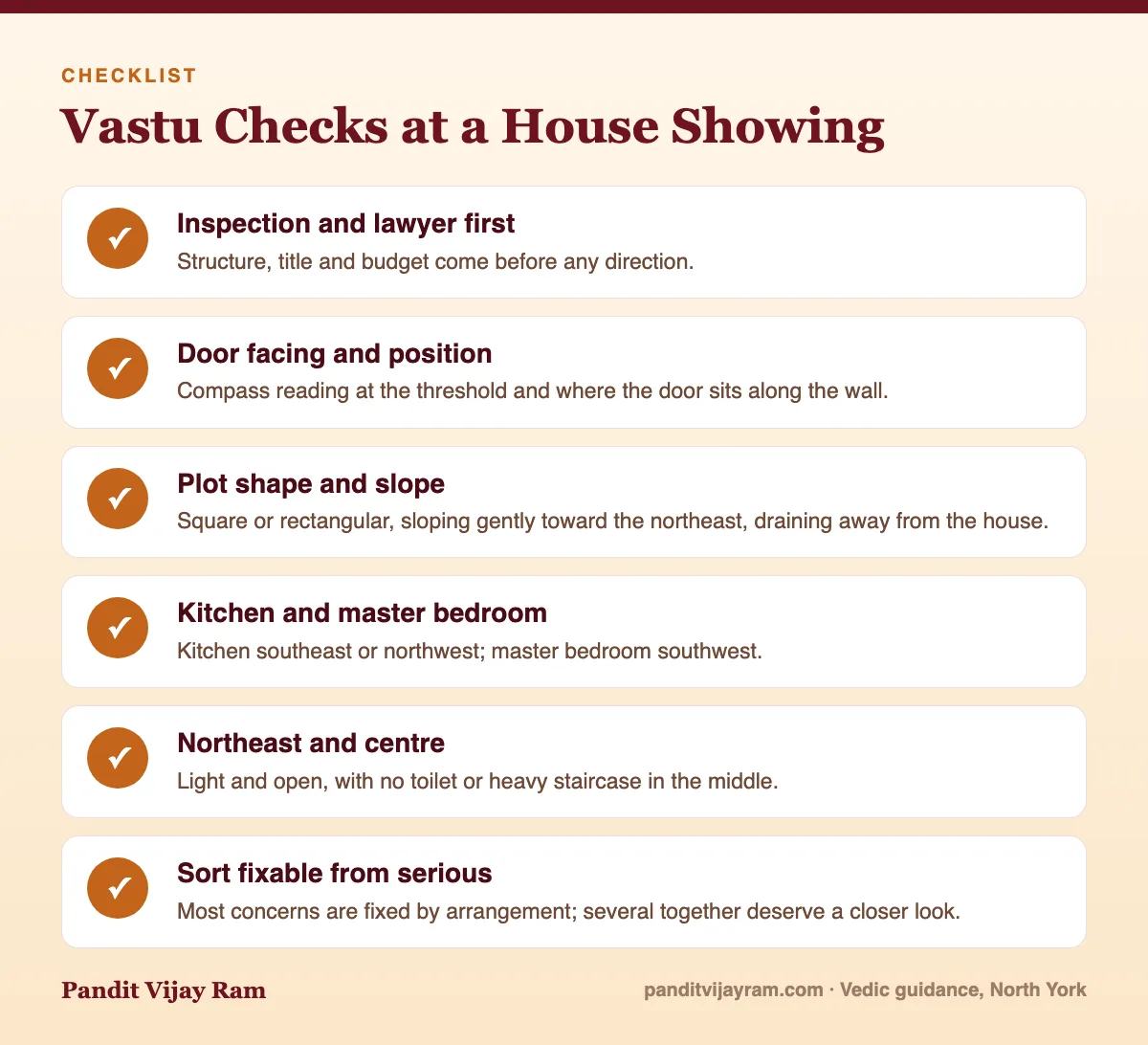
Vastu tips for buying a house belong after the home inspection, the real estate lawyer and your budget, never in place of them. At a showing, note the door's facing and position, the lot's shape and slope, and where the kitchen, master bedroom, northeast and centre fall. Most concerns are fixable without renovation, while structural problems from the inspection always come first. Choose a sound home, then let vastu help you arrange and bless it.
Key takeaways
- Financing, inspection and a real estate lawyer come before any vastu point.
- Record the door's facing and position at the showing for later review.
- Square or rectangular lots sloping toward the northeast are traditionally preferred.
- Most kitchen, bedroom and bathroom concerns are fixable without renovation.
- Structural, legal and budget issues always outweigh vastu.