
How to Cleanse a New House Before Moving In: Griha Pravesh Steps
Getting the keys to a new home is one of the happiest moments for a family, and also one of the most hectic. Between movers, closing papers and paint samples, many people want to know how to cleanse a new house before moving in so the first chapter starts on a calm, blessed note. Families in North York, Brampton and Vaughan often call me with the same questions: does the house need to be empty, what goes in the kalash, and what if the closing date does not match a good muhurat? This guide walks through the full sequence, from scrubbing the empty rooms to the first boil of milk. You will learn the meaning of each step, which parts can be adapted for a condo or a busy schedule, and the safety points that matter in a Canadian home with sealed windows and sensitive smoke alarms. In more than forty years of guiding families through griha pravesh, I have seen that a simple ceremony done with care feels richer than an elaborate one rushed between deliveries.
What is griha pravesh and why is it done?
Griha pravesh is the Hindu ceremony of first entry into a new home. It welcomes the household deities, honours Vastu Purusha, the spirit of the site, and asks for peace, health and prosperity. It marks the moment a building becomes a family home, and it is traditionally done before anyone sleeps there.
The word means "entering the house". Traditional texts describe three kinds. Apurva is the first entry into a newly built home. Sapurva is moving into a home after travel or a long absence. Dvandvah is returning to a house after renovation or repair, sometimes after a fire or flood.
Whichever type applies, the ceremony usually includes the same core elements:
- Ganesh puja to remove obstacles at the start.
- Kalash sthapana, installing a water pot that represents abundance.
- Vastu puja, honouring the deity of the plot and its directions.
- Navagraha shanti, a short offering to the nine planets, in fuller ceremonies.
- A small havan with ghee and samagri, where the home allows it.
Regional customs differ. Some South Indian households bring a cow, or a picture of one, in first; Punjabi Hindu and Sikh families may hold a simpler Ardas. All are valid.
For the full puja and havan options, see the puja and anushthan services. The wider set of home methods sits on the cleansing and protection hub.

How do you cleanse an empty house before griha pravesh?
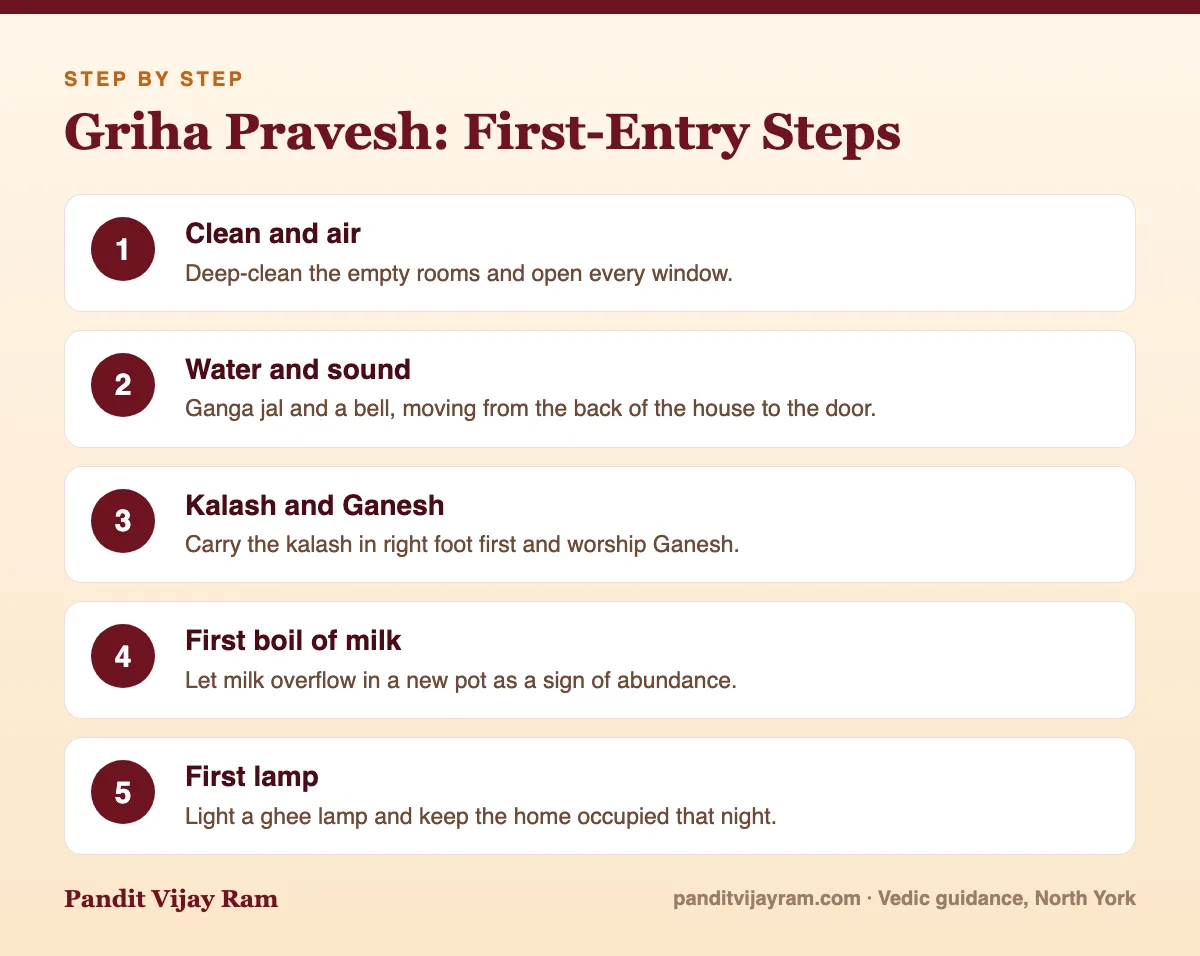
Start with a deep physical clean of every room, cupboard and vent while the house is empty. Open windows, then mop floors with water and a little rock salt where the flooring allows. Sprinkle Ganga jal or turmeric water from the back of the house toward the main door, chanting as you go.
An empty house is the easiest one to cleanse, so use the window well. The order matters in tradition: you move from the inside outward so that whatever is cleared leaves by the main door.
- Clean physically. Wipe shelves, scrub the kitchen and bathrooms, and change the furnace filter. Dust and old cooking smells make a home feel stale.
- Air it out. Open every window for an hour, even in cold weather.
- Mop with salt water on tile, vinyl and sealed stone. Skip salt on hardwood and unsealed marble. The separate guide to salt water mopping covers floor types in detail.
- Sprinkle Ganga jal with a mango leaf in each room, starting at the far corner and working toward the entrance.
- Ring a bell or blow a conch in each room. Sound is a traditional way to wake up a space.
- Remove old items left by previous owners, such as broken pots, old calendars or religious objects. Offer any sacred items to a temple rather than discarding them.
If the house came from a family who went through a hard time, such as divorce or illness, this stage is a good moment to add a short prayer for their wellbeing too. That gesture keeps the cleansing kind rather than suspicious. For deeper direction-wise priorities, the guide to vastu cleansing by room explains the northeast and centre.
What should be in the kalash for griha pravesh?
A griha pravesh kalash is a copper, brass or silver pot filled with clean water or Ganga jal, a coin, a betel nut, a little rice, turmeric and a few flowers. Five or seven mango leaves rest in the mouth, topped with a coconut wrapped in red cloth and tied with sacred thread.
The kalash represents the cosmic waters and the fullness the family hopes to receive. It is carried into the house by the woman of the home, or by the couple together, during the first entry.
Common kalash contents:
- Clean water mixed with a little Ganga jal
- A silver or copper coin, a whole betel nut (supari) and a pinch of akshat (unbroken rice)
- Turmeric, a little kumkum and a few fresh flowers
- Five or seven mango leaves arranged around the mouth
- A whole coconut, often wrapped in red cloth and tied with kalava thread
The outside of the pot is marked with a swastik or Om in kumkum or sandalwood paste. It is placed on a small heap of rice or wheat, ideally in the northeast area of the main room. It stays there through the ceremony and often for a few days after.
When it is time to remove it, the water is sprinkled through the home or poured at the base of a tree or plant. The coconut is broken and shared as prasad. Rice can be cooked or given to birds. Avoid pouring the water down a drain if you can, simply as a matter of respect.
If you want to understand the Ganesh part of the ceremony, the Ganesha puja page explains it.
Why do you boil milk when moving into a new house?
Boiling milk until it overflows is a sign of abundance spilling over in the new home. It is usually the first cooking done on the new stove, often in a new pot. The overflow is allowed to run over the rim, then the milk is made into kheer or shared as prasad.
This is one of the most loved parts of griha pravesh, and it carries a simple message: may food and plenty never run short here. In many South Indian families the ritual is called paal kaachal, and it is sometimes done even without a full puja.
How families usually do it:
- Use a new steel, brass or clay pot, washed and marked with a little turmeric and kumkum.
- Pour in fresh milk, sometimes with a little water, rice and jaggery.
- Light the stove after the kalash and Ganesh puja are complete.
- Let the milk rise and spill over on its own. The direction of the spill is noticed in some families; spilling toward the east is considered auspicious, but no one should worry about the direction.
- Add rice, sugar or jaggery to make kheer or pongal, offer it to the deity, then share it.
In a condo or new build with a sensitive induction or glass-top stove, put a tray beneath the pot or let only a small amount spill. Never leave the stove unattended during the ritual, and keep children back from the hot pot.
Sharing the kheer with the people next door is a lovely, practical blessing.
What if my closing date does not match a good muhurat?
That is common and not a problem. You can do the cleansing and a small Ganesh prayer on the day you get the keys, then wait for an auspicious muhurat for the formal griha pravesh before moving in to sleep. A local panchang or your family priest can suggest a suitable window.
A muhurat is an auspicious time window chosen from the panchang, the Hindu almanac. For griha pravesh, families traditionally consider the lunar day, the nakshatra, the weekday and the month. Some periods, such as Chaturmas or Pitru Paksha, are often avoided. I will not give specific dates here because they change each year and depend on your location. Check a local panchang for Toronto time.
Practical ways to bridge the gap:
- Keys first, ceremony later. Clean and do a brief Ganesh prayer on handover day. Move boxes in if you must, but hold off on sleeping there until the formal entry.
- Rental or short timeline. A simple entry with a kalash, a lamp and the milk boil, done at a reasonable hour, is far better than skipping the ritual.
Your kundli can also help choose a muhurat that suits the head of the household. The kundli and horoscope service covers that. After the move, the guide to main door and threshold rituals explains how to keep the entrance fresh.
Can you do griha pravesh in a condo or apartment?
Yes. Many GTA families hold griha pravesh in condos and rentals. Replace a full havan with a ghee lamp, a small camphor flame or a sealed diya, check building rules on open flames, and warn your concierge if a smoke alarm might trigger. The kalash, Ganesh puja and milk boil all work well indoors.
Condos and high-rises in Toronto are fitted with sensitive smoke detectors and sometimes sprinkler systems. A full havan with a fire pit can set them off, and a false alarm may bring a fine or an evacuation. Planning ahead keeps the day peaceful.
Condo-friendly adaptations:
- Use a small brass havan kund with very little samagri, or skip the fire entirely and offer ghee to a lamp with mantras instead.
- Burn a single small piece of camphor on a brass plate for aarti, and keep it away from the detector.
- Open balcony doors or windows and run the range hood during any flame.
- Ask property management about their open-flame rules in advance.
When you later move out, a short thank-you prayer before handing back the keys closes the circle.
If smoke is not an option at all, the separate guide to cleansing a condo without smoke lists sound, water and mantra methods that work well alongside a griha pravesh.
The bottom line
To cleanse a new house before moving in, start with a thorough physical clean, air the rooms, and sprinkle Ganga jal from the back of the house toward the door. Then hold the griha pravesh with a kalash, Ganesh puja and the first boil of milk at a muhurat that suits your family. Condos and rentals can follow the same order with smaller flames and an eye on the smoke alarms. A modest ceremony done with care is a fine way to begin.
Key takeaways
- Clean and air the empty house before any ritual.
- Sprinkle Ganga jal from the far rooms toward the main door.
- The kalash, Ganesh puja and first milk boil are the core of griha pravesh.
- If dates clash, do a small prayer at handover and the formal entry later.
- In condos, keep flames small and check building rules on open fire.