
Cleansing a Puja Room or Home Mandir: Daily and Monthly Routine

The home mandir is the quietest corner of most Hindu households, and puja room cleansing is how families keep it that way. Yet many people tell me they are unsure of the details. Which days should the idols be bathed? Can you use lemon on brass? What do you do with a bag of dried marigolds when the nearest river is the Don, not the Ganga? I hear these questions constantly from families in North York, Markham and Brampton, and from newcomers setting up their first altar in a condo. Over more than forty years of practice I have watched many mandirs, large and tiny, and the ones that feel most alive are simply the ones looked after steadily. This guide gives a clear daily, weekly and monthly routine, explains how to clean murtis safely by material, covers respectful disposal under Canadian rules, outlines the main vastu points, and tells you when a priest's purification is worth arranging.
How do you clean a puja room every day?
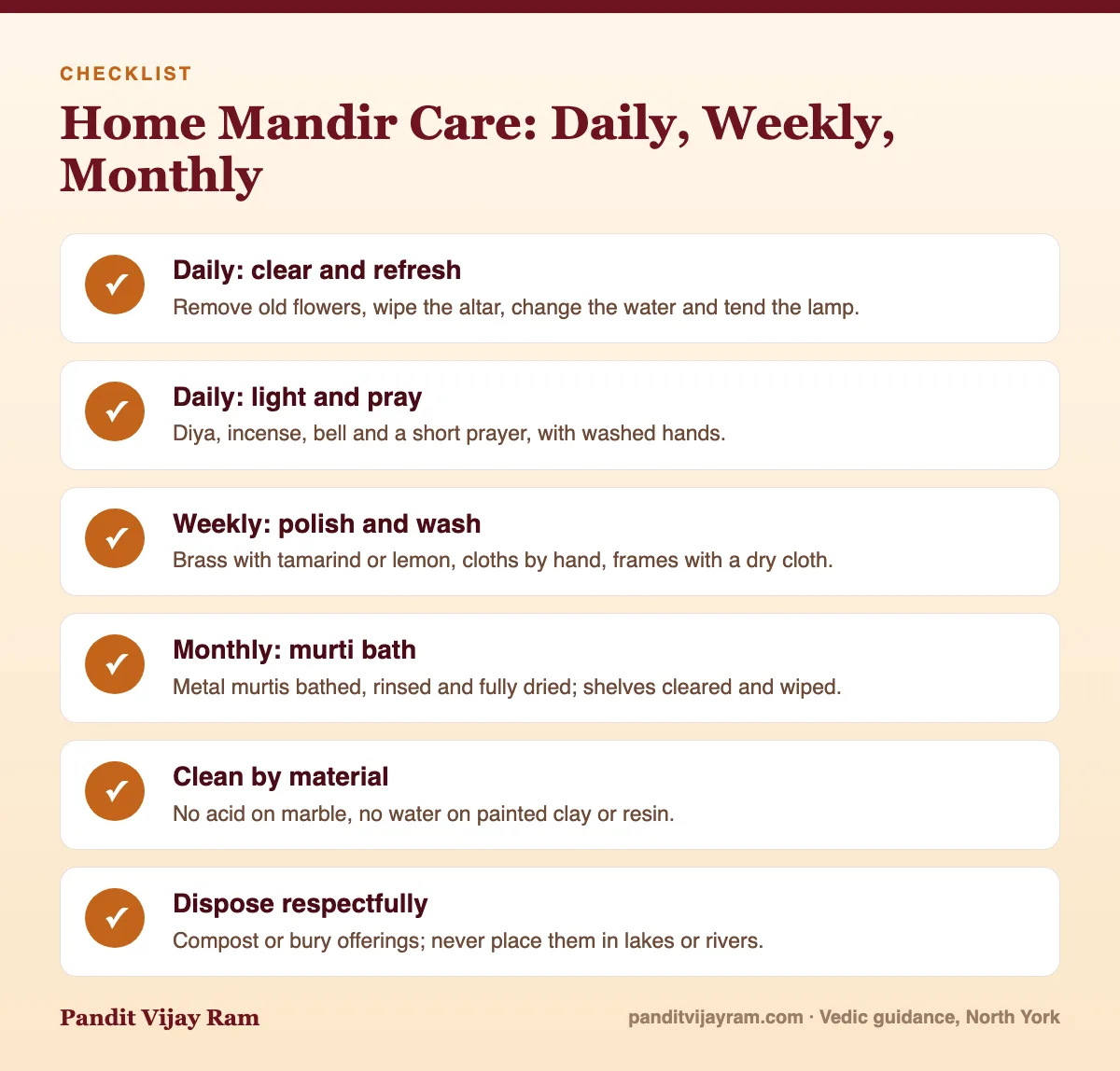
Each morning, remove the previous day's flowers and offerings, wipe the altar with a clean dry cloth, empty and refill the water pot, trim or replace the lamp wick, and light the diya and incense with a short prayer. Wash your hands first and keep this cleaning cloth only for the mandir.
The daily routine takes five to ten minutes and sets the tone for the rest of the house. Most families do it after their own bath, before breakfast.
- Remove the nirmalya. Yesterday's flowers, tulsi leaves and leftover offerings are called nirmalya. Collect them in a small dedicated bowl, not the kitchen garbage.
- Dust and wipe. Use a soft cotton cloth kept only for the mandir. A slightly damp corner works for spills of ghee or kumkum.
- Fresh water. Empty the copper lota or kalash into a plant pot, rinse it and refill with clean water.
- Lamp care. Pinch off the burnt tip of a cotton wick or replace it. Top up ghee or sesame oil.
- Offer and pray. Light the diya and an agarbatti, ring the bell, place fresh flowers if you have them, and sit for a moment.
Families differ on who tends the mandir at certain times, for example during sutak after a birth or death. Follow your own household's custom. For the grief period specifically, see the guide to cleansing the home after a death.

What should be cleaned in the home mandir weekly and monthly?
Weekly, polish brass lamps and bells, wash the altar cloths and wipe photo frames. Monthly, give metal murtis a full bath, clean the shelves completely, sort out old items and refresh the space. Many families choose a Sunday for weekly care and a full moon or new moon day for the monthly bath.
A simple rhythm keeps the work from piling up. Use this as a starting schedule and adjust it to your family's custom.
- Weekly: lamps and bells. Brass and copper darken with ghee smoke. Clean them with tamarind pulp, or lemon juice with a little salt, then rinse and dry.
- Weekly: cloths. Wash the altar cloth and the deities' small garments by hand in mild soap. Dry them in a clean place, not beside shoes.
- Weekly: frames. Wipe glass on photo frames with a dry microfibre cloth. Spray cleaner can seep behind the glass and stain prints.
- Monthly: murti bath. Bathe metal murtis in water, optionally milk or panchamrit, then rinse well and dry thoroughly so no residue sours.
- Monthly: shelves and storage. Take everything off, wipe the shelf, and remove anything that has drifted in, such as receipts, keys or medicines.
- Monthly: review. Check for cracked murtis, faded prints and rusting items to retire respectfully.
The guide to the best day for spiritual cleansing explains weekday and lunar-day choices if you want to time the monthly bath more carefully. A local panchang will give exact days.
How do you clean idols and murtis without damaging them?
Match the method to the material. Brass and copper tolerate tamarind or lemon. Silver needs only mild soap and a soft cloth. Marble must never touch lemon, vinegar or milk left to sit, because acid etches stone. Painted clay, plaster and resin murtis should only be dusted with a dry soft brush.
More murtis are damaged by eager cleaning than by neglect. Use this guide by material:
- Brass, copper and panchdhatu. Tamarind paste or lemon with salt, a soft brush for crevices, warm water rinse, and dry completely. Commercial pitambari powder works too.
- Silver. Mild dish soap and lukewarm water, soft cloth, immediate drying. Avoid tarnish dips on pieces with enamel or stones.
- Marble. Plain water and a soft cloth. Acids such as lemon, vinegar and even milk left to sour will dull and pit the surface.
- Painted, clay, plaster or resin. Dry dusting only. Water lifts paint and softens unfired clay.
- Wood and sandalwood. Dry cloth. A drop of sandalwood oil occasionally keeps it from cracking in dry Canadian winters.
- Shaligram and Shivling stones. Water abhishek is traditional, followed by careful drying.
Never use bleach, ammonia or abrasive pads. If a murti chips or cracks, tradition generally holds that it should no longer be worshipped. It is retired with a prayer of thanks and replaced. The article on cleansing metals, gemstones and objects has more on which materials react badly to which cleansers.
How do you dispose of old puja flowers and items in Canada?
Compost flowers, leaves and fruit through the municipal green bin or bury them in garden soil or under a tree. Scatter cooled lamp and incense ash on plants. Do not put offerings, idols or ashes in Lake Ontario or rivers, where it is discouraged and can be an offence. Ask your temple about broken murtis.
In India, offerings traditionally go into flowing water. In Canada, that custom collides with environmental law and with the reality that our lakes and creeks are drinking water and fish habitat. Plastic, paint, synthetic cloth and coloured powders harm them. A respectful alternative keeps the spirit of returning things to nature.
- Flowers, tulsi and leaves. Collect in the nirmalya bowl. Bury in a garden bed, place under a tree, or put in the green bin. Remove plastic wrapping and thread first.
- Fruit and coconut. Eat it as prasad or share it. If it has spoiled, compost it.
- Ash. Cooled ash from the diya and agarbatti can be mixed into potting soil.
- Used incense sticks and wicks. These go in regular garbage once completely cold.
- Old printed images and calendars. Many families store them in a box, then hand them to a temple that collects such items.
- Broken or retired murtis. Several GTA mandirs accept these for respectful disposal. Clay Ganesh murtis can be dissolved in a bucket at home and the water given to plants.
None of this lessens the offering. The intention to return it gently to the earth carries the meaning.
Where should the puja room be placed according to vastu?
Vastu prefers the northeast corner for the mandir, with the worshipper facing east or north while praying. Avoid placing it under a staircase, against a bathroom wall or in a bedroom where possible. In a condo, a clean shelf on an east or north wall, at or above chest height, works well.
Vastu Shastra treats the northeast, the Ishan corner, as the most spiritually receptive part of a home. That is why the mandir traditionally sits there. GTA homes rarely follow vastu layouts, so practical compromises are normal.
- Direction. Northeast is ideal, then east, then north. When you pray, face east or north.
- What to avoid. Under stairs, beside or sharing a wall with a toilet, and directly facing the main door.
- Bedrooms. If the altar must be in a bedroom, keep it in the northeast and draw a curtain across it at night.
- Idol size. Keep home murtis modest, roughly hand-sized. Large idols are traditionally kept in temples.
- No storage. The mandir is not a shelf for bills, medicines or broken items.
For the rest of the home, the room-by-room vastu cleansing guide sets priorities. If you are renovating or buying, a vastu consultation can plan the mandir placement before the walls go up.
When does a home mandir need a priest's purification?
A deeper shuddhi by a priest is traditionally done after a death in the family, after major renovation or water damage, after the home has stood empty for a long time, when a new murti needs prana pratishtha, or when the family feels the mandir has been neglected. Daily care is otherwise enough.
Most of the year, the routine above is all a home mandir needs. Certain moments, though, are traditionally marked with a more formal purification.
- After sutak ends. Following a death, many families keep the mandir covered, then perform a shuddhi with Ganga jal and a short havan when the period closes.
- After disruption. Renovation dust, a flood in the basement or a long trip can all leave a mandir unused. A reset puja reopens it.
- New murtis. A newly bought murti is often consecrated through prana pratishtha, an invocation that some families prefer a priest to perform.
- A sense of neglect. If the family simply feels distant from the mandir, a fresh start can help.
Vijay Ram ji performs these through the puja and anushthan service, either in person or by guiding the family remotely. For the fire element, see the household havan guide, and the cleansing and protection hub covers wider home practices.
The bottom line
Steady puja room cleansing means small daily care, a weekly polish and wash, and a fuller monthly bath and review. Clean each murti according to its material, and never let acids near marble or water near painted clay. In Canada, return old offerings to the earth through compost and gardens rather than lakes and rivers. A priest's purification is for special moments, not routine.
Key takeaways
- Remove yesterday's flowers, wipe the altar and refresh water every morning.
- Polish brass and wash cloths weekly; bathe metal murtis monthly.
- Clean by material: no acid on marble, no water on painted clay.
- Compost or bury old offerings instead of placing them in lakes or rivers.
- Northeast placement is ideal, and the mandir should never become storage.