
Hindu Temples and Community Centres in Scarborough: A Respectful Visitor's Guide
Few parts of Canada can match the number of Hindu temples in Scarborough, and the variety surprises first-time visitors. A Tamil kovil in a converted industrial unit sits a few minutes from a North Indian mandir with Sunday satsang, and both may be full on the same festival evening. For a newcomer, or for a family from North York or Etobicoke visiting for a wedding or a puja, knowing which temple suits which need, and how to behave once inside, makes the visit easier for everyone. This guide names temples whose details we could confirm on their own websites or official listings, points to City community centres used for gatherings, and sets out first-visit etiquette. It also explains how a temple visit links with the prayer you keep at home. In more than forty years as a Vedic astrologer and healer I have sent many families to their local temple first, because regular worship in community steadies people more than any single remedy. I am based in North York and do not represent any temple named here.
Which Hindu temples are in Scarborough?
Scarborough has dozens of Hindu temples. Among those we confirmed on official sources are Sri Ayyappa Samajam of Ontario on Middlefield Road, Jai Durga Temple, the Jai Durga Hindu Society, on Markham Road, and Sri Varasiththi Vinaayagar Hindu Temple of Toronto, a registered charity listed on Birchmount Road. Always check the temple's own site before visiting.
Here is what each temple's own website or official charity listing confirms. Schedules change, so treat this as a starting point.
- Sri Ayyappa Samajam of Ontario, also known as Canada Sri Ayyappan Hindu Temple, on Middlefield Road in north Scarborough. Its website publishes daily darshan times, an events calendar and contact details. Devotion to Lord Ayyappa has strong roots in Kerala and Tamil Nadu.
- Jai Durga Temple, run by the Jai Durga Hindu Society (Sri Vrindavan Dhaam), on Markham Road. The temple describes itself as a temple and cultural centre, lists weekly programmes such as a Sunday service, Tuesday Hanuman Chalisa and Friday Durga puja, and celebrates Holi, Ganesh Chaturthi and Diwali.
- Sri Varasiththi Vinaayagar Hindu Temple of Toronto, a Ganesha temple whose registered charity address is on Birchmount Road. We could not find its own website, so ask locally for current darshan times.
Many more Tamil Saiva kovils, Murugan and Amman temples, Swaminarayan mandirs and Indo-Caribbean satsang halls operate across Scarborough. We have not listed ones we could not verify. Our broader directory of Hindu temples across the GTA and the companion guide to temples in North York cover neighbouring areas.
Which community centres in Scarborough host cultural and faith gatherings?
Besides temple halls, families in Scarborough use City of Toronto recreation centres for cultural classes, seniors' groups and community events. Malvern Recreation Centre on Sewells Road and Birchmount Community Centre on Birchmount Road appear on the City's facility listings. Bookings go through the City, and religious rituals with fire need separate approval.
Many Scarborough temples double as community centres. Jai Durga Temple calls itself a cultural centre, and Tamil kovils commonly run language, music and dance classes for children alongside worship. For anything larger than a temple hall can hold, or for groups without their own building, families turn to City spaces.
A few practical points for using a City centre:
- Booking. Rooms and gyms are booked through the City of Toronto, not through the centre's front desk alone.
- Fire. Toronto does not allow open-air burning without approval, and an indoor havan in a City room is unlikely to be permitted. Plan a lamp-free bhajan or a symbolic diya that the staff approve.
- Food. Serving food to the public in a park counts as a special event under City rules; indoor rules depend on the booking.
- Accessibility. City centres are generally easier for elders with walkers than basement temple halls, which matters for satsang groups.
Scarborough's Indo-Caribbean Hindu families, many with roots in Guyana and Trinidad and Tobago, have a long tradition of satsang groups meeting in rented halls and homes before building their own mandirs. Our guide to Indo-Caribbean Hindu life in the GTA explains that history with care.
How should you behave on a first visit to a Scarborough temple?
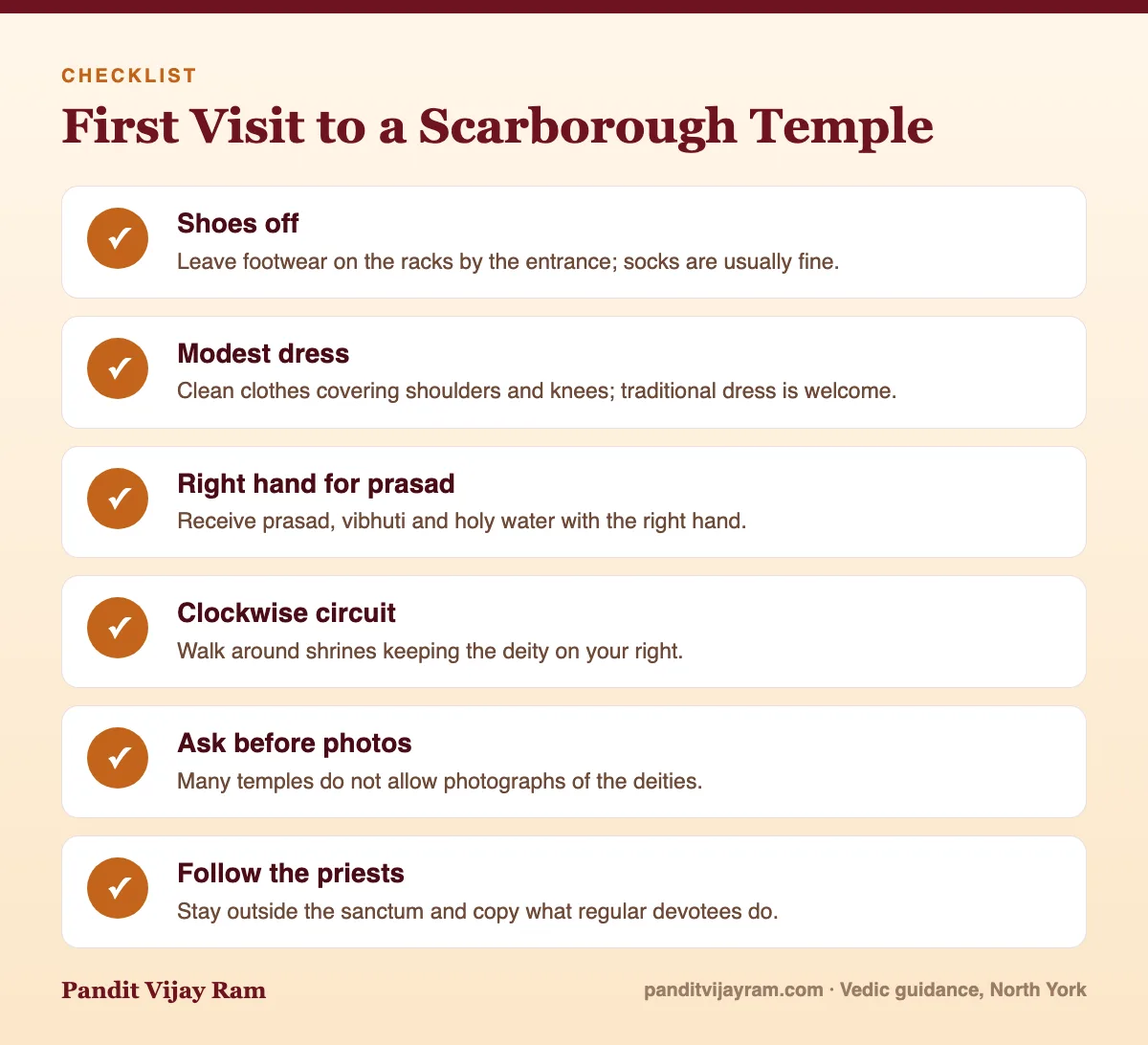
Remove your shoes where others do, dress modestly with shoulders and knees covered, silence your phone and enter quietly. Accept prasad and holy water with the right hand, never touch the murtis or step into the sanctum, and ask before taking photographs. Follow the lead of regular devotees and priests.
Etiquette varies a little between a Tamil kovil and a North Indian mandir, but the basics are shared.
- Footwear. Leave shoes on the racks near the entrance. Socks are usually fine.
- Clothing. Modest and clean. Some South Indian temples expect men to remove shirts for certain rituals inside the sanctum; visitors are not expected to join in.
- Hands. Use the right hand to receive prasad, vibhuti, kumkum or tirtha. Wash hands before entering if a tap is provided.
- Circling. Walk around shrines clockwise, keeping the deity on your right.
- Sanctum. Only priests enter the garbhagriha. Stand outside and offer prayer from there.
- Photography. Many temples prohibit photographs of the deities. Ask at the office.
- Offerings. Flowers, fruit, coconut or a small donation are welcome but never compulsory. Ask before bringing anything that is not vegetarian; most temples will not accept it.
Families sometimes worry about customs around mourning periods or menstruation. These differ by tradition and household; the respectful course is to ask the priest privately rather than assume. If you want to recreate a little of the temple's order at home, our guide to cleansing and arranging a home mandir is a gentle place to begin.
How do Tamil kovils differ from North Indian and Indo-Caribbean mandirs?
Tamil Saiva kovils usually follow Agamic temple ritual led by trained priests, with abhishekam, archanai and festival processions for deities such as Vinayagar, Murugan, Amman and Shiva. North Indian mandirs often centre on aarti, bhajan and Hanuman Chalisa, while many Indo-Caribbean mandirs hold a Sunday congregational service with a sermon. All belong to one living Hindu tradition.
Knowing the difference helps visitors understand what they are seeing and choose a temple that suits the family's background.
- Tamil Saiva kovil. Worship is structured through the day by the priests. Devotees bring archanai baskets with fruit and flowers and give the family name and birth star so the priest can include them. Large festivals may include a chariot procession, and the energy can be intense and joyful.
- North Indian mandir. Several deities share one hall: Ram, Krishna, Durga, Hanuman, Shiva. Evening aarti draws families together, and devotional singing plays a large part.
- Indo-Caribbean mandir. Many follow a weekly service format with bhajans, a pandit's talk and prasad, shaped by more than a century of community life in the Caribbean. Jai Durga Temple in Scarborough lists a Sunday service among its programmes.
- Ayyappa and other specialised temples. Devotees may observe particular vows and seasons associated with the deity.
No form is more correct than another. When a mixed couple asks me which temple to attend, I suggest they try both families' styles and notice which one brings peace to their home; many end up alternating. A Durga devotee drawn to the Friday puja can learn more from our Durga puja and havan page.
How does temple worship connect with prayer at home?
In Hindu practice the temple and the home shrine support each other. The temple offers darshan, community and rites a household cannot perform alone, while daily prayer at home keeps devotion steady between visits. Many families take prasad, flowers or holy ash home and use them at the family altar, carrying the temple's blessing into ordinary life.
People sometimes ask whether going to a Scarborough temple every week is enough, or whether they also need prayer at home. The scriptures and most priests would say both have a place, and that neither should become a burden.
A simple rhythm that many families keep:
- Daily. A diya and a short prayer at the home shrine, even five minutes before work.
- Weekly. A temple visit on the deity's day, such as Tuesday for Hanuman or Friday for the Goddess, when work allows.
- Monthly. Observing a vrat or a special puja on Ekadashi, Sankashti or Pradosham according to family custom.
- Festivals. Celebrating with the community at the temple and with family at home.
If you cannot reach a temple, perhaps because of shift work, illness or no car in a part of Scarborough poorly served by transit, the home altar is fully valid. Our guide to Hanuman puja at home gives a straightforward method. When something specific is troubling you, such as a run of misfortune or a family conflict, prayer at the temple and a calm kundli review can work together. The Scarborough astrologer page explains how families here book an in-person consultation in North York or a phone or video session.
When should you ask a temple priest and when an astrologer?
Ask a temple priest about rituals the temple performs, such as archanai, abhishekam, samskaras and festival participation, and about the customs of that tradition. Consult an astrologer when the question concerns your kundli, timing, a dosha, or a pattern of difficulty that needs a personal reading. Many families need both, at different moments.
A simple decision rule avoids confusion and saves money.
- Is it a fixed ritual? A naming ceremony, first rice feeding, griha pravesh or a temple archanai is the priest's work. Book it with the temple.
- Is it about timing? A wedding muhurat, a business opening or the best day for a puja depends on the panchang and often on the kundli. An astrologer or a priest trained in jyotisha can help.
- Is it a pattern? Repeated losses, delays in marriage, or a feeling of heaviness that does not lift may call for a chart reading, honest questions about health and finances, and possibly a specific remedy.
- Is it medical, legal or about safety? Then neither the priest nor the astrologer comes first. See your family doctor, a lawyer, or the police.
Before arranging any private puja, ask whoever performs it what will be done, what it costs and what you should do afterwards. Our checklist of questions to ask a pandit in the GTA helps with that conversation. For larger rites performed on your behalf, the puja and anushthan page describes how Vijay Ram ji conducts them in the Vedic tradition, separate from any temple.
The bottom line
Hindu temples in Scarborough offer Tamil kovils, North Indian mandirs and Indo-Caribbean congregations within a short drive of one another. Check each temple's own site for current times, and use City community centres such as Malvern and Birchmount for gatherings the temple cannot hold. On a first visit, remove shoes, dress modestly, receive prasad with the right hand and follow the priests' lead. Keep the temple and the home shrine working together, and turn to a priest or an astrologer according to the question.
Key takeaways
- Scarborough's temples reflect Tamil, North Indian and Indo-Caribbean Hindu traditions.
- Confirm darshan times on each temple's own website before travelling.
- City recreation centres can host gatherings, but fire and food need the City's rules.
- Shoes off, modest dress, right hand for prasad and no photographs without permission.
- Temple worship and a daily home prayer support each other.