
Hindu Temples and Community Centres in North York: A Respectful Visitor's Guide
North York is where I live and work, and the question I hear most from new neighbours is simple: where is the nearest mandir, and will I feel welcome there? This guide to Hindu temples in North York answers it with places I have checked on their own websites or official listings. The district is large, so the temples here are spread out and each has its own character. In more than forty years as a Vedic astrologer I have seen how a regular temple visit anchors a family far better than occasional crisis prayers. You will find a short profile of each temple, an explanation of how to request an archana in the South Indian style, a comparison of etiquette across traditions, the civic spaces that host festivals, and ideas for carrying temple practice into a North York apartment or bungalow. I am not affiliated with any temple named here; I simply want you to find your spiritual home.
Which Hindu temples are in or near North York?
Within North York, the Sridurka Hindu Temple at 30 Carnforth Road is devoted to Goddess Durga and follows Shaiva and Shakta traditions, and the Pranav Hindu Mandir Cultural Centre is a registered charity at 102 Rivalda Road. A short drive north on Yonge Street, the Vishnu Mandir in Richmond Hill hosts a large temple campus.
Each of these temples serves a different community and style of worship.
- Sridurka Hindu Temple. Also known as Thurkeswaram, it describes itself as a temple for the Divine Mother. Sri Durga Devi is the main deity, and the temple also observes festivals for Ganesha, Kumara and Bairavar. Its calendar includes a long annual Mahotsavam that opens with the Kodiyettam flag-hoisting, a Thiruvilakku holy lamp pooja and monthly observances such as Pradosham and Amavasai.
- Pranav Hindu Mandir Cultural Centre. Listed by the Canada Revenue Agency as a registered charity, with its address on Rivalda Road. Call or check its listing before visiting, since smaller mandirs often keep shorter, changing schedules.
- Vishnu Mandir, Richmond Hill. Run by the Voice of Vedas Cultural Sabha on Yonge Street, just beyond the city boundary. Its campus includes a main prayer hall, Balaji and Narsimha shrines, a fifty-foot Hanuman statue, a museum and a peace park, as well as classes and a Montessori school.
Plenty of North York families also travel to temples in neighbouring areas. Our guides to Hindu temples in Richmond Hill and Hindu temples in Toronto describe more options, and temples across the GTA maps the whole region.
How do you request an archana at a North York temple?
An archana is a short offering in which the priest chants the deity's names on your behalf, often including your name, nakshatra and gotra. At South Indian–style temples you usually request it at the counter, bring or buy flowers and fruit, then wait near the shrine until the priest calls you.
Visitors from North Indian or Caribbean backgrounds are sometimes unsure how an archana works, and visitors from Tamil or Telugu families may not realise how different a Gujarati mandir feels. Here is the typical sequence at a temple run in the Agamic South Indian style, such as Sridurka:
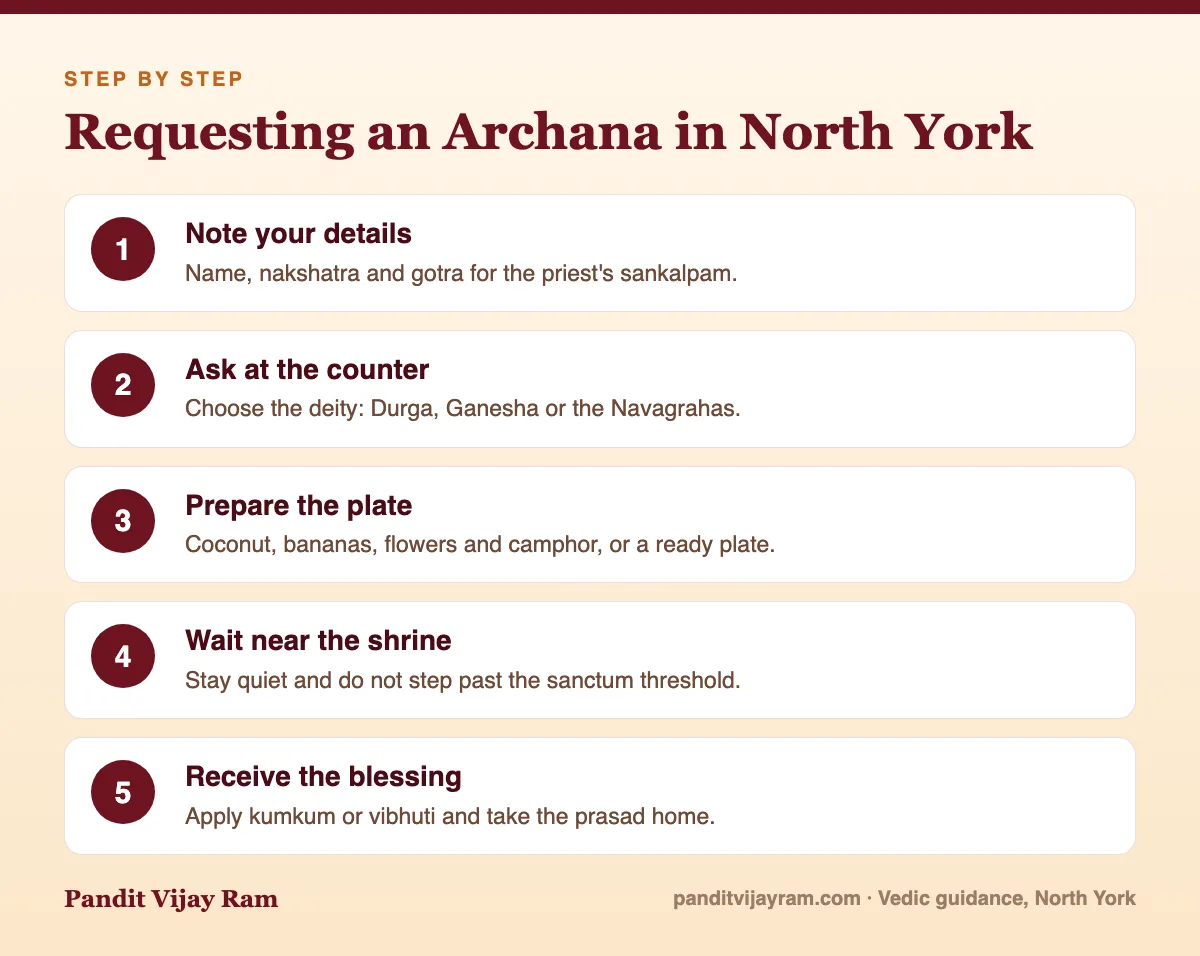
- Know your details. Write down your name, your birth star (nakshatra) and, if your family uses one, your gotra. The priest will include them in the sankalpam.
- Go to the counter. Ask for an archana for the deity you wish to honour. Some temples list specific archanas for Durga, Ganesha or the Navagrahas.
- Prepare the plate. A coconut, bananas, flowers and a little camphor are traditional. Many temples sell ready plates.
- Wait quietly. Stand or sit near the shrine. Do not step past the threshold of the sanctum.
- Receive the blessing. The priest returns part of the offering with kumkum or vibhuti. Apply it to your forehead and take the prasad home.
An archana is a lovely way to mark a birthday or a new job. For a larger ceremony at home, read our page on puja, havan and anushthan, and for Durga-specific worship the Durga puja and havan service explains a fuller rite.
How does etiquette differ between South Indian and North Indian temples?
The basics are shared: shoes off, modest dress, quiet voices, no touching the murtis. South Indian temples often have separate shrines in a set order, priests who perform archana on request, and vibhuti or kumkum as prasad. North Indian mandirs centre on communal aarti, bhajans and shared seating in one hall.
Knowing what to expect helps you relax, wherever you came from.
At a South Indian–style temple you often move from shrine to shrine in a traditional order, beginning with Ganesha. The Navagraha shrine, with the nine planetary deities, is usually circled a set number of times; follow the people ahead of you. Coconuts may be broken at a designated spot. During the annual festival, processions with the utsava murti can fill the halls, so stand aside respectfully.
At a North Indian or Caribbean-founded mandir the main hall is usually the focus. People sit together for aarti, kirtan or a katha, and prasad is shared at the end. Larger temples like the Vishnu Mandir also have separate shrines and outdoor statues to walk around.
Some habits are welcome everywhere:
- Remove leather belts if the temple asks, and keep bags small.
- Do not turn your back directly on the sanctum when leaving; step back a few paces first.
- Ask before photographing, and never photograph the sanctum during worship.
- Women in some families avoid the sanctum during menstruation. Customs vary, and no one should be shamed either way.
If you are planning your first Navratri at a temple, our guide to Kanya pujan during Navratri explains one of the most beautiful rituals you may see.
Which community spaces in North York host Hindu festivals and gatherings?
Mel Lastman Square, beside the North York Civic Centre at 5100 Yonge Street, is the district's main civic square and the City says it hosts cultural festivals, concerts and community events. Beyond the square, temples, cultural associations and rented halls hold most garba nights, bhajan evenings and children's classes.
North York does not have one central Hindu community centre. Instead, community life gathers in several kinds of place.
- Mel Lastman Square. The City describes an open square with a garden court, an outdoor amphitheatre, fountains and a reflecting pool. It hosts cultural festivals and community events booked through the City, so check its page each season for what is coming up.
- Temple halls. The Vishnu Mandir and Sridurka both run festival programmes, and the Vishnu Mandir lists music, dance and Bal Vihar classes for children.
- Cultural associations. Regional groups, from Gujarati samajs to Tamil and Telugu associations, rent school gyms and banquet halls for festivals.
- Your own building. Condo party rooms along Yonge Street are often used for small satsangs. Ask management about rules on candles and incense first.
For Navratri specifically, our guide to Navratri in the GTA, garba and fasting explains how to balance public garba with home puja. If your question is about something more personal than a festival, the astrologer in North York page explains how private consultations work.
How do you carry a temple visit into daily prayer in a North York home?
Bring one practice home from each visit: a stotram the priest chanted, the vibhuti or kumkum you received, or the lamp-lighting time you noticed. Set a small shrine facing east or north, light a diya at the same hour daily, and return to the temple for festivals so the two rhythms reinforce each other.
North York homes range from tower suites near Sheppard and Finch to wide postwar bungalows on quiet crescents. Whatever the space, a home shrine works the same way.
- Start with what you received. Keep temple vibhuti or kumkum in a small silver or steel box at the shrine and apply a little each morning.
- Learn one prayer. If Sridurka's Durga worship moved you, learn a short Durga stotram. If the Vishnu Mandir's aarti stayed with you, sing it at dusk.
- Keep a weekly anchor. Many families light a lamp to Durga on Tuesdays or Fridays, or recite Hanuman Chalisa on Tuesdays and Saturdays.
- Return items properly. Old flowers and worn pictures can go back to a temple that accepts them.
When something feels heavier than a routine can lift, such as repeated family conflict, a difficult planetary period or a sense that the home has changed, a one-to-one conversation can help. Vijay Ram ji meets people for in-person consultations in North York and speaks with others by phone, video or WhatsApp. Our guide to Hanuman puja at home is a gentle place to begin.
The bottom line
Hindu temples in North York, including the Sridurka Hindu Temple on Carnforth Road and the Pranav Hindu Mandir on Rivalda Road, with the Vishnu Mandir just north on Yonge, offer very different styles of worship. Learning how an archana works and how etiquette shifts between South and North Indian temples makes a first visit easy. Mel Lastman Square and community halls carry the festival life. Bringing one temple practice into a daily home prayer keeps the connection alive.
Key takeaways
- The Sridurka Hindu Temple on Carnforth Road follows Shaiva and Shakta traditions with Durga as the main deity.
- The Pranav Hindu Mandir Cultural Centre is a registered charity on Rivalda Road; check its schedule before visiting.
- The Vishnu Mandir on Yonge Street in Richmond Hill is a short drive north of the district.
- For an archana, bring your name, nakshatra and gotra, and follow the priest's lead.
- Mel Lastman Square hosts cultural festivals and community events beside the North York Civic Centre.