
Lakshmi–Ganesh Puja for Diwali at Home
Diwali puja at home is the moment the whole festival leads up to, yet many families feel unsure about it. Which time is right in Toronto when the Indian calendar shows something else? Where do the murtis go, and what do you do with the account book? Every autumn, families in North York, Thornhill and Mississauga ask me to walk them through the evening so that a grandparent's way of doing it is not lost. In more than forty years of Vedic practice, I have seen that a short Lakshmi–Ganesh puja done at the right time, with the family seated together, leaves a deeper mark than a long one rushed between guests. This guide covers how to read the Diwali muhurat for your own city, the altar layout, the samagri, the step-by-step vidhi, regional differences in how the night is kept, and what to do after the aarti. Lamp and smoke-alarm safety has its own guide, linked below.
What is the right muhurat for Diwali puja in Toronto?
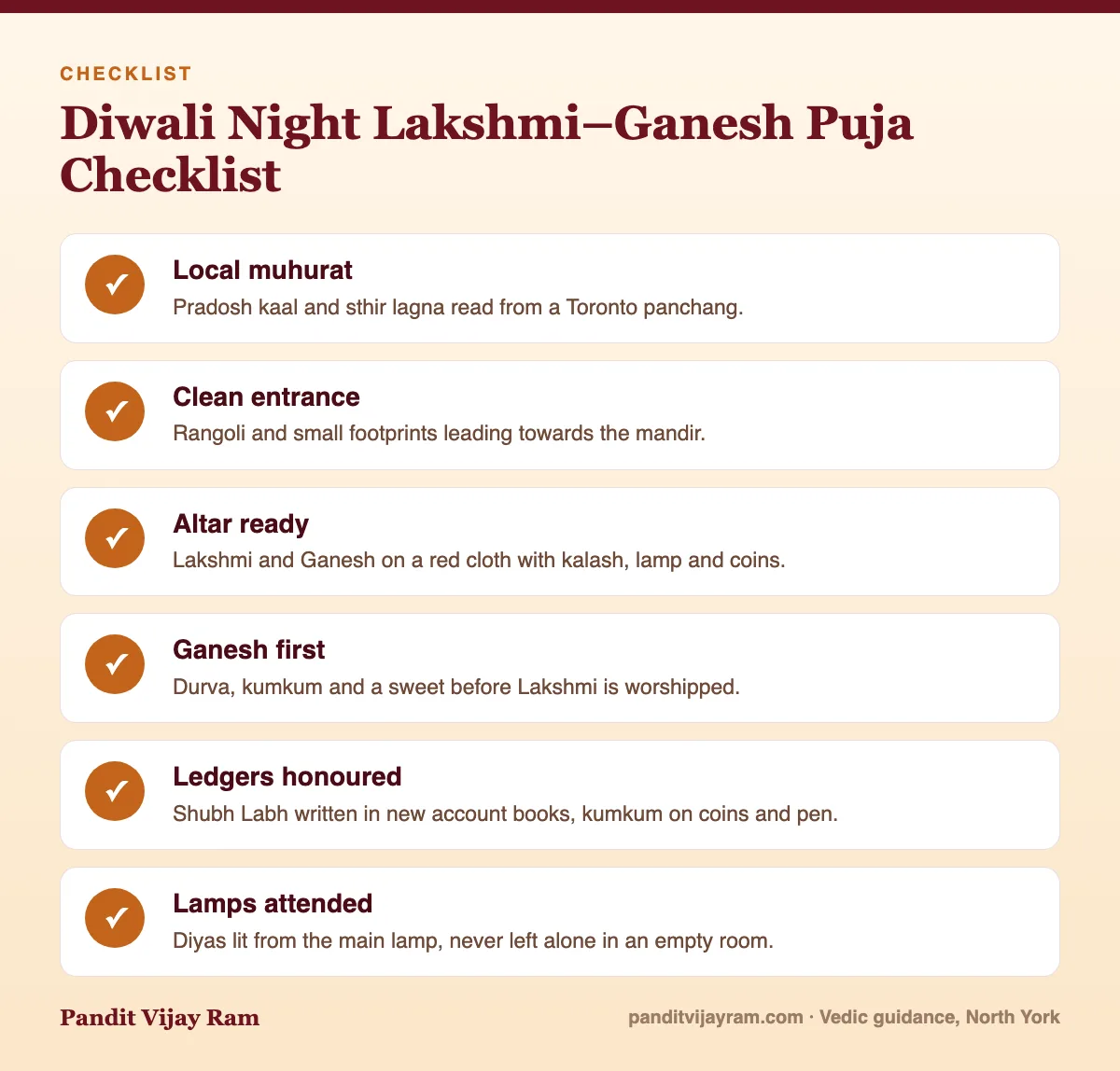
Lakshmi puja is traditionally done on the Kartik Amavasya night during pradosh kaal, the period of about two and a half hours after local sunset. Many families narrow it further to a sthir, or fixed, lagna such as Taurus that rises within that window. Because sunset and lagna depend on location, use a Toronto panchang, not an Indian one.
Indian calendars print timings for Delhi, Mumbai or another Indian city. Those clock times mean nothing in Ontario, because the sunset, the rising sign and sometimes even the day on which Amavasya covers the evening are different here.
Here is how to read a Toronto panchang for the night:
- Confirm the date. Find the evening when Amavasya is in force at Toronto sunset. Occasionally this differs from the Indian date.
- Note pradosh kaal. It begins at local sunset and lasts roughly two and a half hours.
- Look for sthir lagna. A fixed sign, usually Vrishabha, is considered steady, so wealth invited then is believed to stay. If it overlaps pradosh kaal, that overlap is the preferred window.
- Some households also use nishita kaal, around midnight, especially for Kali puja or tantric forms of worship.
If the best window clashes with work or children's bedtime, do the puja within pradosh kaal at a time you can all attend. A family seated together at a reasonable time is a good muhurat in its own right. For the principles behind auspicious timing, see our article on calculating muhurat for Canadian time zones.

How do you set up the Lakshmi Ganesh altar for Diwali?
Spread a red or yellow cloth on a raised chowki placed so the family faces east or north while praying. Seat Lakshmi and Ganesh side by side, adding Saraswati or Kuber if your tradition includes them. A water-filled kalash, a large ghee lamp, coins, account books and a pile of rice complete it.
A practical layout that works on a living-room table:
- Back row: Ganesh and Lakshmi murtis or a joint picture. Bengali, Gujarati and North Indian families each place Saraswati, Kuber or a silver coin slightly differently, so follow what your elders did.
- Front centre: a heap of rice with a kalash on it, filled with water, a coin, betel nut and mango leaves, topped with a coconut.
- To one side: the main ghee lamp on a metal plate, which many families keep burning through the night under supervision.
- Offerings tray: kheel and batashe, sweets, fruit, lotus or marigold flowers, sandal paste and kumkum.
- Wealth items: new account books, a pen, a cheque book or a laptop for business owners; coins or a little jewellery for families.
Before the puja, the home is cleaned and the entrance decorated with rangoli and small footprints drawn towards the mandir, a welcome for Lakshmi. Our guide to threshold rituals at the main door explains the meaning of the doorway customs.
Many families buy new murtis each Diwali and move the previous year's set to the mandir or return it respectfully. Clay murtis can be dissolved in a bucket at home and the water given to plants.
What samagri do you need for Diwali Lakshmi puja?
The essential Diwali puja samagri is Lakshmi and Ganesh murtis, a red cloth, a kalash with mango leaves and coconut, ghee and diyas, cotton wicks, kumkum, haldi, rice, flowers, betel leaves and nuts, sweets, kheel and batashe, fruit, incense, camphor, coins and a sacred thread. Business owners add account books and a pen.
Group the items so nothing is hunted for during the muhurat.
- For the altar: chowki, red cloth, murtis, a kalash, a coconut, mango or betel leaves, mauli thread.
- For worship: kumkum, haldi, sandal paste, unbroken rice, a small bowl of water with a spoon, flowers, durva grass for Ganesh, lotus if available for Lakshmi.
- For light: one large ghee lamp, small clay diyas for the house, cotton wicks, a lighter, camphor and a heat-proof tray.
- For offering: kheel, batashe, laddoos or other sweets, seasonal fruit, dry fruit, paan.
- For wealth worship: silver or regular coins, new account books, a pen, sometimes a picture of Kuber.
Lotus flowers are hard to find in Ontario in autumn, and marigold, rose or chrysanthemum are fine substitutes. Kheel and batashe are stocked at most South Asian grocers across the GTA in the weeks before the festival. For a general list with Canadian substitutes, see our puja samagri list. Families who also want a Kuber prayer can read our explainer on the Kuber mantra and yantra.
What is the step-by-step Lakshmi Ganesh puja vidhi on Diwali?
The vidhi begins with purifying water and a sankalp, then Ganesh puja, kalash puja and the main worship of Lakshmi with the sixteen traditional offerings or a shorter five-offering form. Account books and coins are honoured, the Lakshmi and Ganesh aartis are sung, and diyas are carried from the altar to every room.
A family can follow this sequence in about forty-five minutes.
- Purify. Sprinkle water on yourselves, the altar and the samagri while saying a short prayer.
- Sankalp. The head of the household, or the couple together, states names, gotra, place and the intention of welcoming prosperity and harmony.
- Ganesh puja. Offer durva, kumkum, a modak or laddoo and chant Om Gam Ganapataye Namah. Our Ganesh puja guide has the short form.
- Kalash and navagraha. Honour the kalash, and offer rice to the nine planets if your family does.
- Lakshmi puja. Offer water, panchamrit, cloth, kumkum, flowers, lamp, incense, sweets, kheel and fruit while chanting Om Shreem Mahalakshmyai Namah. Some read the Shri Suktam.
- Wealth worship. Draw a swastika or write Shubh Labh in the new account book, and place kumkum on the coins and pen.
- Aarti. Sing Om Jai Lakshmi Mata and the Ganesh aarti.
- Deepdaan. Light the small diyas from the main lamp and place them through the home.
For lamp placement in a condo, smoke alarms and LED options, read our separate Diwali diya fire-safety guide. Families who want a priest to lead can book through Vijay Ram ji's Ganesha puja service.
How do different communities celebrate Diwali night?
North Indian homes centre the night on Lakshmi–Ganesh puja and Rama's return to Ayodhya. Gujarati families perform Chopda pujan of account books and welcome the new year the next day. Many Bengali families worship Kali on this night. South Indian Deepavali focuses on the early-morning oil bath of Naraka Chaturdashi. Sikhs and Jains mark their own observances.
In a GTA household, two or three of these traditions may meet at one table, especially in mixed marriages.
- North India and the Indo-Caribbean diaspora: Lakshmi puja at pradosh kaal, diyas for Rama, Sita and Lakshman's homecoming, and Govardhan puja or Annakut the following day.
- Gujarat and Rajasthan: the Chopda or Sharda pujan of new ledgers, then Bestu Varas, the Gujarati new year.
- Bengal and Assam: Kali puja on the Amavasya night, often at nishita kaal. Lakshmi is worshipped on Kojagari Purnima earlier in the season.
- South India: Naraka Chaturdashi, with an oil bath before dawn celebrating Krishna's victory over Narakasura, is the main day.
- Maharashtra: Lakshmi puja with a broom honoured as a symbol of Lakshmi in some homes, and Padwa the next day.
- Sikh and Jain families: Bandi Chhor Divas and the nirvana of Mahavira fall in the same season.
If two families' customs differ, choose one sequence for the main puja and add a short element from the other. Couples blending traditions may also find our guide to blending regional customs helpful.
The bottom line
Diwali puja at home works best when the muhurat is read from a Toronto panchang, ideally within pradosh kaal and a fixed lagna. Set Lakshmi and Ganesh on a simple altar with a kalash, lamp, coins and account books, and keep the samagri grouped before you begin. Follow the vidhi from sankalp to deepdaan at a time your family can share, and keep the regional customs that make the night yours.
Key takeaways
- Diwali Lakshmi puja is done on Kartik Amavasya, usually in pradosh kaal.
- Take the muhurat from a Toronto panchang, not an Indian city's timings.
- Ganesh is always worshipped before Lakshmi.
- Account books, coins and new ledgers are honoured as forms of prosperity.
- Regional customs differ, and every community's sequence is valid.