
Diwali, Navratri and Holi in North York: Local Celebrations and Practical Rules

Around Diwali my North York neighbours ask whether the rules here are different from downtown. Some remember the old City of North York and its own bylaws. Others have just moved into a tower near Sheppard and wonder whether a sparkler on the balcony is allowed. This guide to Diwali in North York, along with Navratri and Holi, sets out what actually applies today, using the City of Toronto's own pages. I am a Vedic astrologer based here, with more than forty years of guiding festival pujas, and I care about two things at once: that the festival keeps its sacred heart, and that nobody gets hurt or fined. You will learn why North York follows Toronto-wide rules, what the fireworks rules mean for tower residents versus house owners, where families gather to celebrate together, how to plan a Holi or garba event in a local park, and how to keep diyas safe in a high-rise or a bungalow.
Do North York residents follow Toronto's festival rules?
Yes. North York was amalgamated into the single City of Toronto, so Toronto's municipal code, fire rules and park booking system apply across the district. There is no separate North York fireworks bylaw today. When a neighbour quotes an old North York rule, check the current toronto.ca page before relying on it.
North York was once a city in its own right, with its own council at the civic centre on Yonge Street. When Metropolitan Toronto and its municipalities were merged into a single-tier city, North York became one of its districts, and today the rules that apply come from the City of Toronto. The North York Civic Centre is still a City office, and Mel Lastman Square beside it is still the district's gathering place, but the rules come from the City of Toronto.
That has three practical consequences for festival season:
- One fireworks rule. The same permit system applies in Willowdale, Don Mills, Downsview and downtown.
- One fire service. Toronto Fire Services issues fireworks permits and handles ceremonial fire authorizations for the whole city.
- One park booking system. Parks in North York are booked through the City's Parks, Forestry and Recreation process.
This is good news. A family moving between Toronto neighbourhoods does not need to relearn the rules. For the downtown and citywide view, read our guide to Diwali, Navratri and Holi in Toronto. For Brampton, Mississauga, Markham and other cities, where rules do differ, see Diwali fireworks rules across the GTA.
What do the fireworks rules mean for North York condos and houses?
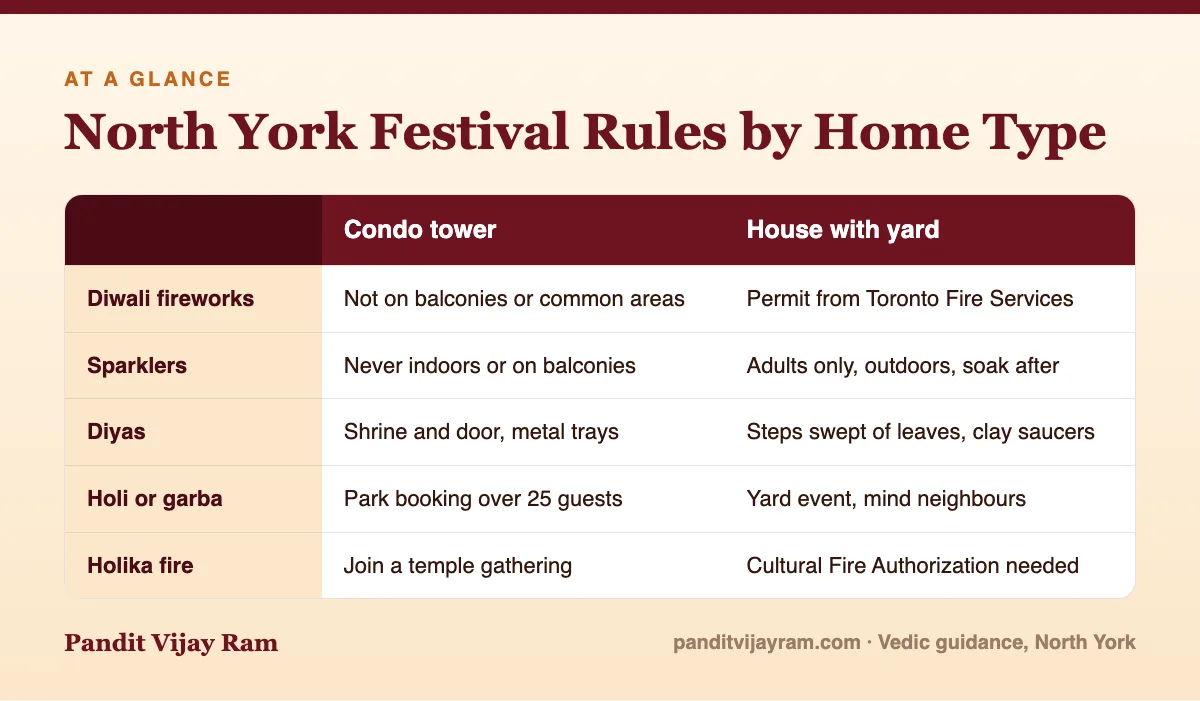
In a condo tower, fireworks are effectively ruled out, because balconies, streets, parks and parking lots are all off limits. In a detached house or bungalow with your own yard, you may set off consumer fireworks on Diwali only with a Toronto Fire Services permit, applied for well ahead, and never after 11 p.m.
North York's housing is unusually mixed. Tall towers cluster along Yonge Street near Sheppard and Finch, while quiet crescents of postwar bungalows and rebuilt detached homes sit a few blocks away. The same rule plays out very differently in each.
If you live in a tower:
- The City names balconies among the places where fireworks are not permitted. Sparklers count.
- Common areas and parking lots belong to the corporation or landlord, not you, so they are off limits too.
- Your best options are LED lights, a few supervised diyas indoors and a public display.
If you own a house with a yard:
- Victoria Day and Canada Day are the only permit-free days. Diwali requires a permit from Toronto Fire Services, and the City asks for at least ten business days' notice.
- Only adults may light fireworks, and an adult must supervise the whole time. Anyone under eighteen may not set them off.
- Afterwards, soak used fireworks in water overnight before binning a few at a time. They never go in the Blue Bin.
For indoor lamp safety in a high-rise, our guide to Diwali diyas and condo fire safety has a practical checklist.
Where do North York families celebrate Diwali and Navratri together?
Temples carry most of the celebration: Lakshmi puja, aarti and community meals at mandirs such as the Sridurka Hindu Temple or, just north, the Vishnu Mandir. Mel Lastman Square hosts cultural festivals and community events through the City's bookings, and cultural associations rent halls for garba, dandiya and Diwali dinners.
In North York the festival tends to move between three places over a single week.
- The temple. Many families make one evening visit for darshan and aarti. Our guide to Hindu temples in North York introduces local options and explains etiquette.
- The square. Mel Lastman Square, beside the North York Civic Centre at 5100 Yonge Street, has an amphitheatre, a garden court and open space. The City says it hosts cultural festivals and community events, so check its page each autumn to see which celebrations are booked.
- The hall. Regional associations hold garba and dandiya nights in school gyms and banquet halls across the district. These are often the most joyful nights for teenagers and young couples.
Then the family comes home for the most important part. Lakshmi puja on Diwali night is a household rite. If you need help with timing, our guide to Diwali Lakshmi Ganesh puja at home covers the method, and the Ganesha puja and havan service explains how a priest-led rite begins with Ganapati.
Remember that public events change organisers and venues often. Always confirm on the organiser's or the City's own page.
How should you plan a Holi or garba gathering in a North York park?
Count your guests first. Under 25 people with no barbecue needs no booking. Over 25 people, or bringing your own barbecue, needs a City park booking. Add speakers, food for the public or a tent and it becomes a special event with its own application, insurance and longer lead time.
North York has many large parks and ravine trails, and Holi in particular is meant to be played in open air. A little planning keeps the day joyful for everyone, including other park users.
- Estimate numbers honestly. Extended family plus friends quickly passes 25. If in doubt, book.
- Use the City's booking pages. The simple permit booking covers picnics and gatherings. Special event booking applies if you plan amplified sound, public food service, alcohol or structures.
- Choose a suitable spot. Stay away from playgrounds, splash pads and sports fields in use.
- Pick gentler colours. Plant-based powders are easier on skin and grass. Keep them away from dogs and strollers.
- Leave no trace. Bag every packet, bottle and plate, and brush colour off benches.
For garba, music is the issue. A small speaker for a family circle is different from a sound system for two hundred dancers. Large garba nights belong in a rented hall, where neighbours are not disturbed.
Never light a fire in a park for Holika. The City does not permit open-air burning without an exception, and religious fires need a Cultural Fire Authorization. Our guide to Holika Dahan bonfire rules in the GTA suggests symbolic home alternatives.
How do you keep Diwali lamps safe in a North York home?
Light few flames and watch every one. Place diyas in metal trays away from curtains and clothing, keep them out of children's and pets' reach, and test smoke alarms on every level beforehand. In towers, follow the building's fire safety plan; in houses, keep outdoor lamps off wooden steps and away from dry leaves.
Diwali falls in autumn, when North York homes are closed up against the cold and the furnace is running. That makes good habits more important.
- In a high-rise suite. Keep real flames to the shrine and perhaps one lamp inside the front door. Never place diyas on a balcony railing, where wind and falling embers are real dangers.
- In a bungalow or detached house. Outdoor diyas on the front steps are beautiful, but autumn leaves catch quickly. Sweep the steps and set lamps in clay saucers on stone or concrete.
- Everywhere. Tie back dupattas and long sleeves during aarti, and put out every flame before bed.
Spiritually, the scriptures ask for a lit, clean and welcoming home on Diwali, not a dangerous one. A single ghee diya at the threshold, lit with a sincere prayer, carries the whole meaning of the festival.
If you would like help choosing a muhurat for Lakshmi puja, or want to understand which festival observances suit your chart, the astrologer in North York page explains how consultations work. Vijay Ram ji meets people in person in North York and speaks with families elsewhere by phone, video or WhatsApp.
The bottom line
Diwali in North York follows City of Toronto rules, so a Toronto Fire Services permit is needed for consumer fireworks on Diwali, and balconies, streets and parks are always off limits. Holi or garba groups over 25 people need a park booking, and any religious open-air fire needs a Cultural Fire Authorization. Temples, Mel Lastman Square and community halls carry the public celebration, while a few well-watched diyas keep the home festival safe.
Key takeaways
- North York uses Toronto's fireworks, fire and park rules; there is no separate local bylaw.
- Tower residents cannot use fireworks on balconies; house owners need a permit on Diwali.
- Park gatherings over 25 people, or with your own barbecue, need a City booking.
- Religious open-air fires for Holika need a Cultural Fire Authorization and a site inspection.
- A few supervised diyas and tested smoke alarms keep home celebrations safe.