
Holika Dahan in the GTA: Bonfire Rules and Safe Alternatives
Families planning Holika Dahan Toronto style often hit the same wall. In the village or old neighbourhood, a pyre rose at the crossroads and everyone walked around it with coconuts, grains and prayers. In a GTA suburb, you look at the backyard, the fence and the neighbour's deck and wonder whether a fire is even allowed. I hear this question every spring from clients in North York, Brampton and Markham. The honest answer is that it depends on your city, and often the answer for a private yard is no or only with a permit. In more than forty years of practice, I have seen that the heart of the ritual travels well even when the bonfire cannot. This article explains the story and meaning of Holika Dahan, what to check before lighting anything outdoors, how to take part in a temple or community fire safely, and simple ways to observe the night at home without a pyre.
What is Holika Dahan and why is a bonfire lit?
Holika Dahan commemorates the Puranic story of Prahlad, a child devoted to Vishnu, whose aunt Holika tried to burn him in a fire. Holika perished and Prahlad was protected. The bonfire on the full-moon night before Holi symbolises devotion outlasting arrogance and the burning away of what harms us.
The demon king Hiranyakashipu demanded worship for himself and could not bear his son's devotion to Vishnu. After many failed attempts on the boy's life, he asked his sister Holika, who was believed to be protected from fire, to sit in a pyre with Prahlad on her lap. The fire consumed her instead, and the child came out unharmed. Vishnu later appeared as Narasimha to end the king's cruelty.
Families read several lessons into the fire:
- Faith over fear. Prahlad kept chanting while the flames rose.
- Power misused turns on itself. Holika's boon failed when used to harm.
- Seasonal renewal. In farming regions the fire also marks the ripening of winter crops, and new grain is roasted in it.
The ritual usually takes place in the evening of Phalguna Purnima after a period called bhadra has passed. Exact timing comes from a panchang for your location, and our guide to choosing an auspicious day explains how to read one. For the deity at the end of the story, see our article on the Narasimha mantra for protection.

Can you have a Holika Dahan bonfire in your backyard in the GTA?
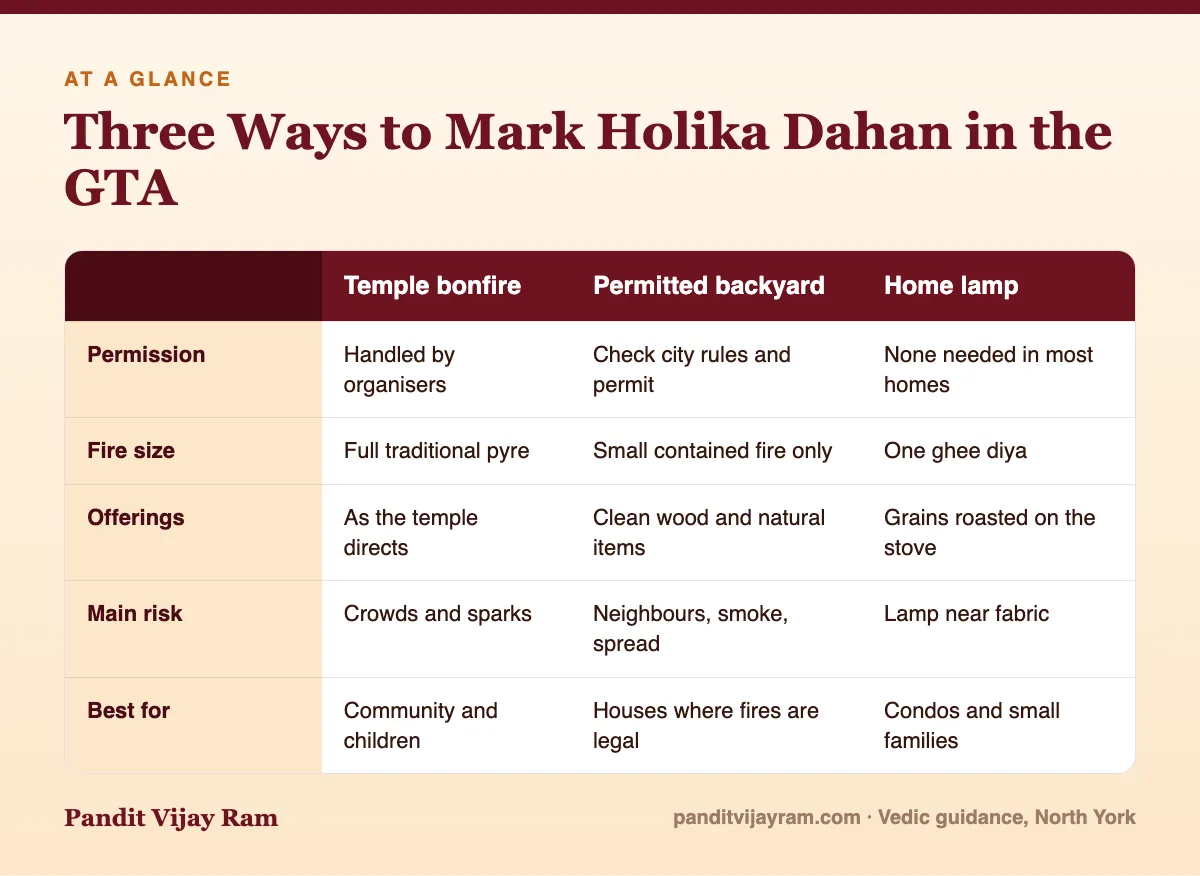
Only if your municipality allows it. Open-air burning rules differ across Toronto, Peel, York, Durham and Halton, and many urban areas prohibit backyard fires or require a permit, specific fuel and set distances. Check your city's open-air burning rules and the local fire service before planning, and expect the answer to be no in dense neighbourhoods.
Each GTA municipality sets its own approach, and the rules for a recreational fire, a fire pit and a large ceremonial pyre may all be different. Some places ban open fires in most residential areas. Others allow small contained fires under conditions, or require a permit for anything larger. Fire bans can also be declared during dry spells.
Before you buy wood, find out:
- Does your city permit any open-air fire on a residential lot?
- If so, is a permit required, and what size and fuel are allowed?
- How far must the fire be from buildings, fences, trees and property lines?
- Are there restrictions on burning anything other than clean, dry wood?
- Is a burn ban in effect on the day?
Your city's website or a call to the non-emergency line of the local fire service usually answers these. Condos and most rentals will not allow it at all. Even where a small fire is legal, a traditional Holika pyre with cow-dung cakes, branches and offerings is often larger and smokier than a backyard permit allows. Smoke drifting into a neighbour's open window also creates friction that sits poorly with a festival about goodness.
Where can you attend a Holika Dahan bonfire in Toronto?
Many GTA mandirs and community organisations hold a supervised Holika Dahan on temple grounds, with the permissions and safety arrangements already handled. Contact temples near you in the weeks before Holi, ask about timing, parking and what offerings to bring, and arrive early because these gatherings can be crowded.
A community fire is often the best way to keep the tradition alive in a city. The organisers deal with permits and fire safety, the pyre can be built properly, and children see the ritual as a shared event rather than something done quietly in a yard.
When you call or check a temple's notices, ask:
- What time the fire will be lit, since it follows the muhurat.
- Whether families bring their own coconuts, grains, cow-dung cakes or garlands, or whether the temple supplies them.
- Whether there are rules about what can be thrown into the fire.
- Whether there is a Holi gathering the next day.
Customs at the fire vary by region. Many people circle the pyre several times, tie raw cotton thread around a stake, offer water from a lota, and roast wheat or barley ears and green chickpeas. Some take a little cooled ash home the next morning as tilak. Follow the temple's guidance on all of this.
If you would like a protective prayer performed in your family's name at this time of year, Vijay Ram ji's puja and havan service can include it.
How can you observe Holika Dahan at home without a bonfire?
Light a ghee lamp at the shrine after sunset, tell or read the Prahlad story with your family, chant a Narasimha or Vishnu prayer, offer roasted grains cooked on the stove, and name one habit you want to release. The fire becomes a single flame, and the meaning stays intact.
A home observance works well for condo dwellers, families with small children and anyone who cannot reach a temple. Here is a simple sequence:
- Clean the shrine area in the afternoon and set out a lamp, flowers, a coconut and a small bowl of grains.
- Check the muhurat for your city in a panchang, or simply begin after sunset.
- Light one ghee diya on a metal plate, following the same placement care described in our fire-safe diyas guide.
- Tell the story. Children remember Prahlad better from a parent than from any video.
- Walk around the lamp three or seven times, or around the shrine if space is tight, offering water from a small lota.
- Offer grains roasted in a pan on the stove, then share them as prasad.
- Name what to release. Each person writes one habit, resentment or fear on paper, then tears it up and puts it in compost. No burning is needed.
For families who feel a heavy year behind them, this is also a natural night for a short protective prayer. Persistent worry about negativity is best discussed in a consultation through our negative energy removal service rather than through bigger fires.
What safety rules matter at a Holika Dahan bonfire?
Keep children and loose clothing well back from the pyre, never use gasoline or other accelerants, do not throw plastics, sealed containers or whole coconuts that can burst, follow the organisers' boundary lines and leave only once the fire is fully out or handed to the people managing it.
Whether you attend a temple fire or hold a permitted one, the same practical rules apply:
- Distance. Large pyres throw heat and sparks further than people expect. Keep a clear ring around the fire and hold small children's hands.
- Clothing. Synthetic saris, dupattas and scarves melt and catch quickly. Tuck them in, and tie back long hair.
- No accelerants. Gasoline, lighter fluid and kerosene cause flare-ups and burns. Light with dry kindling only.
- What goes in. Clean wood, dried cow-dung cakes and plain natural offerings. No plastic, foil, painted items or sealed bottles. Crack coconuts before offering, or place them at the edge as directed.
- Water ready. Organisers should have water, extinguishers and a plan. At home, a hose or buckets of water and a shovel.
- Put it out properly. Douse, stir and douse again until there is no heat, unless trained organisers are managing the embers.
Never place leftover ash or offerings in a lake, river or ravine. Cooled ash can be mixed into garden soil. Our guide to disposing of puja items in Toronto covers the rest. If anyone is burned, cool the area with running water and call 911 for anything serious.
The bottom line
Holika Dahan Toronto families can still keep the night meaningful, even when a backyard pyre is not allowed. Check your city's open-air burning rules and the local fire service before lighting anything, join a supervised temple bonfire where you can, and mark the night at home with a single lamp, the Prahlad story and a simple act of letting go. Safety and devotion belong together on this festival.
Key takeaways
- Holika Dahan remembers Prahlad's protection and the burning of Holika on the night before Holi.
- Open-air burning rules differ across GTA municipalities, so check before planning any fire.
- Temple and community bonfires handle permits and safety for you.
- A single lamp, the story, roasted grains and a release prayer make a complete home observance.
- Never use accelerants, and never put ash or offerings in waterways.